
Hire the Reviewer Before the Coder: Building a Startup Engineering Team When Agents Write the Code (2026)

By Surya Pratap
July 31, 2026
11 min read
Startup Strategy

July 31, 2026
11 min read
There is an argument running on LinkedIn that will not resolve, and a quieter one on Reddit that already has. The LinkedIn version is about whether AI killed entry-level engineering jobs—AWS CEO Matt Garman on one side calling the idea of replacing juniors with AI “one of the dumbest things I've ever heard,” and a wall of hiring data on the other showing entry-level postings down sharply. The Reddit version, in threads like r/ExperiencedDevs, is less philosophical: seniors describing days that have become an unbroken queue of pull requests to review, and a memo from Indeed saying senior engineers are no longer expected to mentor anyone below senior.
For a founder about to make their first three engineering hires, both arguments are the wrong shape. The useful question is not whether AI is destroying junior jobs in the aggregate. It is: given that agents now write a large share of your code, what is actually limiting how fast your product ships—and who do you need to hire to unblock it? The data on that is unusually clear, and it points somewhere most founders do not expect.
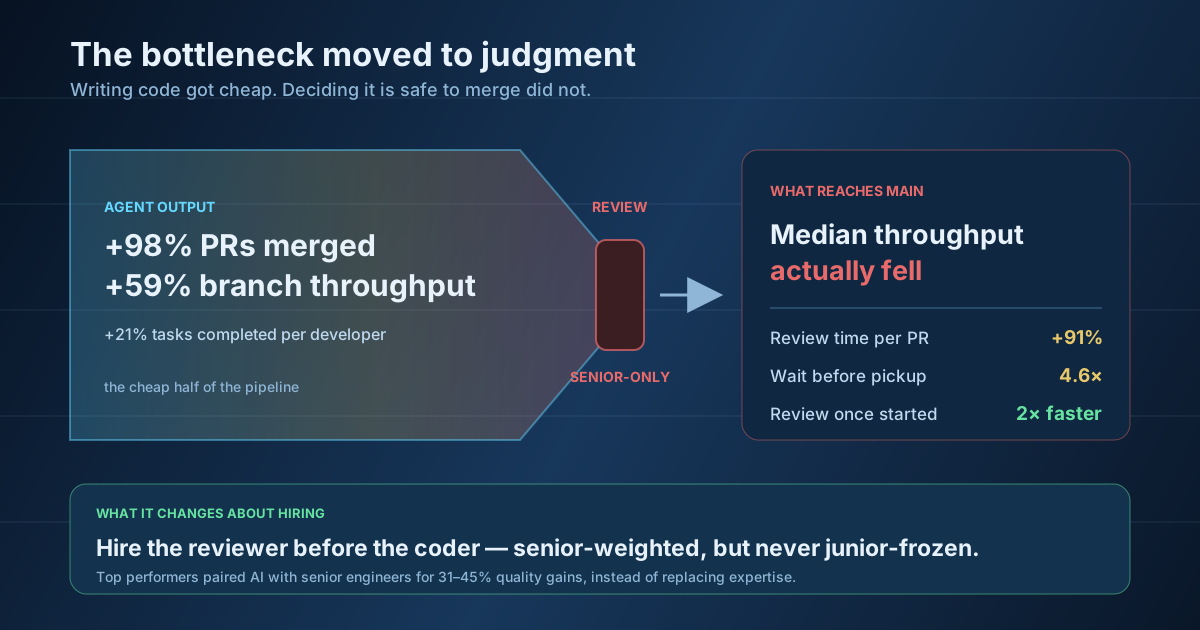
CircleCI's 2026 data contains a result that should be pinned above every founder's desk: feature branch throughput rose 59% year over year, while main branch throughput for the median team fell. More code than ever is being written. Less of it, proportionally, is reaching production.
The developer-level numbers explain the mechanism. Engineers using AI completed 21% more tasks and merged 98% more pull requests—roughly double the output—but PR review time increased by 91%. AI-generated PRs wait 4.6 times longer before a reviewer even picks them up. Once review actually starts it completes about twice as fast, which sounds encouraging until you notice what it implies: the reviewing is not the slow part. The queue is. Cycle time barely improves because the work sits, waiting for a human with enough context and authority to say yes.
This is what people mean when they say the bottleneck moved. Writing code was the constraint for the entire history of software. It is not the constraint anymore. Deciding whether code is safe to merge is—and that decision is not evenly distributable across a team.
Why this hits startups hardest
A large company absorbs a review backlog inside existing layers. A four-person startup has exactly one or two people who can meaningfully approve a change to the core system. Buy them more agent capacity and you have not increased shipping speed—you have lengthened their queue.
The reason this bottleneck is stubborn is that reviewing agent output well requires exactly the thing agents do not supply: knowing what should have been built. A senior engineer reviewing a plausible-looking 400-line PR is not checking syntax. They are asking whether this is the right abstraction, whether it duplicates something that already exists, whether it will behave under load, whether the error path is real, and whether the thing quietly breaks an assumption three services away. That is context, and context is accumulated, not hired instantly.
Which is why the Reddit complaint is more informative than the LinkedIn debate. Seniors are reporting that they now spend more time in review than in design—that the work which used to flow through several layers of the organisation is concentrating on the few people qualified to judge it. That is not a complaint about workload. It is a description of a system whose throughput is capped by its scarcest resource, and where every efficiency gain upstream makes the cap bite harder.
The obvious conclusion—staff entirely with seniors, let agents do what juniors used to—is the one a lot of founders reached in 2025, and it fails in two specific ways.
The first is arithmetic. Senior engineers are the review capacity. If everyone on the team is generating agent output at doubled volume and the same people are the only ones who can approve it, you have built a system where each new hire adds to both sides of the equation. Past a certain point, adding another senior producer to a small team makes the queue worse, not better. This is why the most useful piece of guidance circulating among engineering leaders right now is deceptively simple: hire the reviewer before the coder. Your next hire should be chosen for whether they can absorb review load, not whether they can produce more work that needs reviewing.
The second failure is the one Garman was actually pointing at, and it is worth quoting properly because the soundbite loses it. Juniors, he noted, are “probably the least expensive employees you have, they're the most leaned into your AI tools”—and then the real argument: “How's that going to work when ten years in the future you have no one that has learned anything?” Seniors are not a renewable resource you buy on demand. They are juniors who were given hard problems and someone to check their work. A company that freezes entry-level hiring is deferring a cost, not avoiding one, and the market it will be buying mid-level talent in a few years from now is one that everyone else also starved.
The strongest evidence in the LinkedIn argument is a Harvard study by economists Seyed Hosseini and Guy Lichtinger covering roughly 285,000 US firms and over 60 million workers from 2015 to 2025. It found that after companies adopt generative AI, junior employment falls about 9–10% within six quarters while senior employment stays essentially flat. They call it seniority-biased technological change, and the mechanism is intuitive: generative AI is good at the routine, well-specified work that entry-level roles were built around.
But the honest counter-argument deserves airtime, because founders making hiring plans should not over-attribute. The entry-level collapse began in 2022, months after the Fed moved rates from near zero to 5.25%, and well before AI was meaningfully in most workflows. Post-pandemic over-hiring corrections and straightforward cost-cutting explain a large share of what happened; AI only added real pressure from late 2024 onward. “We replaced them with AI” is, for a number of companies, a more flattering story than “we over-hired and rates went up.”
Both things are true, and the combination is what matters for you: the macro crash was mostly not AI, and the seniority-biased effect on top of it is real and measurable. What that means practically is that junior talent in 2026 is simultaneously more available and more undervalued than at any point in a decade—while the specific skill you most need is the one that got scarcer. That is a hiring opportunity, not a reason to freeze.
The empirical picture from teams shipping fast in 2026 is smaller than founders expect. Engineering leadership at OpenAI has pointed to groups of three or four people with strong collaboration as the unit that moves fastest; Sora shipped in 28 days with four people. Small teams win here partly because of the review constraint—fewer handoffs, more shared context, and a reviewer who already understands the change before opening it.
The composition guidance that follows is consistent: the AI-native team is senior-weighted, but it does not freeze entry-level hiring. And the quality evidence points the same direction—McKinsey found that top-performing organisations combined AI with senior engineers to achieve 31–45% improvements in software quality, rather than using AI as a substitute for expertise. The leverage came from pairing the tool with judgment, not from replacing judgment with the tool.
The through-line is that AI changed which resource is scarce, and most hiring plans have not caught up. For thirty years the answer to “we need to ship faster” was more people who write code. That answer is now wrong in a specific, measurable way: you can double the code and watch less of it reach production.
The founders who get this right in the second half of 2026 will look slightly unfashionable—small teams, senior-weighted, still hiring juniors while everyone on LinkedIn explains why nobody needs them. They will also be the ones whose main branch keeps moving. Hire for the constraint you actually have, not the one you had in 2021.
IdeaToMVP Academy
4-week live cohort for founders. Learn to ship AI agents, scope MVPs, and automate your business — taught by the same team that writes these guides.