The Vibe Coding Trap: Why AI Startups Are Paying $50K–$500K to Rebuild Their MVPs (2026)

By Surya Pratap
April 7, 2026
14 min read
MVP Strategy

April 7, 2026
14 min read
It started as a victory story. You opened Lovable, described your startup idea, and watched a working web app materialize in under an hour. No engineers hired. No agency contracts. Just you, an AI tool, and a product that looked production-ready. You shipped. You got your first users. You raised a pre-seed.
Then the cracks appeared. Authentication tokens leaking. Database queries timing out at 50 concurrent users. A security researcher emailing you about exposed API keys in your frontend bundle. And the worst part: the AI tool that built it cannot fix it, because the underlying architecture was never designed to survive contact with reality.
This is the vibe coding trap. And in 2026, thousands of founders are paying $50K–$500K to escape it.
TL;DR
The term "vibe coding" was coined in early 2025 to describe a new way of building software: you describe what you want in natural language, and AI tools generate the code. Tools like Lovable, Bolt.new, Cursor, and v0.dev made this mainstream for non-technical founders.
The appeal was undeniable. In the time it used to take to write a product brief, you could have a working prototype. Lovable grew at +207% user growth month-over-month in mid-2025. Entire communities formed around building companies with zero code written by humans. r/vibecoding now has over 89,000 members sharing wins, tips, and increasingly — disaster stories.
The problem is not that vibe coding is fake. These tools genuinely do produce working software. The problem is what "working" means in a demo versus in production.
AI tools are extraordinarily good at the first 80% of any software project: UI layouts, CRUD operations, basic API integrations, forms, dashboards. This is why vibe coding feels so powerful early on. But the last 20% is where software either survives or dies in production.
Row-level security policies, token rotation, OAuth edge cases, RBAC, secrets management — these require deliberate architectural decisions, not generated patterns.
Schema decisions made wrong at the start compound exponentially. AI tools optimize for the happy path, not for the query patterns you'll have at 10,000 users.
What happens when a payment fails mid-flow? When two users edit the same record simultaneously? AI-generated code handles none of this gracefully.
Connection pooling, caching layers, background job queues, rate limiting — the infrastructure that keeps your app alive under load is absent from vibe-coded apps.
The cruel irony: the AI tools that built your app cannot help you fix these problems, because fixing them often requires rebuilding the foundation — not patching the surface.
The vibe coding failure pattern is well-documented across r/startups, r/SaaS, and r/vibecoding. Here are the recurring failure modes founders are reporting:
The Moltbook Incident (Feb 2026)
A vibe-coded B2B SaaS app exposed 1.5 million authentication tokens due to a misconfigured Supabase Row Level Security policy. Built entirely with Lovable. The founder had no idea RLS existed. The security researcher who found it posted the write-up on Reddit — it went viral.
The $2 Demo That Became a $180K Rebuild
A founder on r/startups built a marketplace MVP with Bolt.new over a weekend. It got 400 signups and a $200K pre-seed. When they went to add real payment flows and multi-tenancy, an engineering audit revealed no foreign key constraints, no indexes, and no transaction handling. Complete rebuild: $180K, 14 weeks.
The Cursor CEO Warning
In March 2026, the CEO of Cursor — one of the most popular AI coding tools — publicly warned against vibe coding as building on "shaky foundations." The statement went viral because it came from inside the industry. His point: AI accelerates good engineering. It does not replace the judgment that makes engineering good.
The API Bill Shock
Multiple founders on r/SaaS shared experiences of building LLM-integrated apps with no rate limiting, caching, or cost guardrails. One founder's app went from $40/month to $14,000/month in OpenAI API costs after a single Reddit post drove traffic. The vibe-coded app had no protection against this scenario.
The cost depends on how much damage accumulated and how far along your product is. Based on industry data and post-mortems shared in startup communities:
| Scenario | Rebuild Cost | Timeline |
|---|---|---|
| Simple SaaS, pre-revenue, minor auth issues | $8K – $25K | 3–6 weeks |
| SaaS with paying customers, data migration needed | $30K – $80K | 8–16 weeks |
| AI-integrated product, complex data model, security holes | $80K – $200K | 4–6 months |
| Funded startup, multi-tenant, compliance requirements | $200K – $500K+ | 6–12 months |
Here is the uncomfortable truth most vibe coding critics miss: Lovable, Bolt, and Cursor are genuinely excellent tools. The problem is not the tools — it is using demo-grade expectations for production-grade requirements.
A seasoned engineer using Cursor with a well-designed architecture ships 40–60% faster than without it. The AI handles the boilerplate; the engineer handles the judgment calls. This is AI as an accelerant, not AI as a replacement.
The vibe coding trap happens when founders skip the judgment layer entirely. The bottleneck in software development has always been decisions, not keystrokes. AI eliminated the keystrokes. It did not eliminate the need for decisions.
If you built your MVP with AI tools and you are seeing any of these, act before growth forces your hand:
The founders winning in 2026 are not avoiding AI tools — they are using them as amplifiers of good process, not replacements for it:
Before any code is written — AI-generated or otherwise — define your data model, auth flow, multi-tenancy strategy, and infrastructure requirements. These decisions are cheap to make correctly before build and catastrophically expensive to fix after.
Use Cursor, v0, or Lovable to generate the implementation layer. Have a technical architect review the security model, data schema, and deployment configuration. The ratio is roughly 80% AI-generated, 20% human-reviewed — but that 20% determines if your app survives production.
A properly-built MVP designed for 100 users can be scaled to 10,000 with infrastructure changes. A vibe-coded app designed for a demo needs a full rewrite at 100 users. Build for the next phase, not just the current one.
RLS policies, secrets management, input validation, and API authentication are not things you add later. They are the foundation. Any development partner who does not implement these on the first sprint is not building for production.
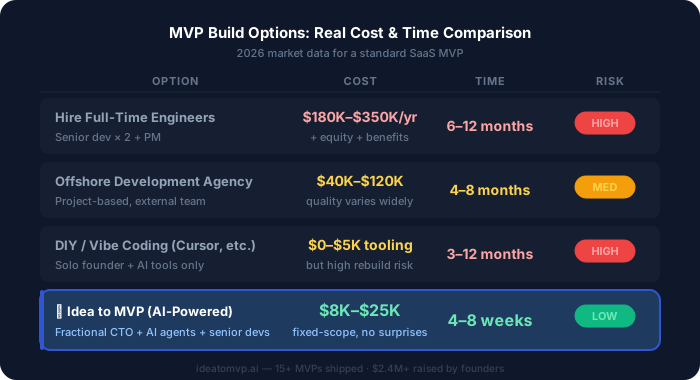
The dream of vibe coding — a non-technical founder building a production-ready product in a weekend — is not fully real yet. What is real is that the cost and time of building a solid MVP has dropped dramatically. A properly-designed AI product can now be built in 4–8 weeks for a fraction of what it cost in 2022.
But "a fraction of the cost" still requires the right judgment at the right moments. The founders who will win in 2026 understand that AI removes the cost of implementation, not the cost of thinking. If you are building something users will trust with their data, their money, or their workflows — you owe them more than a vibe.
IdeaToMVP Academy
4-week live cohort for founders. Learn to ship AI agents, scope MVPs, and automate your business — taught by the same team that writes these guides.