Why AI Is Hard: The Real Problems Founders Hit After the Demo Works (2026)

By Surya Pratap
July 1, 2026
AI & Technology

July 1, 2026
A pattern is showing up constantly in 2026: someone uses Claude Code or another AI tool to build a chat app in twenty minutes, then announces on social media that they have “killed Slack and Discord.” A prototype is maybe 0.5% of what makes a product actually work in production. The remaining 99.5% is infrastructure, reliability, edge cases, security, and years of iteration on problems that only surface when real humans use the product at scale. That gap is what this article is about — not the marketing version of AI development, but what Medium writers, Reddit threads, and public engineering data actually say is hard.
There is a dangerous confidence gap forming between people who have built a working demo and people who have shipped real software to real users at scale. A demo proves the happy path works once, in a controlled environment, with a small dataset, and no adversarial input. Production proves it works every time, at scale, under load, with users who do things you never imagined, on a system that has been running for six months without you personally watching it. AI tools have made the first half dramatically faster. They have not made the second half faster at all — and founders who conflate the two ship things that break in expensive ways.
Research aggregating Stack Overflow and GitHub issue data across AI agent projects (via Cobus Greyling's analysis on Medium) breaks the difficulty of building AI systems into five categories — and the ranking is not what most people expect:
| Category | Volume vs. Difficulty |
|---|---|
| Environment, platforms & dependencies | Highest volume (~22% of posts) but resolves fast — usually under 12 hours |
| Retrieval, embeddings & agent memory | Among the toughest — RAG questions take 87+ hours and often go unanswered |
| Orchestration & execution control | Low visibility early, becomes a major burden as systems scale |
| Interaction contracts (model ↔ tools) | Schema violations halt execution; requires strict JSON contracts |
| Runtime reliability & robustness | Crashes and unhandled errors amplify once real users are involved |
The takeaway: the problems people complain about loudest (installation errors, API key issues, package conflicts) are not the problems that actually sink products. Those get fixed in an afternoon. The problems that quietly kill AI products — bad retrieval, runaway orchestration, silent reliability failures — are the ones nobody posts about because they don't have a clean Stack Overflow question. They just show up as churn.
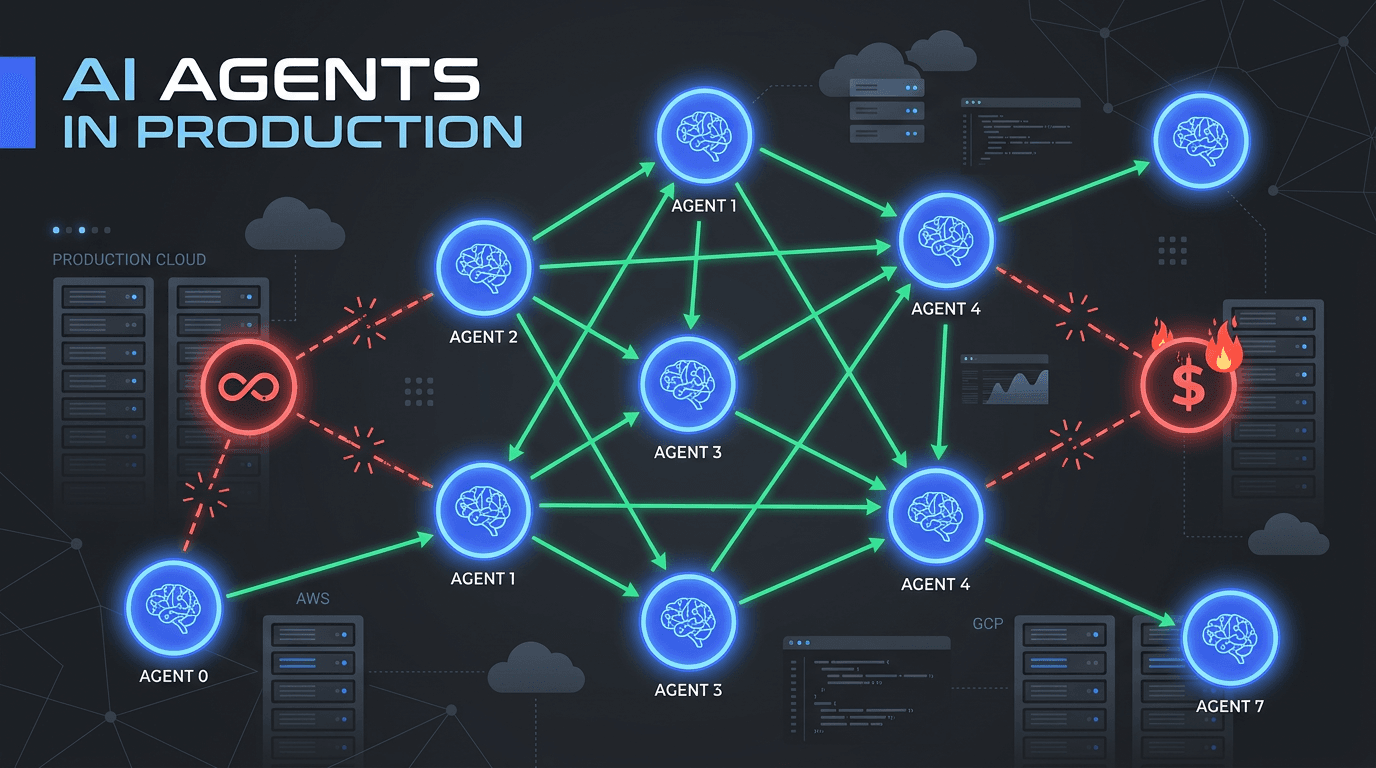
A failure mode that keeps surfacing in 2026 agent post-mortems: agents get stuck retrying the same failing strategy, slightly rephrased each time, without making real progress. In practice, this leads to runaway token usage, unpredictable latency, and systems that appear “alive” but are doing nothing useful. It looks like the agent is working — the logs are scrolling, tokens are burning — but it's spinning on the same dead end. This is one of the most expensive failure modes precisely because it's invisible until you check the bill.
“Agents are not reliable enough to run unsupervised on anything high-stakes. But they are genuinely, measurably useful for the right tasks, deployed with the right expectations.”
Across the Medium and Reddit discourse we reviewed, one question keeps separating hype from substance: “Does it work in production, or only in a curated ‘Hello World’ demo?” The agentic systems succeeding by mid-2026 are consistently the most constrained ones — agents that operate inside explicitly defined action sets, that emit proposals rather than taking side effects directly, and that require human confirmation before any high-impact step (charging a card, deleting a record, sending an email to a real customer). The teams treating autonomy as a dial they can turn up gradually, instead of a binary switch, are the ones shipping things that survive contact with real users.
None of this means AI products are not worth building — the opposite is true, and the founders getting real traction in 2026 are the ones who respected the difficulty instead of marketing past it. AI is hard in the same way distributed systems were hard a decade ago: the parts that are fun to build are not the parts that determine whether you survive contact with real users. Retrieval quality, orchestration discipline, and reliability engineering are unglamorous, and they are exactly where the actual product gets built.
If you want a structured way to get past the demo stage without learning these lessons the expensive way, our Founder AI Sprint at IdeaToMVP Academy walks through retrieval design, agent guardrails, and production reliability patterns directly, with a cohort of founders shipping the same class of product.
IdeaToMVP Academy
4-week live cohort for founders. Learn to ship AI agents, scope MVPs, and automate your business — taught by the same team that writes these guides.