LangChain v1 in 2026: The New Agent-Building Stack (What Reddit & X Are Saying)

By Surya Pratap
April 20, 2026
10 min read
AI & Technology

April 20, 2026
10 min read
For most of 2023 and 2024, the loudest takes about LangChain on r/LangChain, r/LocalLLaMA, and X/Twitter sounded identical: “great for demos, painful in production.” Wrappers on wrappers, abstractions that leaked the moment you needed a real loop, and a roadmap that seemed to ship a new chain every Tuesday. With LangChain v1 (stable since late 2025) that story has shifted. The framework is now openly agent-shaped: one high-level create_agent entry point, a middleware system, and LangGraph as the default runtime under the hood.
Sources reflected in this piece include the official LangChain v1 announcement, the LangChain agents docs, recurring discussion on r/LangChain and r/LocalLLaMA, and threads from @LangChainAI and @hwchase17 on X. Patterns > cherry-picked quotes.
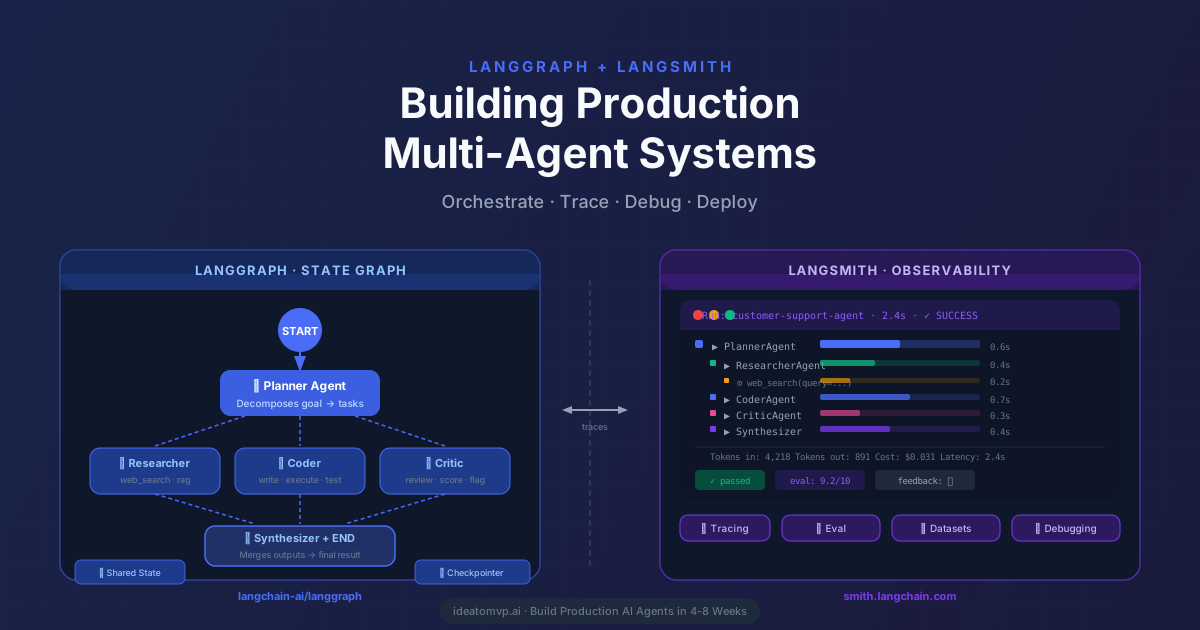 LangChain v1Hover to explore
The headline change is that LangChain is no longer a bag of chains. The top-level package now centers on three things:
Legacy pieces — LLMChain, AgentExecutor, initialize_agent, create_react_agent in the old form — are still importable but marked legacy. New code is expected to live in langchain.agents and langchain.messages, with provider integrations in langchain-openai, langchain-anthropic, and friends.
from langchain.agents import create_agent
from langchain.tools import tool

@tool
def get_weather(city: str) -> str:
    """Return the current weather for a given city."""
    return f"It's 24C and sunny in {city}."

agent = create_agent(
    model="anthropic:claude-sonnet-4-5",   # or "openai:gpt-5", "google:gemini-2.5-pro"
    tools=[get_weather],
    system_prompt="You are a concise travel assistant.",
)

result = agent.invoke(
    {"messages": [{"role": "user", "content": "Weather in Lisbon?"}]}
)
print(result["messages"][-1].content)
Three things to notice: the model is a string (LangChain handles provider resolution), tools are plain Python functions decorated with @tool, and there is no explicit ReAct prompt or parser. The agent loop, tool-calling protocol, and message reducers all live inside the runtime.
One of the most upvoted v1 features on r/LangChain is response_format. Pass a Pydantic model and the agent emits a validated object as part of the same loop—no extra parser, no “now extract this as JSON” follow-up call.
from pydantic import BaseModel
from langchain.agents import create_agent

class TripPlan(BaseModel):
    city: str
    days: int
    must_do: list[str]

agent = create_agent(
    model="openai:gpt-5",
    tools=[get_weather],
    response_format=TripPlan,
)

out = agent.invoke({"messages": [
    {"role": "user", "content": "Plan 3 days in Lisbon."}
]})

plan: TripPlan = out["structured_response"]
print(plan.must_do)Middleware is where v1 stops looking like a wrapper and starts looking like an actual agent framework. You can hook before_model, after_model, before_tool, and after_tool, and ship reusable behaviors like:
from langchain.agents import create_agent
from langchain.agents.middleware import (
    HumanInTheLoopMiddleware,
    SummarizationMiddleware,
    PIIMiddleware,
)

agent = create_agent(
    model="anthropic:claude-sonnet-4-5",
    tools=[refund_order, send_email, query_db],
    middleware=[
        PIIMiddleware(strategy="redact"),
        SummarizationMiddleware(max_tokens_before_summary=12_000),
        HumanInTheLoopMiddleware(
            interrupt_on={"refund_order": True, "send_email": True}
        ),
    ],
)
This is the piece that, in our own client work and across recent X threads, finally makes LangChain feel shippable: the gnarly production concerns are composable instead of glued in at the prompt level.
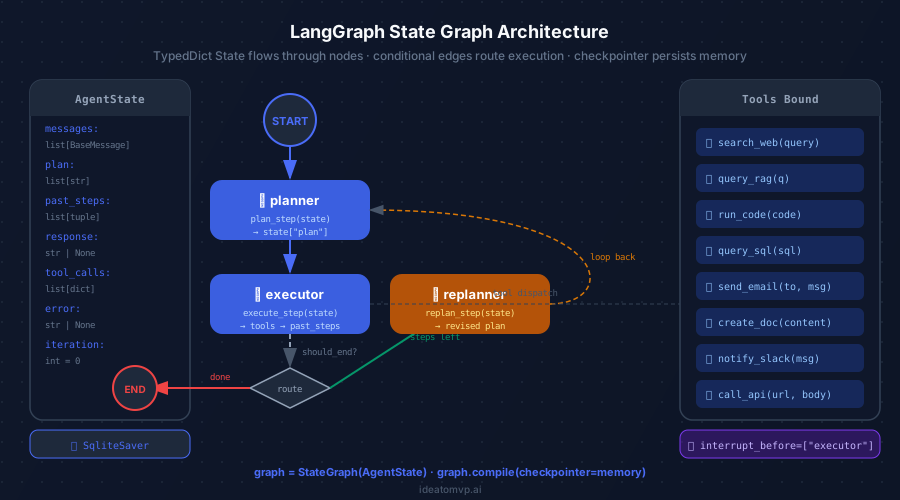 Stateful by defaultHover to explore
For multi-agent setups, LangChain leans on LangGraph plus two prebuilts that get repeatedly mentioned on Reddit:
create_agent outputs into a StateGraph when you need full control over edges and state shape.Across the last few months of r/LangChain, r/LocalLLaMA, and AI-engineering corners of X, the recurring themes look like this:
create_agent is what it should have been two years ago.” Middleware and structured output are the most cited wins. LangSmith traces “just work” without ceremony.langchain, langchain-core, langgraph, provider packages) still trips up newcomers. Migration from 0.x code is “mostly mechanical, occasionally surgical.”“The interesting question in 2026 is no longer ‘which framework’. It is: which one lets you ship the same agent on three providers, with a human in the loop, and a trace for every failure.”
create_agent + 2–5 tools + response_format. Skip middleware on day one.LangChain v1 is the first version where the framework's shape matches how teams actually build agents in production: a tool-using loop with a graph underneath, hooks for the unsexy concerns (PII, approvals, summarization, retries), and the same code path across providers. The Reddit and X conversation has moved from “is LangChain a meme” to “is your agent observable, recoverable, and portable.” For founders shipping an MVP in 2026, that is a much better argument to have.