Forward-Deployed Engineers: When Your AI Startup Should Hire One — and How Not to Become a Consulting Shop (2026)

By Surya Pratap
July 25, 2026
9 min read
Startup Strategy

July 25, 2026
9 min read
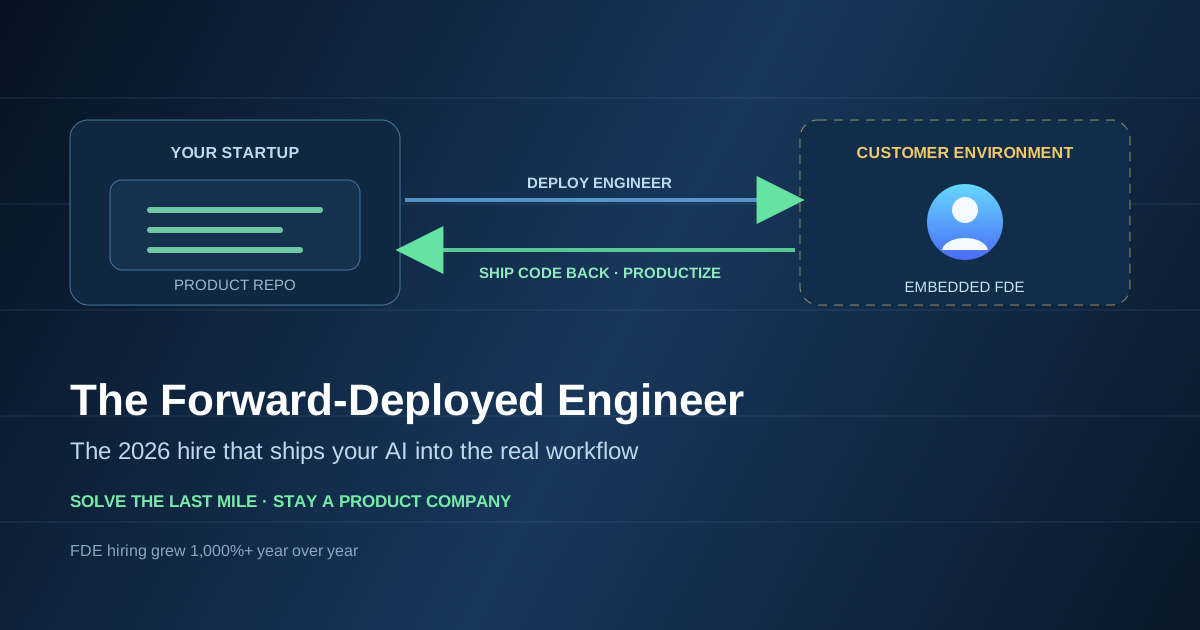
Scroll through founder X this month and one job title keeps surfacing: the forward-deployed engineer. Hiring for the role has grown more than tenfold year over year, AWS has stood up a dedicated forward-deployed engineering organization backed by a reported billion-dollar investment, and by mid-2026 nearly every Series A AI startup with a six-figure contract is trying to hire at least one. On Reddit, the same conversation runs with more anxiety attached: is this the role that finally makes enterprise AI ship, or a polite way to rebuild a consulting business and call it a product company?
Both readings are partly right, and that tension is exactly why the role matters for founders. An FDE is the answer to the last-mile problem in AI: the model is easy, and the messy work of getting it to do a real job inside a real customer's systems is where deals live or die. Get the motion right and it becomes your fastest path to product-market fit. Get it wrong and it quietly turns your startup into a services shop with worse margins than you think. This is a founder's guide to what the role actually is, when to hire your first one, and how to keep it building product.
A forward-deployed engineer is an engineer with customer judgment who embeds in a customer's environment for roughly 60 to 180 days, ships real integrations, and turns a vague enterprise problem into working software. The output is production code, not slide decks or discovery documents. Palantir invented the function around 2008; OpenAI and Anthropic rebuilt it for the language-model era in 2023; by 2026 it has spread from the frontier labs to companies like Sierra, Decagon, Databricks, and a long tail of well-funded startups.
The distinction that matters is between an FDE and a traditional solutions engineer. A solutions engineer supports a sale and configures existing features. An FDE writes code that lands in the customer's stack and, when the motion is healthy, also lands back in your main product repository. They are closer to a field engineer than a pre-sales role, and the best ones are as comfortable with a customer's legacy database as they are with your own codebase.
The FDE boom is the natural consequence of a shift covered widely this year: AI is leaving the demo and starting to do the work. When your product was a copilot that suggested things, a customer could adopt it with a login. When your product is a system that completes a bounded job—reconciling invoices, resolving tickets, preparing filings—it has to plug into permissions, approvals, legacy software, and human workarounds that no two customers share. That integration work is the last mile, and it does not respond to a better prompt.
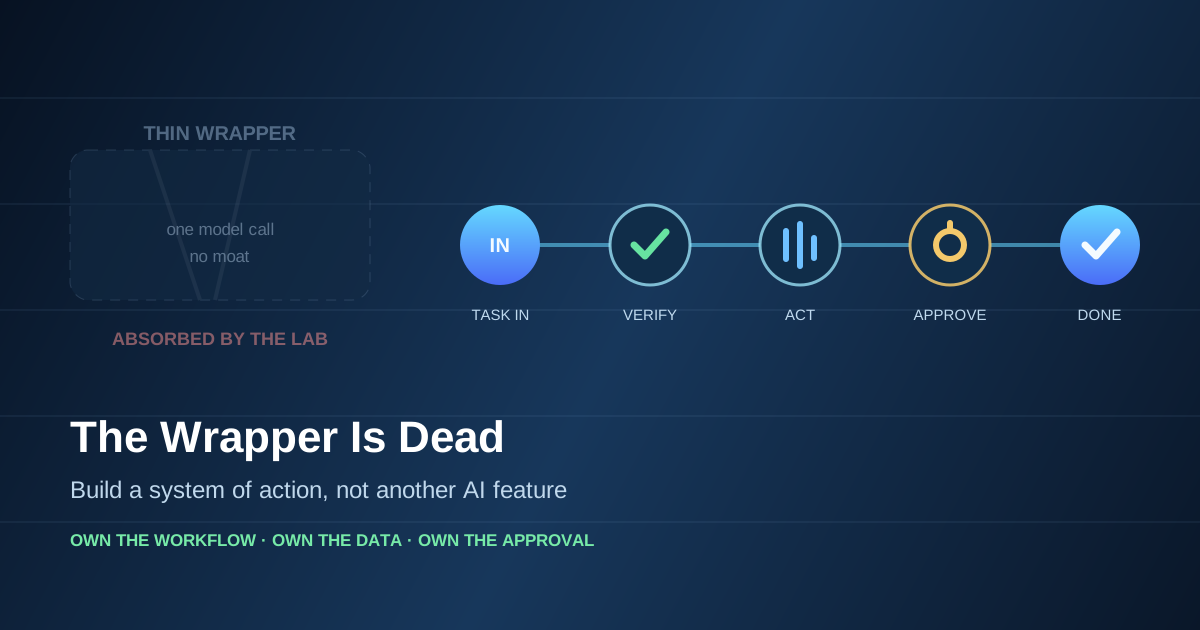
This is also why FDEs pair so naturally with the “systems of action” thesis. If the durable AI companies are the ones that own a bounded workflow with privileged access, then someone has to physically wire the product into each customer's reality—and feed what they learn back into the core product. The FDE is the human mechanism that turns one hard-won enterprise deployment into a repeatable capability the whole product line inherits.
The last-mile problem
In enterprise AI, the model is rarely the hard part. The hard part is the last mile: the customer's data shape, permissions, approval chains, and legacy systems. FDEs exist because that mile cannot be sold, documented, or prompted away—it has to be engineered, in place.
Here is the mistake that dominates the Reddit half of the debate. Founders wire FDEs into the go-to-market org as renamed solutions engineers, measured on deals closed and tickets cleared. That structure quietly optimizes for one-off custom work, because nothing in it rewards turning custom work into product. Do this long enough and you have a consulting company with a software logo—high revenue, thin margins, and a roadmap dictated by whichever customer shouted loudest last quarter.
The pattern that avoids it, used at Palantir originally and at Anthropic today, is to put FDEs inside engineering rather than sales. Full-time engineers rotate between customer sites and the core codebase, and the work they do in the field is expected to become product. Reporting into engineering creates a permanent bias toward productizing what gets built, because the same people who ship the bespoke integration are the ones who have to maintain it—so they are motivated to generalize it into the platform.
The productization test
After each deployment, ask one question: what did the FDE build for this customer that now ships to the next one for free? If the honest answer is “nothing—it was all custom,” you are running a services business. If it is a new connector, template, or capability in the core product, you are running a product company with a field team.
The timing is more important than the hire itself. The signal to bring on your first FDE is not “we want to sell to enterprises”—it is that you have already closed roughly three repeatable enterprise pilots above a meaningful contract value, and you, the founder, have become the bottleneck on customer integration work. In other words, hire the role once demand is proven and your own time is the constraint, not before.
Hire too early and you are paying a senior engineer to manufacture demand that does not exist yet, and you will be tempted to accept any custom project to justify the cost. Hire too late and every deal stalls in implementation while you personally debug customer environments at midnight. The window opens when the pattern across pilots is clear enough that an FDE can generalize it, and closes as slow integration starts capping your growth.
Founders should go in clear-eyed on cost, because this is not a junior hire. All-in compensation for the role runs from around $200K at seed stage to $450K–$550K and up at Series C, with frontier-lab listings clustering above ordinary product-engineer bands; senior FDEs at the top labs report medians near $485K, and staff-level roles higher still. You are paying for a rare blend of shipping skill and customer judgment, and the market for it is genuinely tight.
That price only makes sense against real contract value. If a single FDE unlocks and expands six-figure deals that would otherwise stall, the math is easy. If they are propping up sub-$50K contracts with heavy custom work, the model is upside down—and it is a sign the product is not ready for the enterprise motion yet.
For most founders reading this—pre-Series A, chasing the first handful of real customers—the practical takeaway is not to post a job. It is to recognize that you are already the forward-deployed engineer, and to run the motion deliberately. Sit inside your first customers' environments, ship the integration yourself, and treat every bespoke fix as a research note about what the product should do natively. The patterns you extract during this stage are what make the eventual FDE hire productive instead of expensive.
The forward-deployed engineer is not a fad title; it is the industry admitting that shipping AI into the real world is an engineering problem, not a sales one. Founders who understand that—who embed early, productize relentlessly, and hire the role only when the pattern is proven—turn the last mile from the thing that kills their deals into the moat that protects them.
IdeaToMVP Academy
4-week live cohort for founders. Learn to ship AI agents, scope MVPs, and automate your business — taught by the same team that writes these guides.