OpenAI Is Watermarking ChatGPT's Text in the EU. In the API, It's Off Unless You Turn It On

By Surya Pratap
October 18, 2026
8 min read
AI & Technology

October 18, 2026
8 min read
 On in ChatGPT, off in the APIHover to explore
Most coverage of OpenAI's watermark has asked whether people will be able to tell that a student's essay came from ChatGPT. For founders, the more useful detail is a single line in the announcement: in the API, watermarking stays off by default. ChatGPT's compliance is OpenAI's job. A product built on the API may have to make its own choice.
This article is based on OpenAI's announcement "Our approach to EU text provenance rules" of 5 October 2026, as reported by TechCrunch, The Next Web, Techstrong.ai and Gadget Review. The detection figures are OpenAI's own. The reading from section 3 onward is mine, and it is not legal advice.
The watermark is called textGrain. It does not add hidden characters or metadata. Instead it "subtly shap[es] the model's word choices", using pseudorandom values tied to a secret key, so the text reads normally but carries a statistical pattern a detector can find. Because the pattern is in the words themselves, it survives copy and paste.
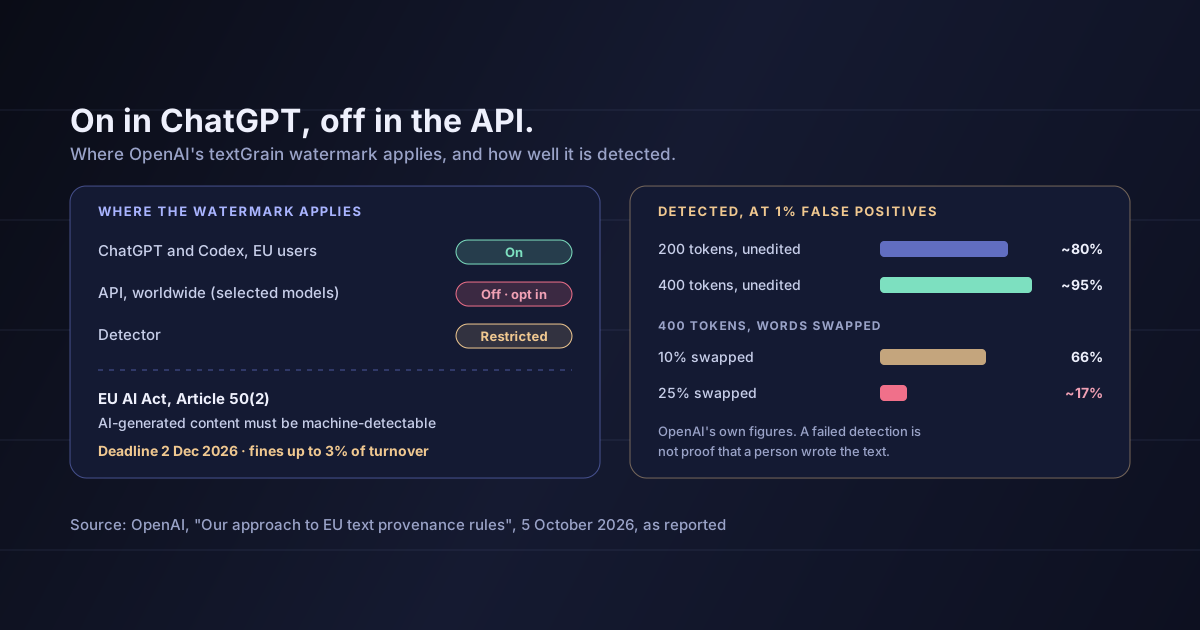
Where it applies:
OpenAI says it saw no meaningful change in model performance with the watermark on. The method is described in a technical report co-written with researchers at the University of Pennsylvania and Yale.
Article 50(2) of the EU AI Act requires AI-generated content to be marked so that it is detectable in a machine-readable format. The transparency rules took effect on 2 August 2026, and providers already on the market have until 2 December 2026 to comply. Techstrong.ai reports fines of up to 3% of global annual turnover.
Other labs have moved too. Anthropic began watermarking Claude's text worldwide in August, with some exemptions, using a comparable statistical approach whose detector is also restricted.
OpenAI's reported numbers, at a 1% false-positive rate:
| Passage | Detected |
|---|---|
| 200 tokens, unedited | about 80% |
| 400 tokens, unedited | about 95% |
| 400 tokens, 10% of words swapped for synonyms | 66% (from about 92%) |
| 400 tokens, 25% of words swapped | about 17% |
Detection is also weaker on short passages, maths answers and translated text.
OpenAI is unusually direct about what this proves. textGrain "does not guarantee reliable detection", and a failed detection "is not proof a human wrote something". It cannot say how much a person edited a passage, whether it is accurate, or who generated it.
A watermark tells a detector that a model probably wrote most of these words. It cannot tell anyone that a person didn't.
This is the part that changes plans. When an EU user reads text in ChatGPT, OpenAI is the provider and the watermark is on. When an EU user reads text in your product, generated through the API, the watermark is off unless you turn it on.
Whether the AI Act's marking obligation falls on you depends on your role — for example, whether you are placing your own AI system on the EU market or deploying someone else's — and that is a question for a lawyer, not a blog post. But three things are worth doing whichever way the answer goes:
Find out if you are in scope. List which of your features generate text that reaches EU users, through which model, and whether the text is published or shared. Take that list to counsel before 2 December, not after.
Decide on the API setting deliberately. Opting in is a configuration change for supported models. If you leave it off, write down why. If you use several providers, check each one — their watermarks and defaults differ.
Tell users what you do. If your output is watermarked, say so where it matters, especially for users publishing it. If it is not, do not imply it is. Either way, it belongs in the same records of what you claim and what you do that regulators are now asking for.
Never sell "undetectable". A tool that promises to strip or evade watermarks is building on the wrong side of a transparency law, and invites deception questions everywhere else.
Hiring tools, plagiarism checkers, publishing platforms and education products are all tempted to treat watermarks as an answer. They are not one yet:
Don't make decisions about people with it
If your product scores, flags or rejects someone because their text "looks AI-generated", a watermark does not make that decision safe. Use it, if you ever can, as one signal reviewed by a person — never as the reason someone loses a job application or a grade.
That every API customer must watermark. The obligations depend on your role under the Act. OpenAI's off-by-default setting suggests it does not see the API as automatically covered by its own ChatGPT compliance, but that is not a legal ruling.
That the detection figures are independent. They are OpenAI's, from its own report.
That watermarking settles AI provenance. It marks text from one provider's models, detectable by that provider's restricted tool. Text from other models, or heavily edited text, is outside it.
That the 2 December date is the last word. Deadlines and guidance under the AI Act have shifted before. Check the current position when you act.
OpenAI is watermarking ChatGPT and Codex text in the EU with textGrain, ahead of the AI Act's 2 December deadline for machine-detectable AI content. In the API, the watermark is opt-in for selected models and off by default. Detection is good on longer unedited passages, weak on short or edited ones, unavailable to the public and never proof that a human wrote something.
For startups the question is not whether ChatGPT is compliant. It is whether your own EU-facing product needs marking, and whether you have made that choice on purpose.
Before 2 December, list every feature that sends AI-generated text to EU users, check each provider's watermark setting, and take both to your lawyer. And if your product judges people by whether their text is AI-written, stop relying on a detector you cannot run.
Sources: OpenAI, "Our approach to EU text provenance rules", 5 October 2026, as reported by TechCrunch — the textGrain name and mechanism, survival through copy and paste, the EU ChatGPT and Codex rollout, the opt-in API setting, the restricted detector, the absence of a performance impact, the 92% and 66% figures, the University of Pennsylvania and Yale report, and the quote that it "does not prove human authorship". The Next Web — the API being off by default, the 2 December deadline for providers already on the market, and Anthropic's worldwide watermarking since August. Techstrong.ai — Article 50(2), the 2 August effective date, fines of up to 3% of global turnover and the 17% figure after 25% edits. Gadget Review — detection of about 80% at 200 tokens and 95% at 400 tokens at a 1% false-positive rate, and the statement that textGrain "does not guarantee reliable detection". The reading in sections 4 to 6 is mine and is not legal advice.
IdeaToMVP Academy
4-week live cohort for founders. Learn to ship AI agents, scope MVPs, and automate your business — taught by the same team that writes these guides.