
The AI Compliance Ceiling for Indian Companies Serving US Enterprises — Why Growth Is Stalling in 2027

By Surya Pratap Singh
July 28, 2026
8 min read
AI & Technology

July 28, 2026
8 min read
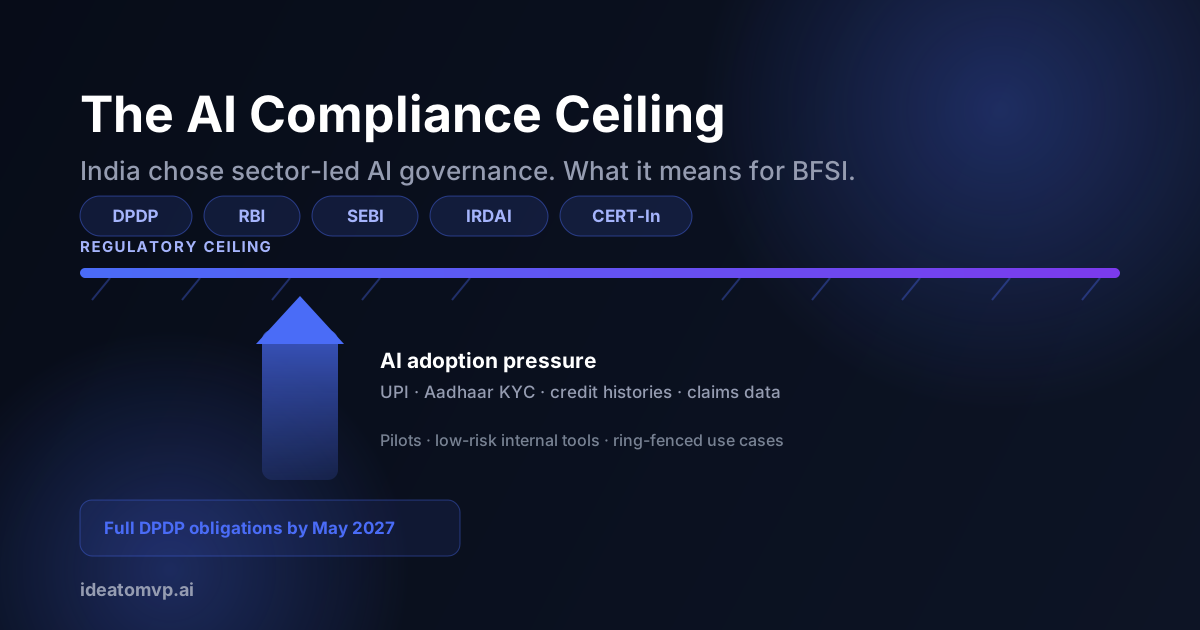
Indian SaaS companies, IT services firms, and business process operators serving US enterprise customers are hitting a compounding compliance ceiling on AI adoption. Their US customers now write specific AI processing terms into contracts — HIPAA BAAs for healthcare data, SOC 2 for enterprise SaaS, DPAs with data residency and audit requirements. On top of that, DPDP Act 2023 and sector-specific Indian regulations create a second layer of constraints. Generic AI vendors don't understand either side deeply. That's the specific gap costing growth.
The paralysis is not caused by one regulator. It is caused by two stacks that have to be satisfied at the same time — one written by your customers, one written by your government — and they were not designed to fit together.
This layer arrives first, moves fastest, and has the sharpest teeth: fail it and you lose the contract. It shows up in procurement questionnaires and master service agreements long before any Indian regulator asks a question.
Required for any AI touching healthcare data — and the BAA has to cover your model provider and every sub-processor, not just you.
Now routinely extended to cover AI features in SaaS products, not just the underlying platform.
Retention limits, explicit prohibition on using customer data for model training, and sub-processor rules that name every model vendor in the chain.
California, Virginia, Colorado, and Texas privacy laws apply to your processing on behalf of the customer — and they do not all say the same thing.
HITRUST for healthcare, PCI-DSS for payments, FedRAMP for public sector. Each carries its own AI evidence expectations.
India deliberately avoided a single, comprehensive AI Act in the style of the EU. MeitY's India AI Governance Guidelines (November 2025) take a principles-based, sector-led approach. Sensible for a fast-moving technology — but it means a second, overlapping set of obligations lands on top of whatever your customer already requires:
| Regulation / Framework | Body | Key AI-Related Requirements | Timeline / Status |
|---|---|---|---|
| DPDP Act 2023 + Rules 2025 | MeitY / DPB | Consent & purpose limitation, data-principal rights, breach notification, SDF obligations; penalties up to ₹250 crore | Rules notified Nov 2025; full obligations May 2027 |
| FREE-AI & Model Risk guidance | RBI | Board-approved AI/model risk policy, independent validation, explainability, bias testing, human oversight | Published 2025; MRM guidelines in consultation 2026 |
| Algorithmic / AI systems expectations | SEBI | Validation, audit trails, suitability assessment, market-integrity controls | Circulars + 2025 consultation ongoing |
| Technology & cyber guidance | IRDAI | Fairness in underwriting/claims, explainability for disputed decisions, cyber controls | Ongoing guidance |
| Cyber & data localisation overlays | RBI, SEBI CSCRF, IRDAI, CERT-In | Incident reporting, resilience, data residency for sensitive data | In force / phased audits |
The result is not a single clear gate. It is two sets of gates — your customer's and your regulator's — that compliance, legal, delivery, and engineering teams must clear simultaneously, often with incomplete internal AI inventories and fragmented ownership.
Survey data paints a consistent picture: high interest and scattered pilots, but only a minority of organisations have mature, centralised AI governance. Many lack effective monitoring, hallucination detection, or structured model risk processes. For companies whose revenue depends on passing someone else's security review, that gap is not an internal problem — it is a sales problem.
Four practical frictions keep these companies stuck — and each one is sharper when your customer, not just your regulator, is the one enforcing it:
Your US enterprise customer writes explainability into the contract directly — they need to answer their own regulators and their own customers. The models that perform best are the hardest to explain, and a black-box frontier API is an immediate procurement blocker, long before any Indian regulator gets involved.
California's CPRA, or GDPR where EU data flows through a US customer to an India delivery centre, frequently sets a higher bar than DPDP. Purpose limitation and the right to erasure collide with how models are trained and updated, and machine unlearning remains immature. You have to satisfy the strictest layer, not the local one.
This is the reframe that matters. Your company is the third party in someone else's vendor risk programme. US customer procurement and security teams send questionnaires, demand audit rights, require sub-processor disclosure for every model provider, and can veto a deployment outright. Sending customer data to an external AI API is often a contractual non-starter.
Who owns the gap between model output and business decision? For this ICP the answer is enforced from outside: your customer's compliance team audits you, usually annually. Without clear internal ownership, a cross-functional AI governance group, and risk classification of every use case, you fail the audit or stall in review cycles that cost you the renewal.
The ceiling is real: the safer a use case looks to your customer's security reviewer, the less transformative it tends to be. The applications that would actually differentiate you — AI embedded in the customer-facing product, automated processing of the client's own regulated data, agents acting on production systems — sit right under the thickest contractual scrutiny.
The companies that will pull ahead treat the dual-compliance stack as a design constraint — and as something to sell against — rather than a post-hoc hurdle. Practical moves that work today:
Map every model and use case once, then tag each entry with the evidence both sides need: customer-facing impact and contractual scope for the US audit, personal-data categories and lawful basis for DPDP. One inventory, two views. Maintaining separate registers for each audience is where teams lose weeks.
A board-approved AI and model risk framework is now a procurement artefact, not just an internal document — US buyers ask for it by name. Create a cross-functional group (security, legal, data, delivery, engineering) with clear escalation paths and the authority to stop or modify a deployment before a customer forces the issue.
Log prompts, features, decisions, and overrides in a form you can hand to an auditor. The same lineage has to answer a DPDP access or erasure request from an Indian data principal. Build one logging and retention layer that serves both, plus a human-in-the-loop path and a technical kill switch for every high-stakes system.
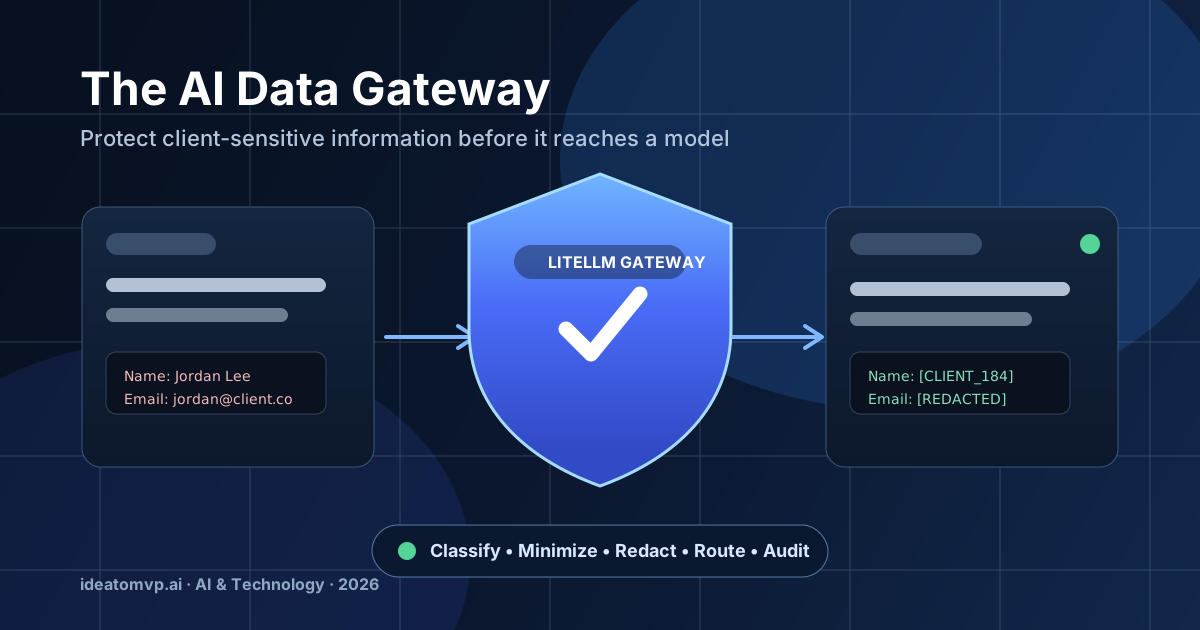
Separate consent for AI training and secondary uses, and build data-lineage capability that answers customer questionnaires and DPDP requests from the same source of truth. Being able to say 'this workload never leaves our India VPC, and here is the evidence' shortens security review — it is a differentiator, not overhead.
Internal productivity, document processing, and non-customer-data workloads deliver measurable ROI without triggering a contract renegotiation. Use the governance maturity and audit evidence you build there to widen the AI processing terms at the next renewal, when you can point to a track record rather than a promise.
Bring your US customer's security and compliance contacts into the design conversation before you build, not at the review gate. Transparent documentation of testing, bias assessment, monitoring, and safeguards is what converts a sceptical procurement reviewer into an internal advocate — and it compounds across every subsequent deal.
Hard enforcement of the core DPDP obligations is scheduled to complete by May 2027 through a phased rollout. Rules published in November 2025 mean several institutional and preparatory steps are already live, and the 18-month window is the practical runway organisations have to get data mapping, consent architecture, and governance structures in place. RBI's FREE-AI work, SEBI consultations, and IRDAI guidance are simultaneously clarifying the sector-specific rules of the road.
Companies that treat this period as a capability-building window — rather than a reason to pause — will own the operating models, audit evidence, and customer relationships that matter when the ceiling rises. The same artefacts that satisfy a DPDP obligation are the ones that shorten your next US security review.
Indian companies that treat this dual-compliance stack as competitive advantage — rather than compliance overhead — will win the next wave of US enterprise contracts. Those still trying to answer "can we use ChatGPT for customer data?" with a shrug will lose to competitors who've built the operating models US buyers actually require.
Surya Pratap Singh runs ideaToMVP, a boutique practice focused on AI compliance and deployment architecture for Indian companies serving US enterprise customers. Currently delivering AI engineering training to TCS engineers via LearnQuest. If you're navigating US customer compliance requirements (HIPAA, SOC 2, DPAs) alongside DPDP for AI adoption, book a qualification call.

IdeaToMVP Academy
4-week live cohort for founders. Learn to ship AI agents, scope MVPs, and automate your business — taught by the same team that writes these guides.