LiteLLM as Your AI Data Gateway: Protecting Client-Sensitive Information

By Surya Pratap
July 15, 2026
8 min read
AI & Technology

July 15, 2026
8 min read
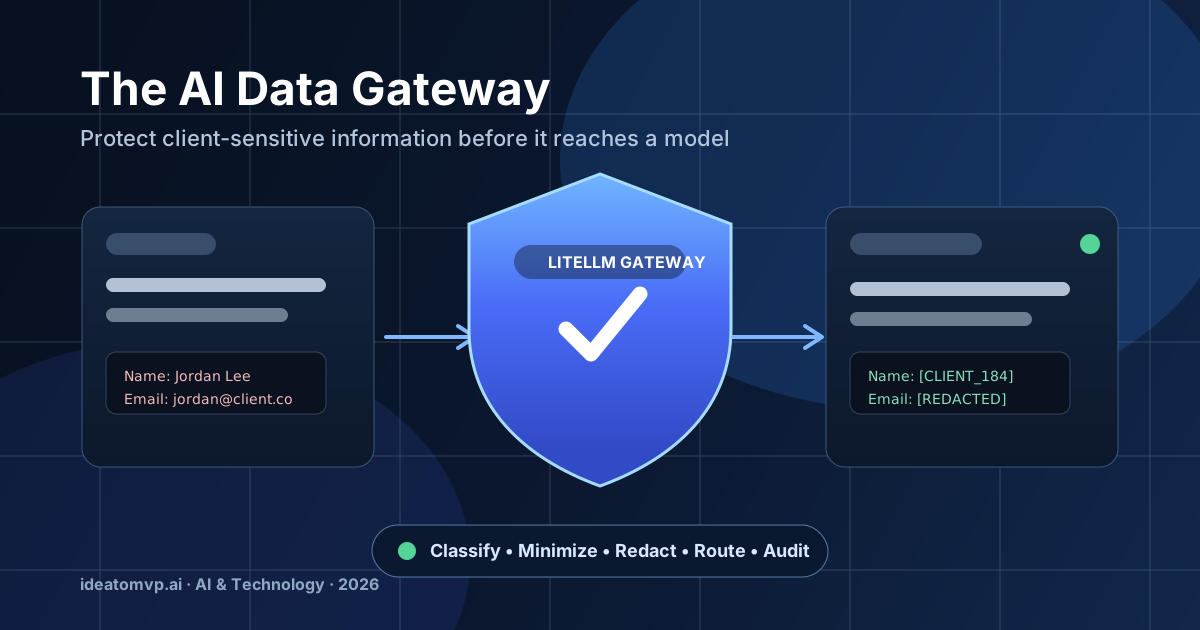
The most consequential AI architecture decision is often not which model you choose. It is deciding where client data crosses the boundary from your application into a model provider's system. A support transcript can contain an account number. A healthcare intake can contain a diagnosis. A sales prompt can contain a contract, a pricing exception, or a private roadmap. Sending that context directly from every feature to every provider creates a data perimeter you cannot reliably see or govern.
LiteLLM is useful here not simply because it gives teams one API for many models. Used deliberately, it becomes an AI gateway: one controlled place to apply policy before any request leaves your environment, then route the minimized request to an approved model provider.
Without a gateway, a product team gradually accumulates direct SDK calls across chat, support, document search, analytics, and agent workflows. Each call can select a different provider, use different logging settings, and carry a different amount of customer context. Security reviews become a search through application code instead of a review of one policy boundary.
This is not an argument that all data is forbidden from reaching a model. The useful question is narrower: what information is necessary for this task, which fields are sensitive, and which provider is approved to process the resulting prompt? A gateway gives those questions an enforceable home.
Redaction is not the entire control
Pattern matching catches only what it knows to look for. Treat redaction as one control in a layered design: structured input contracts, allowlisted fields, provider policy, access controls, retention rules, and reviews of what your logs retain. A gateway makes those controls consistent; it does not eliminate the need to design them.
Choose the transformation based on what the model needs to do. If a customer's name adds no value to a summarization task, replace it with a generic label. If the model must distinguish two people across a conversation, use a stable placeholder such as CLIENT_184, keeping the mapping inside your own system. If a prompt includes a credential, payment card number, or data your policy prohibits from leaving the environment, block the request and return a safe message to the calling feature.
The strongest pattern is usually data minimization before detection: construct prompts from a small, typed set of permitted fields rather than sending an entire database record and trying to scrub it afterward.
Do not begin by putting every AI feature behind a complex policy engine. Start with the workflow that has the clearest client-data exposure: support-ticket summarization, document extraction, or an internal assistant with access to customer records. Map the fields it sends today, decide which are necessary, and put a single gateway path in front of it. The resulting policy and telemetry will show where the next workflow needs a different rule.
The goal is not to make AI unusable. It is to make every model call intentional, explainable, and reversible. A LiteLLM-based abstraction layer turns provider choice and client-data protection from a scattered implementation detail into an architecture your team can inspect and improve.
IdeaToMVP Academy
4-week live cohort for founders. Learn to ship AI agents, scope MVPs, and automate your business — taught by the same team that writes these guides.