AI Agents Need Permission Systems, Not Better Prompts — A Founder’s Guide

By Surya Pratap
July 14, 2026
8 min read
AI & Technology

July 14, 2026
8 min read
Most AI-agent failures do not start with a weak model. They start when a capable model is given a broad API key, an ambiguous instruction, and permission to act. The agent works perfectly in a demo, then reaches production and can email the wrong customer, alter a record it should only read, or make a costly change with no clear human owner.
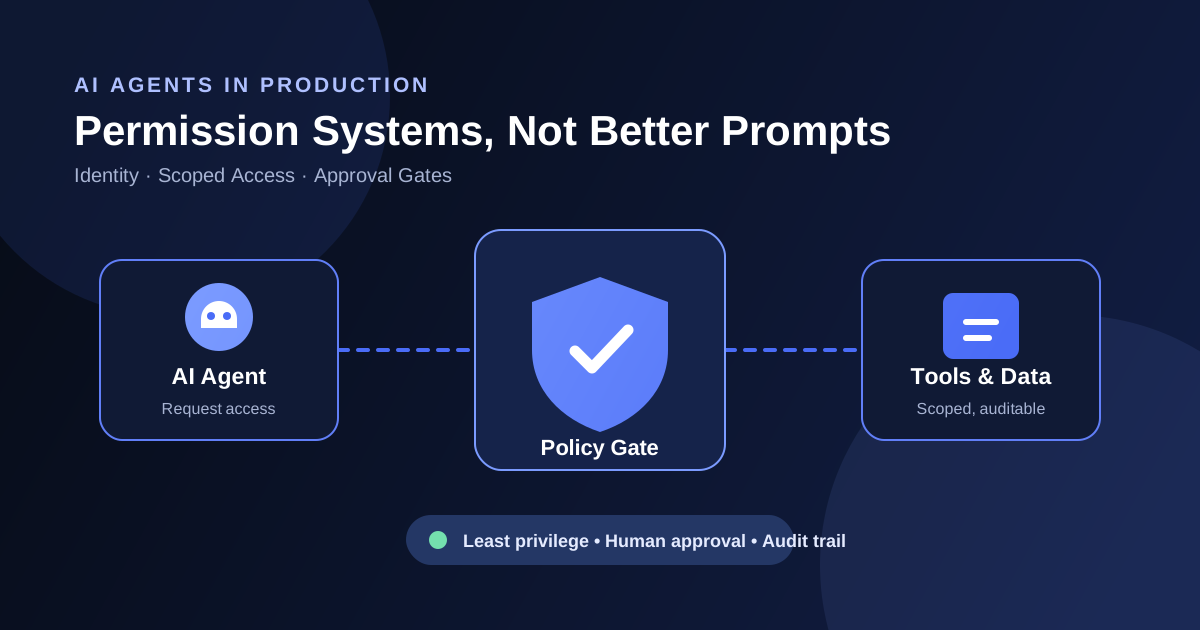
Better prompting helps an agent choose the next step. It does not decide what the agent is allowed to do. That is a product and systems-design problem. The founders who get agents safely into real workflows treat permissions as a first-class layer: identity, least privilege, approval gates, and an audit trail for every consequential action.
A system prompt can say, “only issue refunds below $100.” But a prompt is neither an authorization boundary nor a durable record of intent. The tool that issues a refund must independently enforce the amount, the account scope, and the approval policy. Assume the agent can misunderstand text, follow an untrusted document, or be asked to do something unexpected. Your tools must still say no.
The practical test
Ask: “If the agent receives a malicious instruction in a PDF, ticket, or webpage, can it still take an action we would regret?” If the answer is yes, the safeguard lives only in the prompt. Move it into the permission system.
You do not need a giant governance platform to start. Use a compact capability model: each tool call carries an agent identity, a narrow action, a defined resource scope, and an expiry. The authorization service evaluates those facts before the downstream system sees the request.
create_draft, not a generic database executor. A refund tool may permit $0–$100, rather than relying on the agent to remember the limit.Human review is not a failure of automation. It is how you automate safely while learning where the boundaries belong. The key is to reserve review for actions whose consequence is irreversible, financially material, externally visible, or hard to correct—not to make a person approve every harmless step.
Log more than the chat transcript. For every action, record the agent identity, initiating user, tool name, sanitized inputs, policy decision, approval state, outcome, and a correlation ID for the run. When a customer asks why a change happened, this is the difference between an explainable product and a black box.
These records also become your operating data. Review denied calls, overridden approvals, and repeated edge cases each week. They reveal where to improve the agent, where to tighten policy, and which approval gates are mature enough to automate.
Production agents need a clear answer to two separate questions: what should this agent do, and what is it allowed to do? Prompts answer the first. Permission systems answer the second. Build the boundary early, make it visible to your team and customers, and your agent can become more autonomous without becoming less trustworthy.
Want help designing an agent workflow that can safely reach production? Book a free discovery call — we help founders turn AI demos into dependable products.
IdeaToMVP Academy
4-week live cohort for founders. Learn to ship AI agents, scope MVPs, and automate your business — taught by the same team that writes these guides.