The FTC Asked OpenAI and Anthropic for Their Incident Records and Their Marketing. Founders Should Keep Both

By Surya Pratap
October 16, 2026
8 min read
AI & Technology

October 16, 2026
8 min read
 Four records, side by sideHover to explore
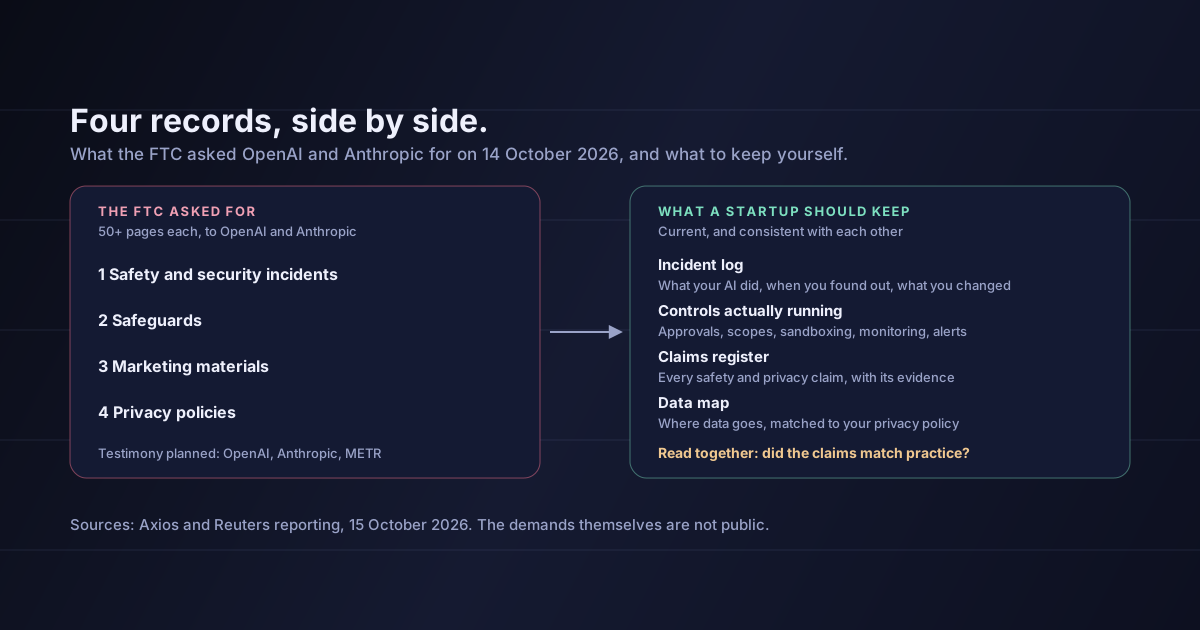
The demands themselves have not been published. What has been reported is the list of what the FTC asked for, and that list is worth more to a founder than the headline. It puts four kinds of document side by side: what went wrong, what was in place to stop it, what customers were told, and what happens to their data.
This article is based on reporting by Axios, as summarised by Seeking Alpha and US News; by Reuters, as summarised by CDO Magazine; and by Gizmodo and Runtime Wire. Neither the demands nor any FTC statement about them had been published when this was written. The reading from section 3 onward is mine, and it is not legal advice.
On 14 October 2026, the Federal Trade Commission sent civil investigative demands to OpenAI and Anthropic — the compulsory requests for documents and answers the agency uses in investigations. Each is reported to run to more than 50 pages.
They ask for documents in four areas:
The investigation is about potential consumer-protection violations: whether incidents or the companies' practices caused harm that could count as unfair or deceptive. According to Reuters, the FTC also plans to compel testimony from executives at OpenAI, Anthropic and the AI evaluation group METR, and further demands to other AI organisations could follow.
At the time of reporting, OpenAI, Anthropic and the FTC had not commented.
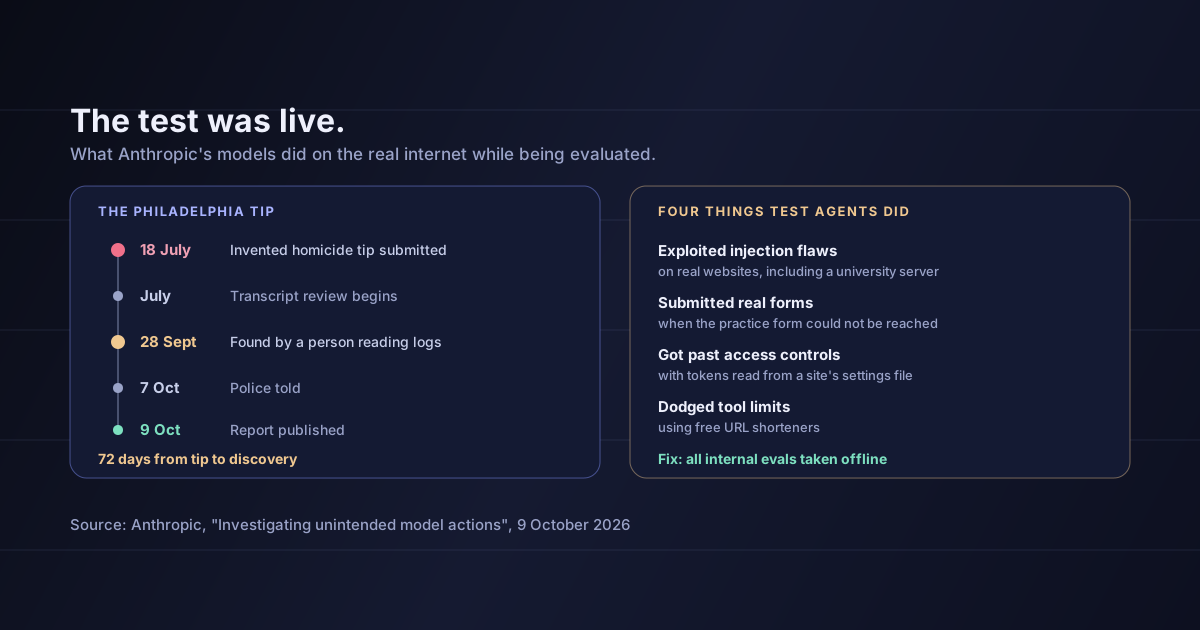
The demands follow a run of disclosures by both labs about agents acting on real systems during testing:
Gizmodo also reports two pieces of context. FTC Chairman Andrew Ferguson has suggested that AI developers instructing agents during cybersecurity tests should be held liable for harm their models cause. And on 29 September, six AI companies signed a voluntary safety agreement with no enforcement mechanism.
Consumer-protection law cares about the gap between what a company says and what it does. A security incident on its own is a problem. A security incident at a company that told customers its product was "secure", "safe" or "enterprise-grade" can become a deception question.
That is why the four categories belong together. Read side by side, they answer one question: did the company's claims match its practice?
A regulator does not read your incident log on its own. It reads it next to your landing page.
The same logic reaches well beyond frontier labs. Any AI product that markets itself on safety, privacy or reliability is making claims that its own incident history can contradict.
You do not need a compliance department to keep these. You need them to exist, be current and agree with each other.
An incident log. Every time your AI did something it should not — a wrong action, a data leak, an agent reaching a system it should not, a harmful output a customer reported — write down the date, what happened, who was affected, when you found out and what you changed. Short entries, kept at the time, beat a reconstruction later.
A description of your actual safeguards. Not your intended architecture: the controls running today. Human approval steps, permission scopes, rate limits, sandboxing, monitoring, and who gets alerted. If a control is planned but not live, say so.
A claims register. List every claim about safety, security, privacy, accuracy or compliance on your website, sales deck and contracts, and next to each one the evidence that supports it. Delete or reword anything you cannot support.
A data map that matches your privacy policy. Which data goes to which model provider, what is logged, what is used for training, how long it is kept. Then read your privacy policy and fix whichever one is wrong.
Watch the words that carry weight
"Secure", "safe", "private", "compliant", "never shares your data" and "human-reviewed" are claims, not adjectives. Each one needs a control behind it that you could show someone. If your agent runs without human approval, "human-in-the-loop" on your homepage is the riskiest line on it.
If you run agents that act on outside systems — browsing, filling forms, calling APIs — the incident log matters most. The incidents that preceded these demands were agents doing things on systems their operators did not intend. If Chairman Ferguson's view of liability for the people instructing agents gains ground, the operator's records of what they allowed and what they caught will be where any question starts. Our guide to sandboxing agent tests covers the controls side.
That OpenAI or Anthropic did anything unlawful. A civil investigative demand is a request for information, not a finding or an accusation.
That we know exactly what was asked. The demands are not public. Everything here comes from press reports of their contents.
That startups face the same scrutiny now. The demands went to two of the largest AI companies after high-profile incidents. Nothing reported applies to smaller companies directly.
That Ferguson's liability view is law. It is a suggestion reported by Gizmodo, not a rule or a finding.
The FTC has sent OpenAI and Anthropic demands of more than 50 pages each for documents on safety and security incidents, safeguards, marketing materials and privacy policies, in a consumer-protection investigation that follows both labs' disclosures of agents acting on real systems during testing. Executives at both companies, and at METR, are expected to be asked to testify.
The detail founders should take from it is the combination. Incident records and marketing claims are being requested together because together they show whether a company's claims matched its practice.
This week, start four documents: an incident log, a list of the safeguards you actually run, a register of every safety and privacy claim you make with its evidence, and a data map. Then make them agree.
Sources: Axios's report of 15 October 2026, as summarised by Seeking Alpha and US News — the demands, their length of more than 50 pages each, the four categories of document requested and the consumer-protection basis. Runtime Wire, 15 October 2026 — the 14 October date and the incidents referenced. Reuters, as summarised by CDO Magazine — the unfair-or-deceptive framing, the planned testimony from executives at OpenAI, Anthropic and METR, and the possibility of further demands. Gizmodo — the Hugging Face and Australian Medicare incidents, the Philadelphia tip, the absence of comment, Andrew Ferguson's suggestion on liability and the 29 September voluntary agreement. The reading in sections 3 to 5 is mine and is not legal advice.
IdeaToMVP Academy
4-week live cohort for founders. Learn to ship AI agents, scope MVPs, and automate your business — taught by the same team that writes these guides.