The AI MVP Evaluation Set: Test Real User Tasks Before You Launch

By Surya Pratap
July 16, 2026
7 min read
MVP Strategy

July 16, 2026
7 min read
An AI demo can look convincing while still failing the work a customer actually needs done. It may produce a polished answer that misses a required fact, cite a document that does not support its conclusion, or take an action a user never intended. These failures are hard to see when every test prompt is invented on the spot.
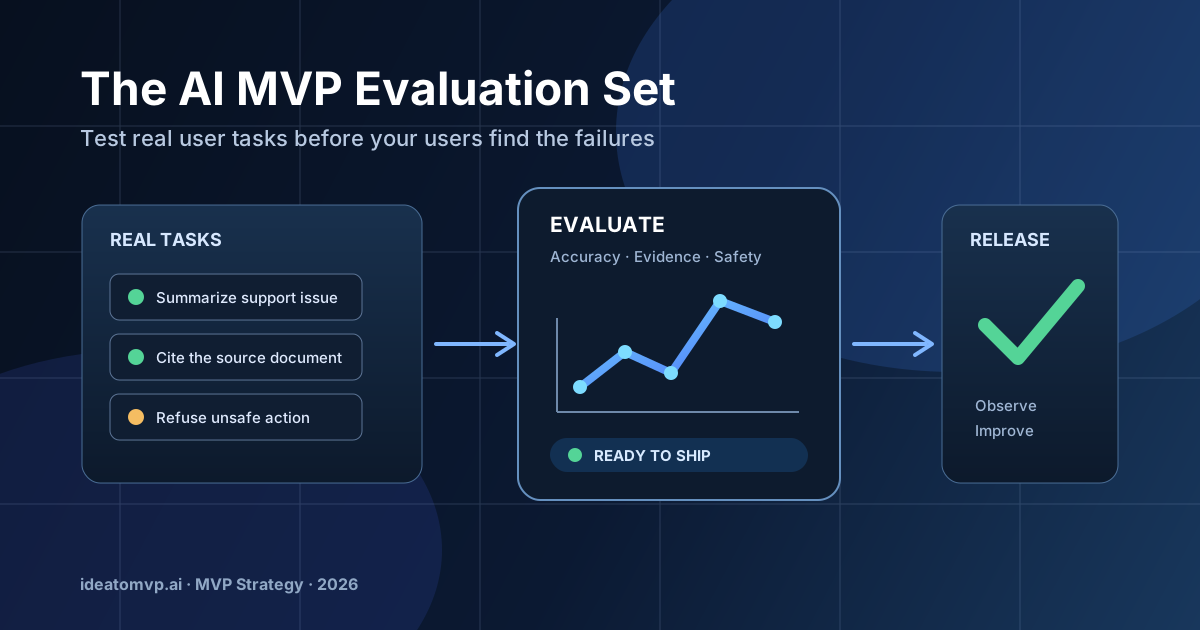
The practical answer for an early-stage product is not a giant benchmark program. It is a small evaluation set: a versioned collection of real tasks, expected outcomes, and clear scoring rules that you run whenever the prompt, model, retrieval system, or workflow changes. It turns “this feels better” into evidence you can compare.
Founders often begin with model selection because it is visible and easy to discuss. Users do not buy a model; they buy a reliable outcome. Write down the job your product is meant to complete in language a customer would use: “turn this support thread into a handoff,” “extract the renewal date from this contract,” or “suggest a reply using only our approved knowledge base.”
Each job becomes a test case. A useful case includes the input a user would provide, the context your system is allowed to use, the expected outcome, and the failure that would make the result unacceptable. This keeps the evaluation connected to product value rather than a generic benchmark score.
You do not need hundreds of examples to learn something important. Start with 15 to 20 cases from discovery calls, manually completed work, customer interviews, support tickets, or documents you have permission to use. Include ordinary cases, not just dramatic edge cases. If the common task is wrong, the product is not useful.
Protect customer data while collecting examples
Use consented, sanitized, or synthetic inputs in your evaluation set. Remove credentials, personal information, and unnecessary customer context. The point is to preserve the task structure and decision criteria—not to create another uncontrolled copy of sensitive data.
Exact string matching is usually too brittle for generative output. Score the properties that define a useful result instead. For a contract extractor, that might mean the date is correct, the source passage is named, and uncertainty is explicit when the date is absent. For a support copilot, it could mean the summary preserves the customer's issue, avoids fabricated commitments, and recommends the next approved action.
A simple three-level rubric works well early on: pass for an outcome a user could act on, needs review for a partly useful result, and fail for a material mistake, unsupported claim, or unsafe behavior. Add a short reason beside every non-pass result. Those reasons are your product backlog.
One score can hide the reason a workflow is unfit to ship. Track three dimensions separately. Quality asks whether the answer solves the task. Safety asks whether the system stayed inside the permitted behavior and data boundary. Operations asks whether the workflow responds quickly enough and at a cost the business can sustain.
This separation makes trade-offs visible. A larger model may improve a difficult reasoning task but push response time beyond what an in-product assistant can tolerate. A retrieval update may improve relevance while increasing unsupported citations. Treating each dimension independently helps you decide whether to tune, route differently, add a human checkpoint, or narrow the feature scope.
Run the same cases before and after meaningful changes: a prompt rewrite, a new model, altered system instructions, new retrieval chunks, or an agent tool. Do not release because the newest output looks impressive in a single conversation. Release when the change improves or preserves the outcomes your users care about and does not create new safety failures.
Your first evaluation set is not a certification. It is a disciplined product habit. Store the cases, their expected outcomes, the scoring rubric, and results alongside the feature work. Give each case an owner and a reason it exists. When a customer discovers a meaningful failure, turn it into a sanitized regression test before you fix it.
An AI MVP becomes credible when it is dependable on the narrow job it promises to do. A compact evaluation set gives founders a way to improve that dependability deliberately—before a polished demo becomes a costly production surprise.
IdeaToMVP Academy
4-week live cohort for founders. Learn to ship AI agents, scope MVPs, and automate your business — taught by the same team that writes these guides.