50% of CHROs Don't Trust Managers to Guide AI Use. Only 57% Are Training Them

By Surya Pratap
September 23, 2026
11 min read
AI & Technology

September 23, 2026
11 min read
 The layer the budget skipsHover to explore
Every argument about corporate AI training is an argument about content. Which topics, how many days, live or self-paced, technical or general. A study published this August points somewhere else entirely — not at what is taught, but at who is in the room.
Figures in this article come from Gallup's AI's Effect on Workplace Culture, published 16 August 2026 and WRITER's 2026 enterprise AI adoption survey with Workplace Intelligence. Both are summarised as published; the reading of them, and everything in section 6, is mine.
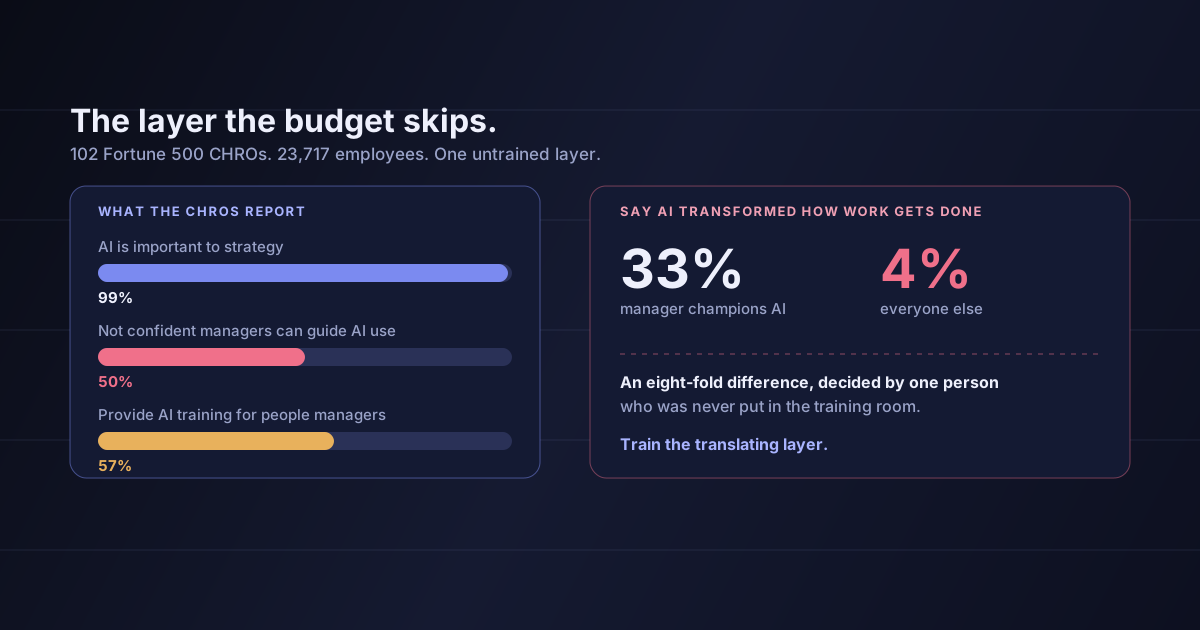
Gallup ran two instruments. One surveyed 102 CHROs at Fortune 500 companies between 10 February and 16 March 2026. The other surveyed 23,717 employed US adults between 4 and 19 February, with a margin of error of ±0.9 percentage points.
From the CHRO side, three findings, in the order that makes them uncomfortable:
Effectively unanimous. Whatever else is contested in these companies, this is not.
Half the people responsible for the workforce do not believe the layer between strategy and the work can carry it.
Which leaves roughly two in five not training managers at all, while half of them report the problem the training would address.
Read together, that is an organisation betting its strategy on a transmission it has diagnosed as faulty and is only sometimes repairing.
The confidence problem and the training gap are the same fact seen from two angles, and one of them is the fixable one.
The employee side of the study is where the argument stops being about governance and starts being about money.
33% of employees who strongly agree their manager champions AI say AI has transformed how work gets done in their organisation. Among those who do not strongly agree, the figure is 4%.
An eight-fold difference. Not on satisfaction, not on sentiment — on whether the work changed.
The softer version of the same effect shows up in culture. 31% of employees who strongly agree their manager actively supports their team's AI use say workplace culture improved over the past year, against 21% of those who do not. And the aggregate picture, absent that support, is a dead heat: in organisations that have implemented AI, 24% say culture improved, 25% say it worsened, 51% say it stayed the same.
What a dead heat actually means
A quarter-up, quarter-down, half-unchanged split is what you get when an intervention has no consistent direction — when the same tools, deployed in the same year, land as a relief in one team and as a threat in the next. The variable producing the spread is not the tool. Every team had the same one.
There is an obvious objection: maybe managers who champion AI are simply the managers in teams where AI was always going to work. Enthusiasm following success rather than causing it. That reading is available, and Gallup's data is correlational, so it cannot be excluded.
But the structural argument does not depend on the causal one. A second survey makes the shape clear. WRITER, with Workplace Intelligence, surveyed 1,200 non-technical employees and 1,200 C-suite executives in research published in April 2026. Two findings sit directly on top of Gallup's:
The executive layer is fluent and committed. The strategy, by three-quarters of its own authors' account, does not tell anyone what to do. Which means the translation from we are an AI company now into here is how this team works on Tuesday happens exactly once, in one place, performed by one person — and that person has a full-time job already.
The practical consequence:
A manager does not need to be an AI expert. They need to be able to answer four questions their team will ask in the first month, and none of them are technical: Is this allowed? Am I supposed to be faster now? What happens if it gets something wrong and I ship it? Is this how you replace me? An organisation that trains its engineers and its executives and leaves those four questions to be improvised is the organisation with a 25% "culture worsened" number.
Training aimed at managers usually arrives as a lighter version of the technical course — the same tool demo with the hard parts removed. That is the wrong shape. The manager's job in an AI rollout is not to use the tools better than their team. It is to make decisions their team cannot make for themselves.
Where the line is. Which work may be delegated to a model, which may be drafted by one and reviewed, and which may not touch one at all. A manager who cannot draw this line will have every person on the team draw it differently.
How to review AI-assisted work. Reviewing output you did not watch being produced is a distinct skill. It means asking what was verified rather than whether it reads well — and knowing that fluent and wrong is the default failure mode.
What to do about the speed question. When a task that took a day takes an hour, someone has to say what the other seven hours are for. If nobody says, the team will assume the answer is "more tasks," and behave accordingly.
How to talk about jobs without lying. The single most corrosive thing a manager can do is give a reassurance they do not control. Saying what is known, what is not, and what the manager will tell people as soon as they know it is the only durable position.
None of that is a tool skill. All of it is trainable, and none of it is in a prompt engineering syllabus.
If you are specifying corporate AI training this quarter, the findings turn into a short list of things to insist on.
Not as observers in the engineering track and not as a diluted executive briefing. The decisions they need to make are specific to their role, and they will not raise a governance question in front of their own reports.
A team trained ahead of its manager comes back with new habits and no authority to use them. The manager becomes the bottleneck the programme created.
A one-page statement of what this manager's team may use AI for, what gets reviewed and by whom, and what the escalation is. It is inspectable, it is the thing the team actually needs, and writing it is the exercise.
Roughly half of CHROs are describing exactly this person. A programme with no answer is planning for the room it wants rather than the room it will get.
And one question worth asking any provider, us included: who in our organisation has to change their behaviour for this programme to have been worth it, and does your curriculum have a session aimed at them? If the answer is "everyone," nobody has been aimed at.
Where the IdeaToMVP Academy sits on each of these:
Our corporate programmes are separated by audience rather than sold as one course, and the manager layer falls between two of them by design — close enough to the engineering track to understand what their team is doing, close enough to the leadership track to make a call about it.
Two honest limits. We do not sell a standalone people-manager course today; managers are placed into the leadership or engineering track according to what their team builds, and if a dedicated manager cohort is what you need, that is a scoping conversation rather than something you can order off the page. And no cohort substitutes for an executive decision: if the strategy is, in WRITER's phrase, more for show than actual guidance, training the manager layer will expose that faster — it will not fix it.
IdeaToMVP Academy
4-week live cohort for founders. Learn to ship AI agents, scope MVPs, and automate your business — taught by the same team that writes these guides.
The correlation problem is real and I am not resolving it. Gallup measures association between manager championship and reported transformation. Managers who champion AI may be a proxy for teams that were better run to begin with. The 33-versus-4 gap is large enough to be worth acting on and not strong enough to be called a causal effect.
The populations are not yours. One hundred and two Fortune 500 CHROs and 23,717 US employees describe large American enterprises. A sixty-person company has a manager layer of a different kind, and a twelve-person one barely has the layer at all. Read the direction, not the percentages.
"Champions AI" is a self-reported perception. It is the employee's read on their manager, not an audit of what the manager did. That is the right measure for a culture question and the wrong one for a competence question, and the two get conflated easily.
Our programme structure is a design choice, not evidence. That our tracks are shaped around decisions rather than tools is how we think this should work. It is not proof that it outperforms, and our own outcome data is thin.
The corporate AI training market is organised around two audiences: the people who build the systems and the people who approve the budget. The study says the outcome is decided by the layer in between — the one that turns a strategy slide into what a team does on a Tuesday, and that half of Fortune 500 CHROs already report they do not trust to do it.
That layer is cheap to train relative to what it governs, and it is the difference between an AI programme that changes the work and one that produces a quarter improved, a quarter worse, and half a company that noticed nothing.
If you change one thing about how you buy AI training this quarter, add a manager cohort and run it first.
Sources: Gallup, AI's Effect on Workplace Culture, Morgan Meinen and Megan Mulherin, 16 August 2026 — a survey of 102 Fortune 500 CHROs conducted 10 February to 16 March 2026, and a study of 23,717 employed US adults conducted 4 to 19 February 2026 with a ±0.9 percentage point margin of error; all CHRO, culture and manager-championship figures are as reported there. WRITER and Workplace Intelligence, enterprise AI adoption survey, published 7 April 2026 — 1,200 non-technical employees and 1,200 C-suite executives; usage, strategy-guidance and manager-champion figures are as reported there. Academy programme details are ours and are current as at publication. For the participant side of this problem see 47% of employees say the AI training is there to automate their job, for the measurement side see only 13% can work with AI agents, and for what each of our programmes commits to see our enterprise AI training, specified.
IdeaToMVP Academy
4-week live cohort for founders. Learn to ship AI agents, scope MVPs, and automate your business — taught by the same team that writes these guides.