Only 13% Can Work With AI Agents. Worse, Only 11% Know Where They Stand

By Surya Pratap
September 17, 2026
10 min read
AI & Technology

September 17, 2026
10 min read
 The skill nobody can see in themselvesHover to explore
Most writing about the AI skills gap argues about whether it exists. A benchmark published this year does something more useful: it measures the gap, ranks it, and then quietly reports the finding that explains why so much training money produces so little.
Figures in this article come from Workera's 2026 AI Skills Enterprise Benchmark Report and The Conference Board's July 2026 AI skilling study. Both are summarised as published; the reading of them, and everything in section 6, is mine.
Workera benchmarked 88,753 assessments across 32,422 individuals, spanning professional services, pharmaceutical and medical, financial services, consumer packaged goods, and the US federal government. People were scored on a 300-point scale across 14 AI and data capabilities, where 201–300 counts as "Accomplished".
That sample size matters because it changes the kind of claim being made. A survey asks people what they think. An assessment finds out.
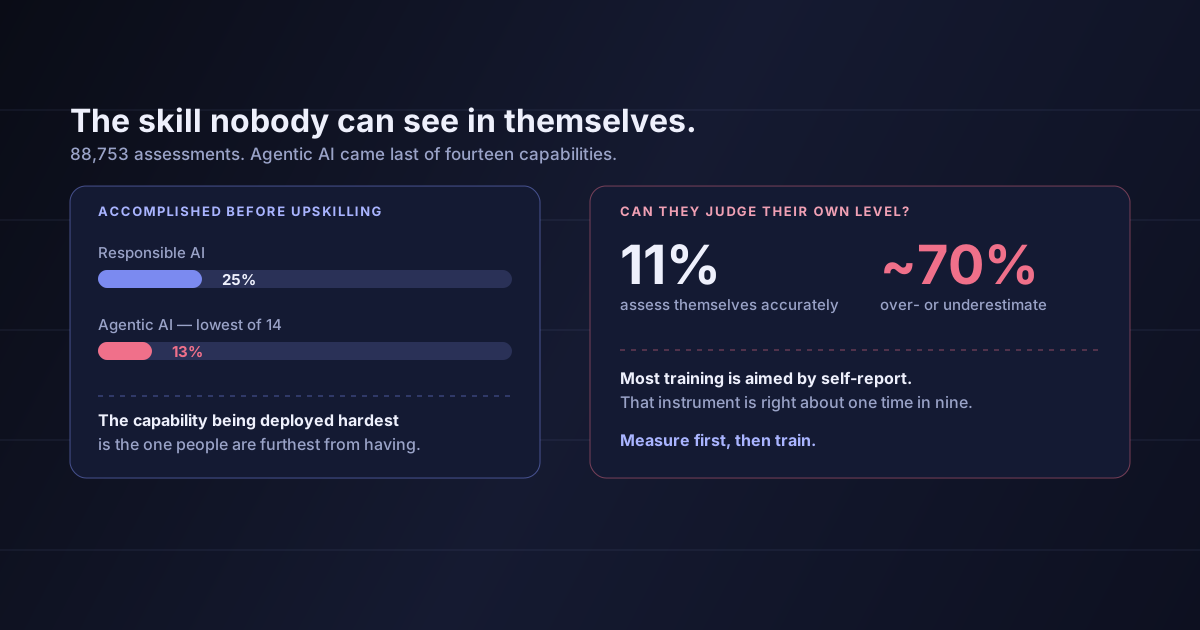
The headline: 13% of employees were Accomplished in agentic AI skills before any upskilling — the lowest of all fourteen capabilities measured.
The capability enterprises are deploying hardest is the one their people are furthest from having.
Agentic AI did not score low because it is new and unimportant. It scored low while being the thing every vendor roadmap, board deck and procurement cycle in 2026 is pointed at. The skill in shortest supply is the skill currently being bought.
The number that should actually change how you spend is further down.
Only 11% of employees could accurately assess their own skill level. Nearly 70% either overestimated or underestimated their abilities.
Sit with that for a moment, because almost every training programme in existence is aimed using exactly the instrument that just failed. Skills surveys, self-nomination for courses, "rate your confidence 1–5" onboarding forms, managers asking who needs help — all of them read a signal that is wrong roughly seven times out of ten.
It breaks in both directions, and the two failures cost differently:
People who believe they are competent do not enrol, do not ask, and ship work nobody reviews closely. This is the expensive direction. An engineer who thinks they understand retrieval will build a pipeline that demos well and degrades silently.
Capable people sit out of work they could do, and the organisation hires or outsources capability it already has. Cheaper, but it distorts the plan.
Why this compounds with agents specifically
Agentic systems fail quietly. A model that is wrong in a chat window is visibly wrong. An agent that is wrong takes an action, and the cost surfaces later, in a support ticket or a reconciliation. The gap between "I can use this" and "I can tell when this is failing" is exactly the gap self-assessment cannot see — and agents are where that gap becomes operational.
The Conference Board surveyed nearly 1,300 workers alongside interviews with 35 enterprise leaders in July 2026. The relevant numbers:
Put the two studies next to each other and the position is unambiguous. A majority of people use these systems every week. A third have had any training recently. Roughly one in eight is assessed as accomplished at the agentic part. And nobody — including them — can reliably say who is who.
The practical consequence:
Daily use is not capability, and it is not evidence of capability. It is exposure. Exposure without assessment is how an organisation ends up confident and wrong at the same time.
It would be easy to read all this as an argument that training does not pay. The benchmark says the opposite, and specifically.
After targeted upskilling, 81% of employees reached Accomplished in Responsible AI, up from 25% at baseline. Other capabilities moved substantially too: 72% average improvement in data visualisation and storytelling, 53% in generative AI essentials, 47% in AI essentials.
Those are large movements. The variable is not whether training happens — Conference Board says a third of people had some this year — but whether it was pointed at a measured gap rather than a felt one.
A programme that begins with an assessment is solving a different problem from a programme that begins with a sign-up sheet. The first knows what it is closing. The second is guessing, using an instrument the same report shows is unreliable.
If you are specifying corporate AI training in the next quarter, the findings translate into a short list of things to insist on.
Do not scope from a skills survey alone. Self-report is the input that failed. Use work samples, a short assessment, or a review of something the team actually shipped.
Specify the work, not the topics. "Our team cannot tell when a retrieval answer is wrong" is a brief. "Introduction to LLMs" is a catalogue entry.
Ask how the programme handles the confident learner. The person who overestimates is the one most likely to disengage and most expensive to leave unchecked.
Insist on an artefact. Something the participant made, that you can look at afterwards. It is the only capability signal that does not depend on anyone's self-assessment.
And one question worth asking any provider, us included: what would this programme look like if it were wrong about our team's starting level? A programme with an answer has thought about assessment. A programme without one is selling a syllabus.
Where the IdeaToMVP Academy sits on each of these:
Our corporate programmes are separated by audience rather than sold as one course, because a finance team and an engineering team do not have the same gap and should not be assessed against the same bar. Each track publishes its prerequisites, its learning objectives and the output a participant leaves with.
Two honest limits. We do not run a standardised psychometric assessment of the kind Workera does — if you want a benchmarked score across fourteen capabilities, that is a different product and we will say so. And a cohort cannot fix a strategy problem: if nobody has decided what AI is for in your organisation, training will not decide it for you.
IdeaToMVP Academy
4-week live cohort for founders. Learn to ship AI agents, scope MVPs, and automate your business — taught by the same team that writes these guides.
The benchmark is not ours, and its population is not yours. Workera's sample skews to large enterprises and the US federal government. A twelve-person startup is not that population, and the percentages should be read as direction rather than as your team's likely score.
Improvement figures come from people who were assessed and then trained. That is a selected group, and the 81% Responsible AI figure is a post-intervention measurement, not a promise attached to any particular programme, including ours.
Correlation, as usual. That our curricula are shaped against these findings is a design choice. It is not evidence that they outperform, and our own outcome data is thin because the engagements we can point to are recent.
The AI skills gap in 2026 is not mainly a gap in provision. It is a gap in sight: the scarcest measured capability is the one organisations are deploying hardest, and the instrument almost everyone uses to aim their training — asking people how they are doing — is reliable in about one case in nine.
Daily use is not capability. Confidence is not capability. The only thing that behaves like capability is something a person made that someone else can inspect.
If you change one thing about how you buy AI training this quarter, stop scoping it from a self-assessment survey and start scoping it from work your team has actually produced.
Sources: Workera, 2026 AI Skills Enterprise Benchmark Report — 88,753 assessments across 32,422 individuals, scored 1–300 with 201–300 as Accomplished, across 14 capabilities; all benchmark and post-upskilling figures are as reported there. The Conference Board, AI skilling study, 28 July 2026 — nearly 1,300 workers surveyed plus interviews with 35 enterprise leaders; usage, training-participation and resourcing figures are as reported there. Academy programme details are ours and are current as at publication. For the provision-side version of this problem see 82% of companies run AI training and 59% still report a skills gap, and for the perception gap between buyers and participants see 47% of employees say the AI training is there to automate their job.
IdeaToMVP Academy
4-week live cohort for founders. Learn to ship AI agents, scope MVPs, and automate your business — taught by the same team that writes these guides.