47% of Employees Say the AI Training Is There to Automate Their Job

By Surya Pratap
September 15, 2026
12 min read
AI & Technology

September 15, 2026
12 min read
 The programme bought, and the programme receivedHover to explore
If you are commissioning AI training for a team, a department or a campus, there is one number that will decide more about the outcome than the curriculum will.
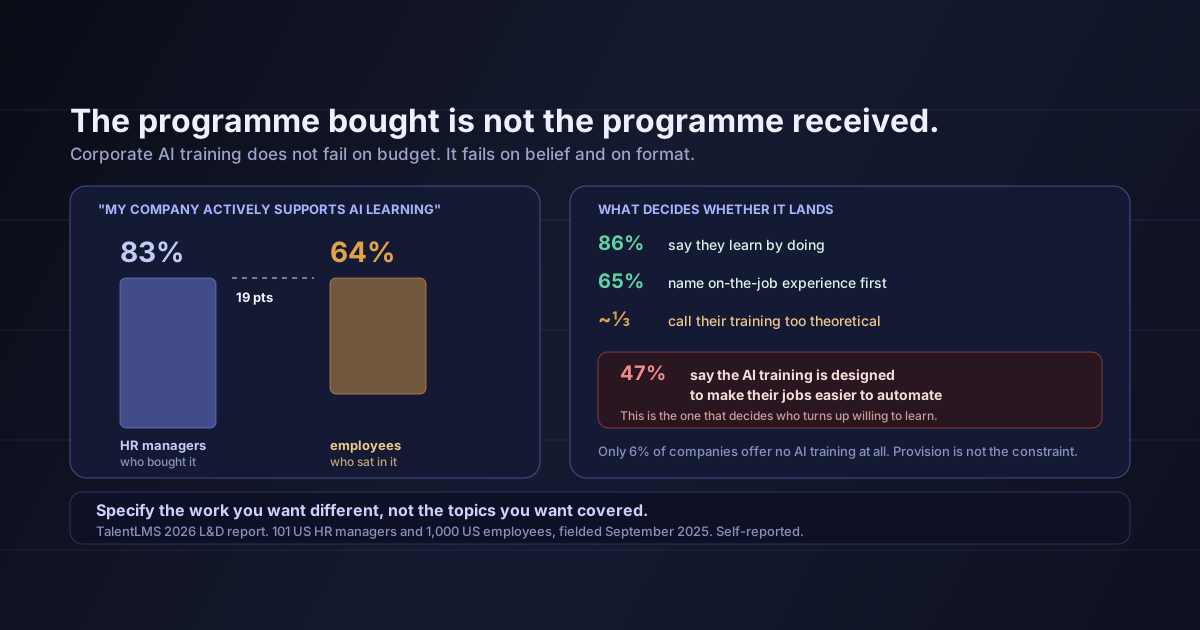
47% of employees say their company's AI training is designed to make their jobs easier to automate.
Not "might lead to". Designed to. Almost half the room, arriving at your programme with a theory about why it exists.
The figures here come from the TalentLMS 2026 L&D report, which surveyed 101 US HR managers — 55% directly managing L&D — and 1,000 US full-time employees who had received training in the previous twelve months. Worth noting up front: the fieldwork was September 2025, so read it as the state of play entering 2026 rather than as this month's snapshot.
Provision is not the issue. Only 6% of HR managers say their company does not yet offer AI training at all.
What HR expects from AI training
The intent side of the survey, and it is coherent
That is a reasonable set of expectations. The trouble starts when you ask the other side of the room.
83% of HR managers believe their company actively supports AI learning. 64% of employees agree.
Nineteen points. Same companies, same programmes, two very different experiences of them.
The people who commission the training and the people who sit in it are describing different programmes. Only one of those groups has to act on what they learned.
This is the most useful diagnostic in the whole report, because it is measurable inside your own organisation this week and it is almost never measured. Ask your L&D function whether the company supports AI learning. Ask a random twenty people in delivery roles the same question. If your internal spread is anywhere near nineteen points, the next programme you buy will land in the gap rather than closing it.
Now put the two findings together. Nearly half of employees believe the AI training exists to automate them, and 72% of HR managers say its purpose is organisational efficiency.
Here is the uncomfortable part: those two statements are not obviously in conflict. Efficiency is what the buyer said out loud. Automation is what the recipient heard. Neither group is lying, and the gap between them is an interpretation problem that no amount of curriculum quality fixes.
What this does to a programme in practice
An employee who believes the programme is automation preparation behaves rationally: they attend, they do not volunteer their real workflow as a case study, they do not surface the manual process that is secretly load-bearing, and they do not build the thing that would make their own role legible to a machine. You will get completion rates and no transfer. The failure looks like disengagement and is actually self-protection.
There is a related finding worth holding alongside it: 36% of employees say generative AI tools are weakening their ability to solve problems on their own. Whatever you think of that as a claim about cognition, it is a real belief held by a third of the people you are training, and a programme that never addresses it is arguing with an objection it refuses to hear.
The fix is not reassurance, it is specificity. "This will not cost you your job" is unfalsifiable and everybody knows it. "Here is the task we want this to absorb, here is what we want your time to move to, and here is who decides" is a claim that can be checked. Programmes that name the target explicitly get engagement; programmes that talk about efficiency in the abstract get attendance.
The format findings in this survey are unusually decisive.
86% of employees say they learn by doing. 65% name on-the-job experience as their top skill-building method. Roughly one third say their training is too theoretical, and "not enough hands-on practice" is the second-ranked blocker they report.
It is tempting to file that under preference — people enjoy hands-on formats more. That is not what the numbers are saying. They are saying that a programme without practice does not produce capability regardless of how well the content is written, because the thing being taught is a skill and skills transfer through use.
For AI specifically this is sharper than for most subjects. Knowing what RAG is takes ten minutes. Knowing whether your document set is a RAG problem, what it will cost, and what it will do when the documents are inconsistent — that takes an afternoon of trying it on the actual documents, and there is no lecture that substitutes.
Campus programmes get treated as corporate training with a younger audience. They are not, and three constraints differ.
The one thing campus and corporate share: the 47% problem has a student version. If the programme reads as "here is the technology that makes your degree worthless", you get the same defensive non-engagement, in a room with less power to object.
Whether you are buying from us or from anyone else, this is the specification I would write. It is deliberately checkable.
We deliver corporate and institutional AI training as IdeaToMVP Academy. The facts, stated so you can check them:
300+ corporate professionals trained, across three enterprise and academic partners. We ran a 30-day in-person intensive Gen AI cohort at TCS in Chennai and continue an ongoing online cohort for TCS professionals. We partner with LearnQuest on project-based online programmes, and with Chitkara University on campus Gen AI programmes. Delivery is on-site, online or hybrid — that is a scoping question, not a fixed constraint.
Three shapes, one curriculum:
The programmes, and who each is for
Scoped rather than sold per seat
Two things we say out loud because they are the questions that actually get asked. The curriculum comes out of shipping AI products rather than a content library, and the people teaching it are the people who do this work commercially. And if a request is outside what we work with commercially, we say so rather than learn it on your budget.
The survey is not ours and the fit is not proof. TalentLMS surveyed 101 HR managers and 1,000 employees in the US in September 2025. That our programmes are shaped against those findings is a design choice, not evidence that they outperform — and our own outcome data is thin, because the corporate engagements we can point to are recent and the public Founder AI Sprint has not run yet.
Hands-on is not free. Building on your own systems means access, approvals and someone on your side who can unblock a credential on day two. Programmes like this are more work for the client than a video licence, and if nobody internally owns that, it will underdeliver regardless of who teaches it.
Training will not fix a strategy problem. If nobody has decided what AI is for in your organisation, a cohort will not decide it for you. That is what the executive format exists for, and running it in the wrong order is the most common expensive mistake here.
Corporate AI training in 2026 does not fail for lack of budget or lack of provision — 94% of companies already offer something. It fails in the nineteen points between what the people who bought it believe and what the people sitting in it experience, and in the half of that room who think the programme is there to automate them.
Neither of those is solved by better slides. They are solved by naming the task, building on the real systems, keeping the room small enough that someone can look at your screen, and saying plainly what the organisation is trying to do.
If you only change one thing about how you buy AI training, make it this: specify the work you want different, not the topics you want covered.
Sources: TalentLMS, "The 2026 L&D Report: The State of Workplace Learning" — survey of 101 US HR managers and 1,000 US full-time employees who received training in the preceding 12 months, fielded September 2025; all HR-manager and employee figures are as reported there and are self-reported. Programme details, partners and the 300+ figure are ours and are current as at publication. The reading of the nineteen-point gap as an adoption predictor, the campus constraints in section 5 and every recommendation are mine. For the founder-scale version of the same problem, see 82% of companies run AI training and 59% still report a skills gap.
IdeaToMVP Academy
4-week live cohort for founders. Learn to ship AI agents, scope MVPs, and automate your business — taught by the same team that writes these guides.