32% Cancelled a Software Purchase to Build It With Agents. 6% Are Actually Seeing Returns

By Surya Pratap
September 1, 2026
11 min read
AI & Technology

September 1, 2026
11 min read
 The decision and the returnHover to explore
If you sell software, the most important number published this week is 32%.
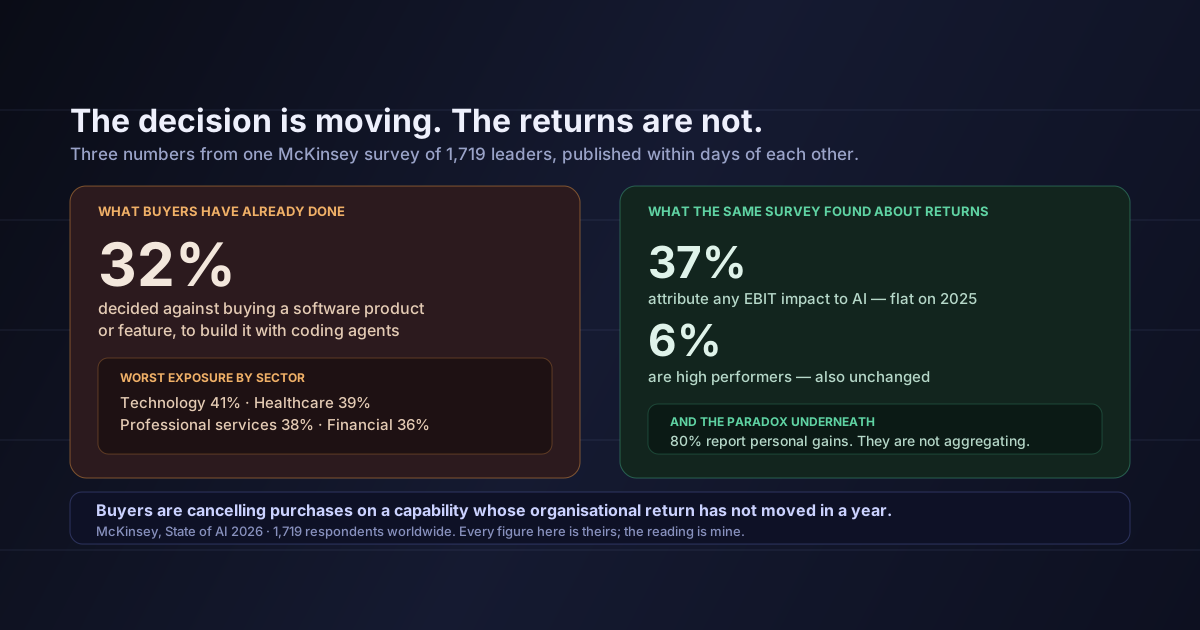
That is the share of organisations in McKinsey's State of AI 2026 — a survey of 1,719 professionals and business leaders worldwide — who report deciding against buying one or more software products or features, because they could build it internally with agentic coding tools.
Not "considered building." Decided against buying.
The headline number hides a spread that matters more than the average, because it tells you whether this is your problem or somebody else's.
Share who skipped a purchase to build with coding agents, by sector
McKinsey State of AI 2026
Notice the floor. The lowest sector in that list is 33%. There is no segment where this is not happening, which means "our buyers are too regulated to build it themselves" is no longer a position you can hold without evidence.
Here is the part worth reading twice, and it comes from the same report, the same respondents, the same fieldwork.
37% attribute at least some EBIT impact to AI. That figure is flat against 2025.
6% qualify as high performers — attributing at least 5% of organisational EBIT to AI with significant impact. That is also unchanged year on year.
The buying decision moved sharply. The measured organisational return did not move at all.
So a third of organisations are cancelling purchases on the strength of a capability that, by their own accounting, has not yet changed their earnings. The confidence is running well ahead of the demonstrated result.
Why this is not simply 'they are wrong'
Returns lag decisions, and they should. Nobody expects a build started this quarter to show up in EBIT this quarter, and a flat aggregate can hide a rising distribution. But two years of flat is not a lag, it is a pattern — and the honest description is that the build decision is being made on belief about where the capability is going rather than on where it has demonstrably arrived.
The mechanism sits in two more figures from the same report.
80% of respondents using AI say it improved their individual productivity. And yet organisational EBIT impact is flat.
That is the classic shape of a productivity paradox: real gains at the level of the person, which fail to aggregate at the level of the firm. Individual time saved gets absorbed — into more meetings, more review, more rework, more coordination — rather than showing up as output or margin.
It also explains how both halves of this report can be true at once. The engineer who used an agent to prototype a replacement for a $40k/year tool genuinely did that faster than they could have last year. Whether the company ends up cheaper, once you count the maintenance, the on-call, and the eighteen months of edge cases, is a different question that the survey period has not yet answered.
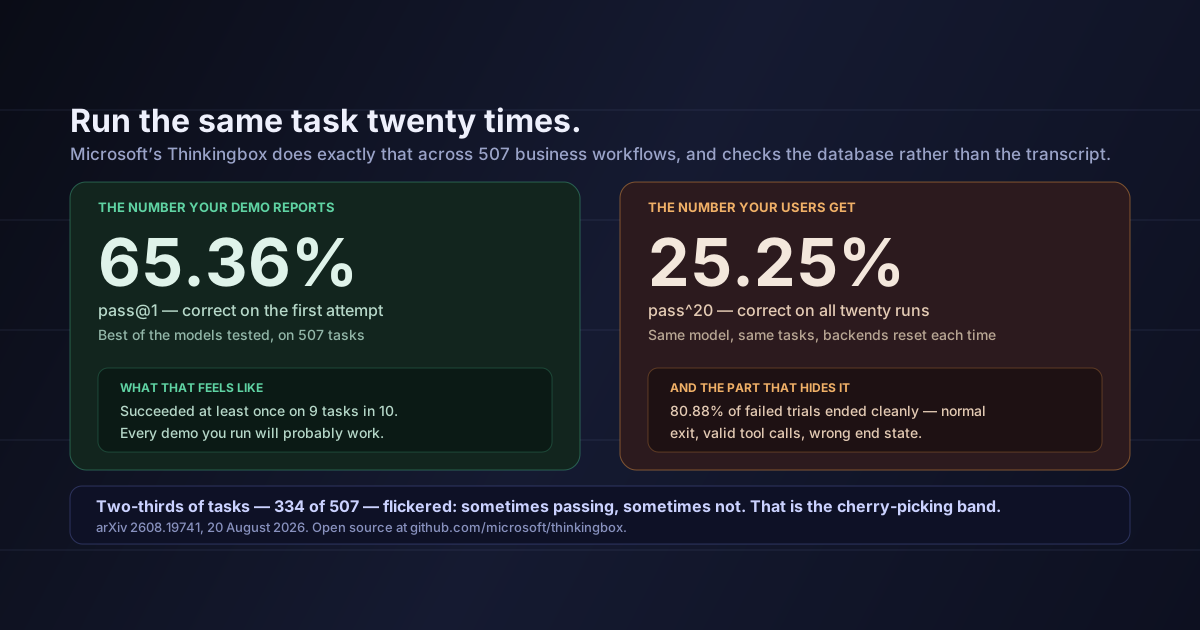
I wrote last week about Microsoft's Thinkingbox benchmark, which runs 507 stateful business workflows twenty times each and grades what actually changed in the database. The strongest model tested managed 65.36% pass@1 and 25.25% pass^20 — right first time on two tasks in three, right every time on one in four.
Put that next to the 32%.
The workflows these teams are replacing — claims processing, billing rules, procurement approvals, account provisioning — are precisely the multi-step, policy-conditioned, state-heavy tasks the benchmark measured. And that is where measured agent reliability is weakest.
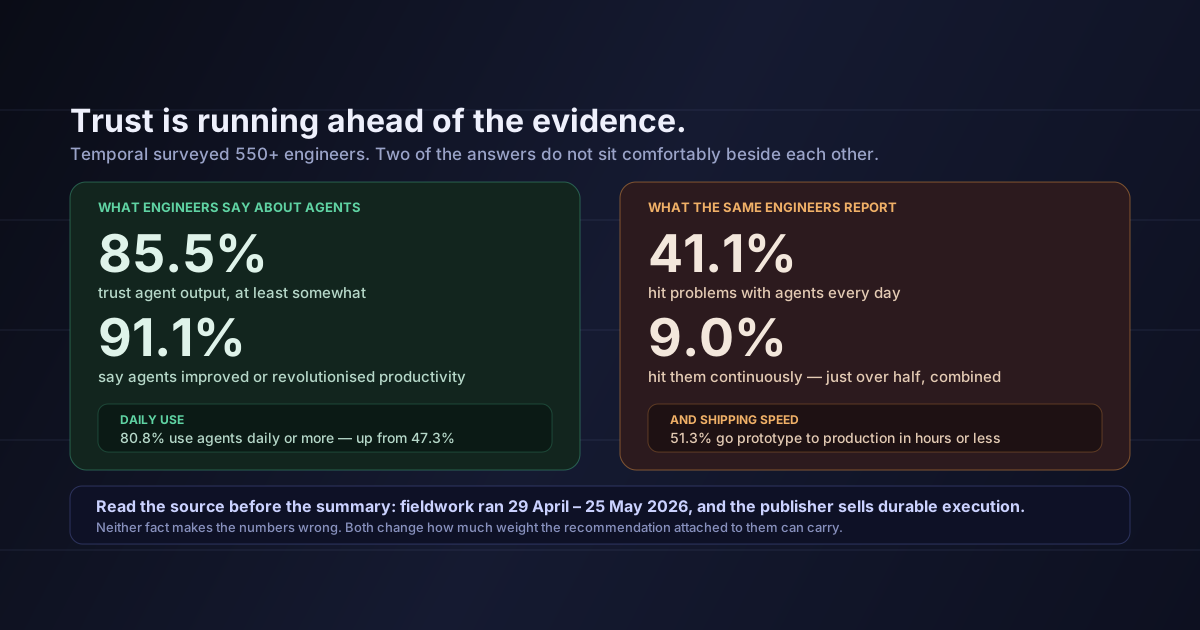
This is the same calibration gap I keep running into, now on the buy side. In the Temporal survey, 85.5% of engineers trusted agent output while half hit problems daily. Here, a third of organisations are cancelling purchases on that same trust. The gap has stopped being an engineering curiosity and started showing up in someone's revenue.
None of this means the 32% are making a mistake. For a genuinely simple, well-bounded internal tool, building it with agents is now often the right call — and the honest response to that is to stop selling those products, not to argue with the buyer.
What survives is what an internal rebuild cannot cheaply reproduce.
The middle card is the cheapest and nobody does it. "Did you consider building this internally, and how far did you get?" turns an objection you handle at the end of a cycle into information you have at the start of one.
Three cautions, because this is a survey and surveys invite over-reading.
It is self-reported intent about past decisions, not audited procurement data. "We decided against buying" covers everything from a cancelled renewal to a feature that never made a shortlist — and the second is far less costly to you than the first.
Flat EBIT is not proof the builds fail. It is proof they have not yet shown up. The interesting figure will be the 2027 report: if the 32% rises again while the 6% stays put, that is a pattern worth naming. One year is not.
McKinsey sells AI transformation consulting. The same discount I applied to Temporal's survey applies here — the raw percentages are far more trustworthy than any framing laid over them, and "on the road to ROI" is a conclusion with a commercial interest attached.
Nearly a third of organisations have already decided against a software purchase because agentic coding tools made building look viable. In technology it is 41%, and the lowest sector on the list is 33%. That is a demand-side shift, it is happening now, and it is measurable in somebody's pipeline this quarter.
The same survey found the share of organisations seeing any EBIT impact from AI did not move all year, and the share seeing serious impact stayed at 6%. Meanwhile the best-measured agent reliability on exactly the stateful workflows being replaced is 25% across repeated runs.
The buyers are not irrational. They are early, and they are betting on a trajectory rather than a result. Your job is not to tell them the trajectory is wrong. It is to be honest about what a rebuild actually costs them, and to be selling something a weekend of agent output cannot approximate.
If you cannot name what that is, the 32% is not the threat. It is the diagnosis.
Sources: McKinsey, "The State of AI in 2026" · The Register, "McKinsey says enterprise AI is finally 'on the road to ROI'" · Sector breakdown as reported by India Gazette · arXiv 2608.19741, Thinkingbox · The 1,719 sample size, the sector percentages and the EBIT figures are as published by McKinsey and the reporting above; the argument and the cautions in section 7 are mine.
IdeaToMVP Academy
4-week live cohort for founders. Learn to ship AI agents, scope MVPs, and automate your business — taught by the same team that writes these guides.