Our Enterprise AI Training, Specified — Including the Parts We Will Not Promise

By Surya Pratap
September 20, 2026
12 min read
AI & Technology

September 20, 2026
12 min read
 Four programmes, three kinds of promiseHover to explore
Three recent articles on this site argued about the buying side of corporate AI training: that provision is not the problem, that participants and sponsors often disagree about why the training exists, and that self-assessment is too unreliable to aim a budget with. Fair enough. It is easier to critique the market than to publish your own syllabus in a form someone can hold you to.
So this is ours, written out.
This article specifies the programmes run by IdeaToMVP Academy. The curricula, prerequisites and delivery details are ours and are current as at publication; the live version is the corporate training page. Where a figure is not stated it is because we have not measured it — section 8 lists those explicitly.
Before the syllabi, the thing that makes them readable.
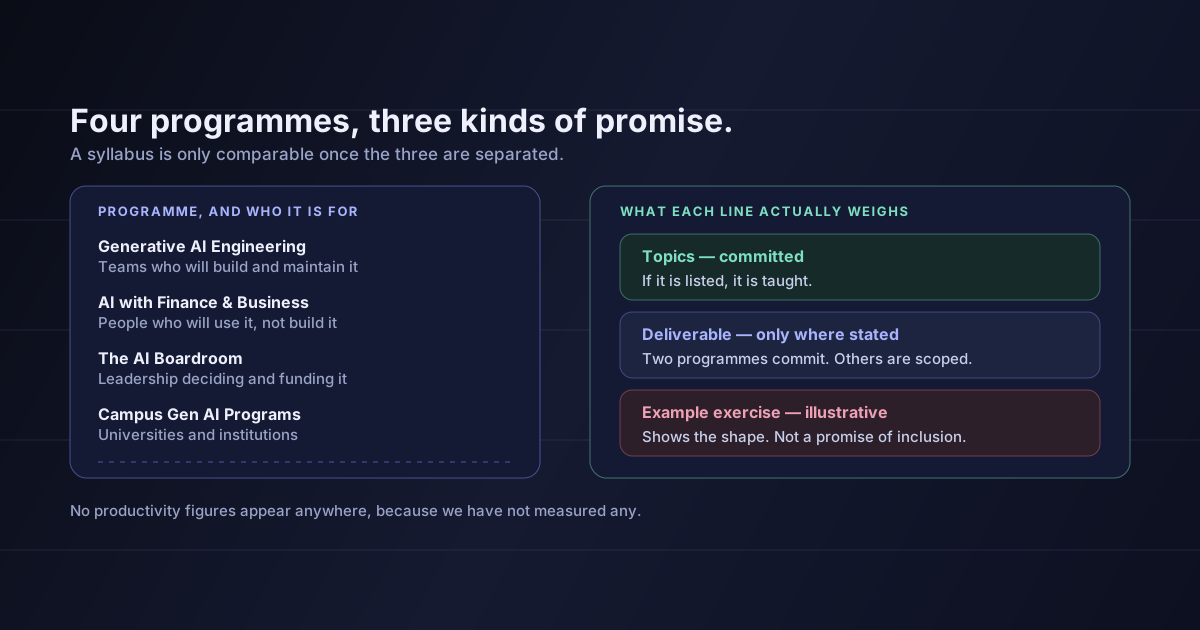
Almost every training page prints its topics, its exercises and its outcomes in the same typeface, at the same weight, as though they were the same kind of claim. They are not, and conflating them is how a buyer ends up surprised in week two.
Topics are commitments. What the programme covers. If it is listed, it is taught.
Example exercises are illustrative. They show the shape of a session. The actual exercises are agreed during scoping and are not guarantees of inclusion.
Deliverables are stated only where committed. Two of our programmes commit to a specific artefact. Where no such commitment exists, we say the output is a scoping outcome rather than inventing one.
That rule is why you will not find a productivity percentage anywhere below. We have no before-and-after data on these programmes, so there is no figure to quote, and quoting somebody else's would be borrowing evidence rather than having it.
For technical teams
Participants. Engineers, product and platform people who will build and maintain AI features — the team that will still own the system after the training ends.
Prerequisites. Working software development experience. Participants should be comfortable reading and writing code in a language their team already uses; no prior machine-learning background is assumed. Exercises can run against representative material — production access is not required to attend.
Objectives. By the end, a participant can:
The explanation is the skill. Choosing an architecture is easy; defending it against the two alternatives you rejected is what survives a design review.
These fail identically from the outside and are fixed completely differently, and teams routinely spend weeks tuning prompts to fix an indexing bug.
The single highest-leverage thing on this list, and the one most often skipped because it produces nothing demoable.
Deciding not to build is an outcome we grade, not a failure state.
Topics covered.
Example exercise — illustrative, not a commitment
Take a documentation corpus agreed during scoping, build a retrieval pipeline over it, then deliberately break it — ask questions the corpus cannot answer, and questions where the right passage ranks third — and write the evaluation set that catches both before a user does.
What a participant leaves with. A capstone built during the programme and reviewed against your own roadmap. This one is a commitment.
For business, finance and operations teams
Participants. People who will use AI in their own work rather than build it — analysts, reporting and planning roles, and the managers who review their output.
Prerequisites. No programming background assumed. Participants should be fluent in their own analysis or reporting work; the programme applies AI to that work rather than teaching the work itself.
Objectives. By the end, a participant can:
Checkable is the operative word. An output nobody can verify is not a time saving, it is a deferred risk.
Taught as a routine with a right answer, not as an awareness topic.
Omission is the harder half. An invented fact is often visible; a quietly dropped exception is not.
Including what to do when the source does not say what the summary claims it says.
The distinction most non-technical users have never had named for them, and the one that governs whether a tool is safe for their workflow.
Topics covered.
Example exercise — illustrative, not a commitment
Take a recurring report your team already produces. Draft it from a structured prompt, then run the review gate over the output: check every figure against its source, mark what the draft omitted, and flag anything it asserted that the source does not support.
What a participant leaves with. This is a scoping outcome, not a fixed artefact, because what is useful differs sharply between a finance function and an operations team. A workflow portfolio — the brief, the prompts, the review steps and the verification trail — is the usual shape, and it has the property we care about: someone who was not in the room can inspect it.
This curriculum is delivered today for undergraduate business cohorts at Chitkara Business School, which is where most of its exercises were pressure-tested. That is a record of delivery elsewhere, not a corporate engagement, and it is labelled that way deliberately.
For leadership teams
Participants. Leadership and executive teams deciding where AI belongs in the P&L — sponsors who fund AI work and are asked to judge it, rather than people who will implement it.
Prerequisites. None technical. Participants need familiarity with their own cost base and business functions; there is no implementation work in this programme.
Objectives. By the end, a participant can:
Against your functions, using your cost base — not a generic industry map.
Wait is a real branch with real conditions attached, not a euphemism for indecision.
Including the costs that do not appear until the second quarter of use.
Proportionate in both directions — over-governing a pilot is as expensive as under-governing a production system.
Topics covered.
Example exercise — illustrative, not a commitment
Take one AI proposal the leadership team is currently being asked to approve, and run it through the framework in the room: where it sits on the opportunity map, what the total cost looks like over a year rather than at purchase, and what would have to be true for the answer to be wait.
What a participant leaves with. A one-page AI roadmap for your company, produced as the programme capstone. This one is a commitment.
For universities and institutions
Gen AI and AI with Finance tracks delivered on campus or online, for technical and non-technical undergraduate cohorts, project-based and assessed on what students produce. This is the same material as the corporate tracks, sequenced for a semester rather than a compressed cohort.
Group sizes. Typically 10–30 people for an executive programme and up to around 40 for a build-focused cohort. Larger groups are split into smaller cohorts, because practical feedback on a participant's own work is the part that does the teaching, and it does not survive a room of eighty.
Delivery mode. On-site, online or hybrid. Our TCS engagement ran as a 30-day in-person intensive in Chennai; other programmes run entirely online. Mode is a scoping decision, not a fixed constraint.
Which track. Tell us who is in the room. Engineering assumes people who write or maintain software; Finance & Business assumes none; the Boardroom is decision work with no implementation in it. Most confusion is about the second and third, and it resolves in one question: will these people be doing the work, or funding it?
Specific stacks. Usually yes. Most requests are some version of agents, RAG, evaluation or AI-assisted development on a named stack. We teach the stacks we work with commercially, and if a request falls outside those we say so during scoping rather than take the engagement.
Corporate programmes are scoped rather than sold per seat, which is a real answer to "what does it cost" and not an evasion: team size, delivery mode, duration and how much of the material points at your systems are the four variables, and a number before those are settled would be a guess.
Audience, approximate team size and what should be different afterwards. Two minutes on the form.
A written outline of what the programme would cover for your teams, in a form you can forward internally without rewriting it first.
Delivery mode, duration, which systems the exercises point at, and how much is tailored. This is what a cost depends on, so it comes before a number.
A proposal reflecting what was scoped, with delivery dates.
The one thing worth bringing to step one:
Not a skills survey. Bring something your team has produced — a feature that shipped, a report that goes out monthly, a proposal you are being asked to approve. Every exercise worth running is built on one of those, and a programme scoped from real work is a different object from a programme scoped from a self-rating. That is not a sales point; it is the single finding from the research we keep citing.
No productivity figures. We have not run before-and-after measurement on these programmes, so we publish no percentage improvement. Anyone quoting one — us included — should be asked where it was measured and on whom.
No certificate. The Academy does not issue one. If your L&D process requires an accredited credential, we are not it, and you should know that before the scoping call rather than after.
Durations are not fixed. Neither are tools, assessments or support terms. They are scoping outcomes. A page that quotes a fixed number of days for a programme it has not scoped is quoting a default, not a plan.
The example exercises are illustrative. Stated three times above, and worth a fourth: they show the shape of a session and are not a promise of inclusion.
Our own outcome data is thin. We have delivered to TCS, through LearnQuest as a delivery partner, and to Chitkara Business School, and around 300 professionals have been through the training. That is a record of delivery. It is not evidence of measured outcomes, and the two are not the same claim.
We are not a psychometric assessment. If you want a benchmarked capability score across a fixed set of competencies before and after, that is a different product and a different vendor, and we will say so.
IdeaToMVP Academy
4-week live cohort for founders. Learn to ship AI agents, scope MVPs, and automate your business — taught by the same team that writes these guides.
A training specification is a strange thing to publish, because every line of it is a line someone can hold against you later. That is the point. The market is full of syllabi that cannot be compared with each other, because none of them distinguish between what will definitely be taught, what might be practised and what a participant will definitely walk away holding.
Those three things have very different value to a buyer, and printing them at the same weight is not an accident of layout. It is what lets a programme sound complete while committing to almost nothing.
If you are comparing AI training providers this quarter, ask each one which lines on their page are commitments and which are examples. The answer, and how quickly it comes, tells you most of what you need to know.
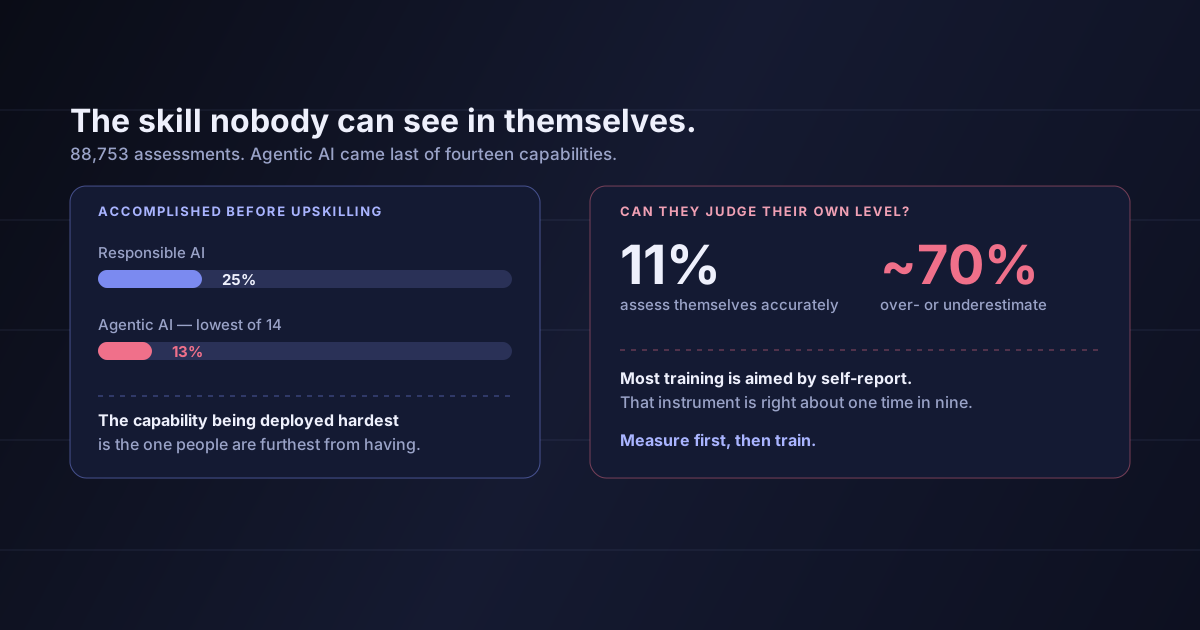
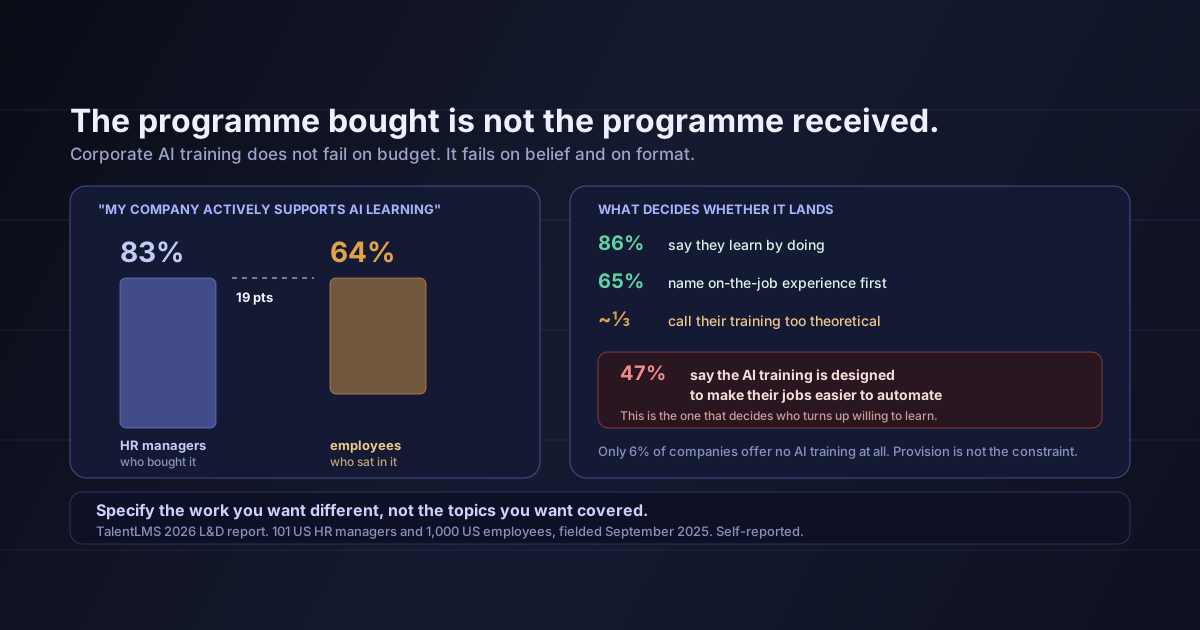
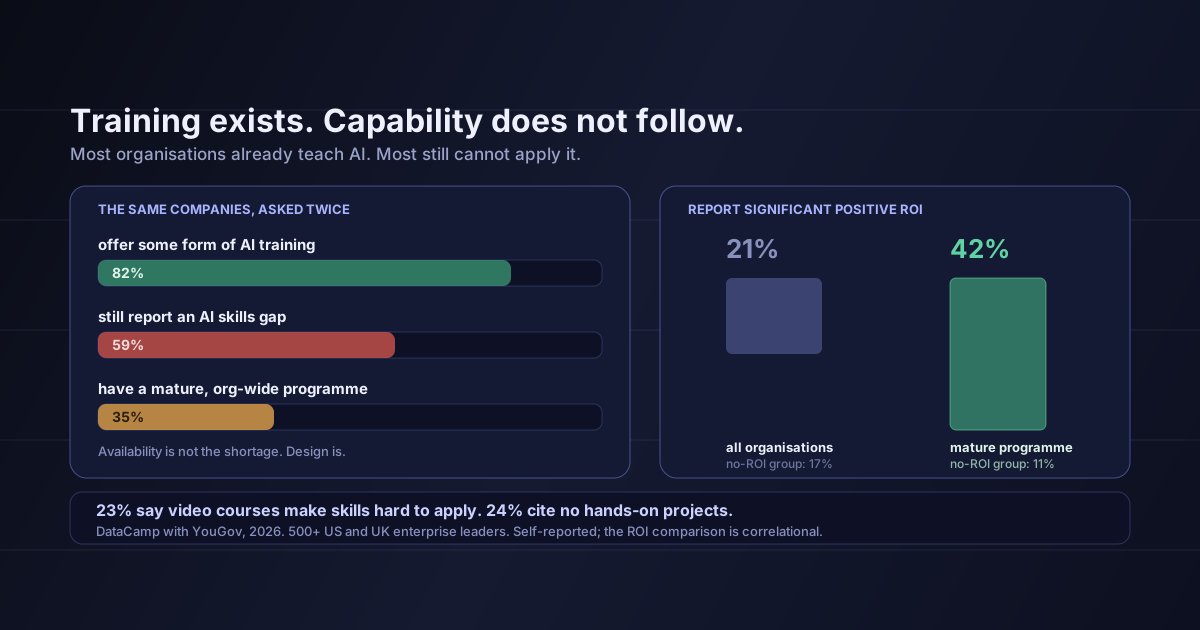
Programme details, prerequisites, objectives, topics, group sizes, delivery modes and the scoping process are ours and are current as at publication; the canonical version is the corporate training page, and the business and finance curriculum profile is published in full at the Chitkara curriculum profile. Delivery references — TCS as a 30-day in-person intensive in Chennai, LearnQuest as a delivery partner, and Chitkara Business School BBA cohorts — are records of work delivered, not measured outcomes. For the research this programme design is a response to, see 82% of companies run AI training and 59% still report a skills gap, 47% of employees say the AI training is there to automate their job and only 11% can judge their own AI skill level accurately.
IdeaToMVP Academy
4-week live cohort for founders. Learn to ship AI agents, scope MVPs, and automate your business — taught by the same team that writes these guides.