
Leading an AI-Native Engineering Team: What the Job Became When Output Stopped Being Scarce (2026)

By Surya Pratap
August 2, 2026
12 min read
Startup Strategy

August 2, 2026
12 min read
Most writing about AI and engineering teams is about headcount—who to hire, who to cut. Far less is written about the part that actually consumes a founder's week: leading the people who are still there. That job changed more quietly and more completely than the hiring math did, and the change has a single root cause. For the entire history of software, the scarce resource was output. Leadership was largely the practice of getting more of it: unblocking, prioritising, protecting focus, hiring. Output is not scarce anymore.
What is scarce now is comprehension, judgment, and the willingness of good engineers to keep doing this work. Those three are what an AI-native engineering leader actually manages, and none of them show up on the dashboards most teams still run. Here is what breaks, what the teams doing this well have figured out, and where founders are quietly getting it wrong.
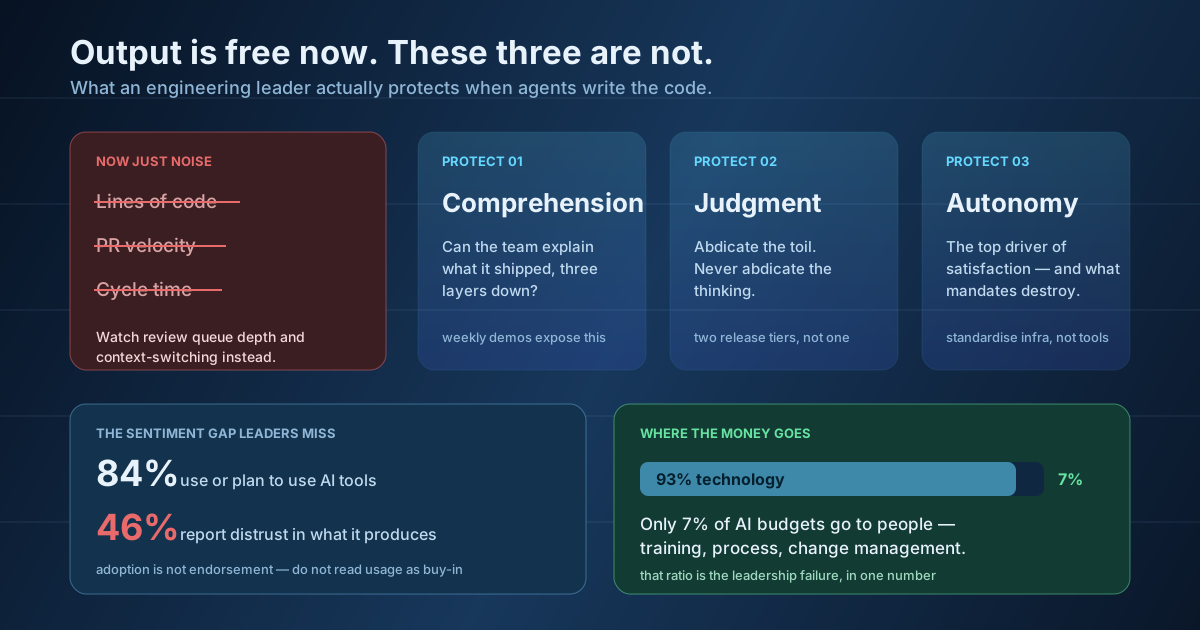
Start with the instrumentation, because leading from broken numbers is worse than leading from none. When agents generate the majority of committed code, lines of code, pull-request velocity, and cycle time stop measuring what you think they measure. They become measures of how much your tooling generated, which is a budget decision, not a performance signal. Any team can double them this afternoon.
The metrics that survived are the ones tracking flow through the constraint rather than volume into it. Review queue depth and context-switching frequency are the useful leading indicators—they predict bottlenecks before delivery numbers show them, because they measure the part of the pipeline that did not get faster. Alongside those, the practices worth adopting are decision velocity, policy adherence, and cohort analysis to catch metric gaming, since a scorecard that rewards volume in an era of free volume will be gamed within a sprint, usually without anyone intending to.
One honest caveat: measured productivity gains from AI vary enormously between teams, and the variance tracks how much a team invested in evaluation, governance, and integration plumbing rather than which model they picked. The capability frontier is rarely the bottleneck. Everything between a frontier model and a measurable outcome is.
The most useful concept I have seen named this year is comprehension debt: engineers shipping quickly without understanding the systems they are shipping into two or three layers deep, and gradually losing the diagnostic and reasoning capability that made them valuable. It is the sibling of technical debt and considerably harder to see, because the code looks fine. The deficit only surfaces during an incident, when nobody on the call can reason about why the system is behaving the way it is.
The diagnostic for it is refreshingly low-tech: weekly demos. Not status updates—demos, where an engineer walks through what they built and answers questions about why. Whether a team can explain its own work is a far better signal than whether it is producing more of it, and unlike every dashboard metric, it cannot be gamed by an agent. The governing principle, from the teams doing this deliberately: you should abdicate the toil, not the thinking.
The quality question, answered
This is not an argument that AI-assisted code is worse. Shopify reports reversion rates for AI-assisted code roughly equivalent to their pre-AI baseline—quality parity is achievable. The risk is not that the code is bad. It is that the humans stop understanding it, which costs you nothing this quarter and everything during your first serious outage.
The most common leadership mistake right now is mandating a tool. A founder reads that one assistant is ahead, declares the team will use it, and treats adoption as a compliance metric. This is the wrong layer to standardise, and it costs you goodwill for no durable benefit—the leaderboard will change before the rollout finishes.
Shopify's approach is the better pattern: rather than mandate one assistant, they built an internal LLM proxy—a central gateway routing requests from Claude Code, Copilot, Cursor, or anything else through one platform. That gives leadership what it actually needs, which is cost control, usage analytics by team and project, and the ability to switch models without touching anyone's workflow. Engineers keep their tools. The company keeps its optionality. The reasoning is disarmingly honest: nobody yet knows which company, workflow, or model is going to win.
This generalises. Standardise the things that are expensive to change and invisible to the individual engineer—the gateway, the evaluation harness, the review requirements, the deployment path. Leave the things that are cheap to change and deeply personal—editor, assistant, prompt style—alone.
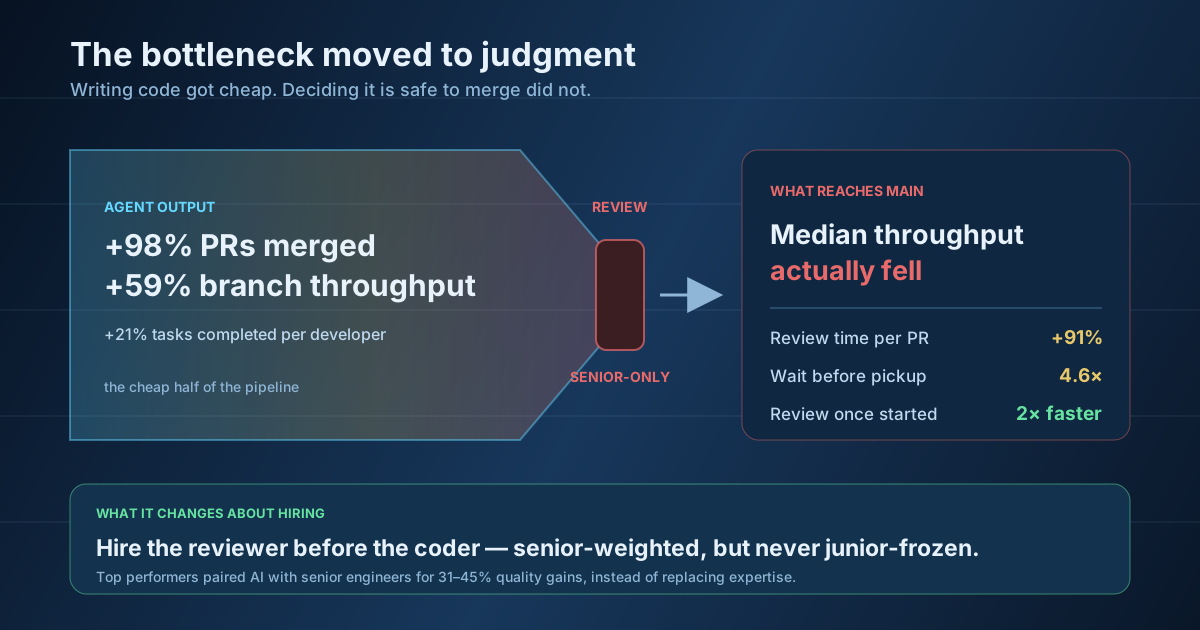
When output multiplies, the release process becomes the place where leadership actually happens, and a single production gate turns into a queue with a manager at the front of it making rushed judgement calls. Ramp's answer is a two-tier system: teams deploy to early access whenever they are ready, reaching roughly 10% of customers, and reaching general availability requires evidence against a templated checklist—feature rationale, demo video, KPI overview, customer feedback, user journey analysis, team readiness, rollout strategy—with leadership turning reviews around inside 48 hours.
The insight underneath it is worth internalising: speed and quality stop being a tradeoff the moment you have two release tiers. Engineers get to ship continuously, which is what makes the work feel good. The business gets a real bar before something reaches everyone. And crucially, the leader stops being the bottleneck on every individual judgement call, because the checklist externalises what “ready” means instead of keeping it in one person's head.
Here is the part that gets underweighted, and it is a leadership problem rather than a technical one. Roughly 84% of developers use or plan to use AI tools—but sentiment has declined, and about 46% report distrust in what those tools produce. The top frustration is not that AI is useless; it is the specific misery of “almost right” output and the toil of debugging code nobody wrote.
Adoption is not endorsement. If you are reading high tool usage as evidence your team is happy with the transition, you are reading a number that does not say that. And on the forums where engineers speak more freely, the complaints are consistent and specific: forced productivity increases, forced metrics, pressure to review machine-generated code all day, and a felt decline in their own skill development. Some are blunt that they would take less money rather than spend fifty hours a week orchestrating agents instead of doing the craft they signed up for.
Set that against what actually drives developer satisfaction, which survey data consistently puts as autonomy and trust, ahead of compensation. Then notice that the standard playbook—mandate the tool, measure the adoption, raise the output target—attacks autonomy and trust directly. That is how a leader ends up with a team that uses AI heavily, hits its numbers, and quietly starts interviewing.
The most effective adoption story I came across involves no mandate at all. Shopify VP Farhan Thawar drove adoption by demonstrating his own use and framing it as leverage rather than brilliance—“I didn't say look at how much work I did and how smart I am. I said, ‘Look how lazy I am.’” That framing spread beyond engineering, because it gave people permission rather than an obligation.
It also solves a status problem leaders often miss. When AI use is mandated and measured, using it becomes an admission that you needed help. When a senior leader publicly uses it to avoid drudgery, it becomes what it should be: a tool that good engineers use because they have better things to do. Those two framings produce very different cultures out of identical tooling.
A useful corrective on all of this: the right technical leadership changes with team size. From seed to about ten engineers you want hands-on builders optimising for velocity, not architects planning for scale you do not have. Between ten and twenty is the genuine inflection point, where one-way architectural decisions—data stores, DevOps model, testing infrastructure—harden into cultural foundations that are very difficult to reverse. Between twenty and fifty, the leadership question becomes diagnostic: are your problems people problems or architecture problems, and does your structure match the answer?
Most founders reading this are in the first bracket, where the honest advice is that you do not need most of the apparatus above yet. You need weekly demos, a gateway rather than a tool mandate, and the discipline to keep understanding your own system.
That last budget figure is the whole argument compressed into one ratio. Teams are spending almost everything on capability and almost nothing on the humans who have to absorb it, then wondering why adoption is uneven and sentiment is sliding. The constraint was never the model.
The leaders who come out of this era well will not be the ones who adopted fastest. They will be the ones whose engineers still understand the system, still exercise judgment about what should be built, and still want to be there in two years. Output was never the hard part of the job. It just used to look like it was.
IdeaToMVP Academy
4-week live cohort for founders. Learn to ship AI agents, scope MVPs, and automate your business — taught by the same team that writes these guides.