On 1 December, Your gemini-2.5-pro Calls Start Running on Gemini 3.8 Flash. Change the Model String Yourself, Before Google Does It for You

By Surya Pratap
November 19, 2026
8 min read
AI & Technology

November 19, 2026
8 min read
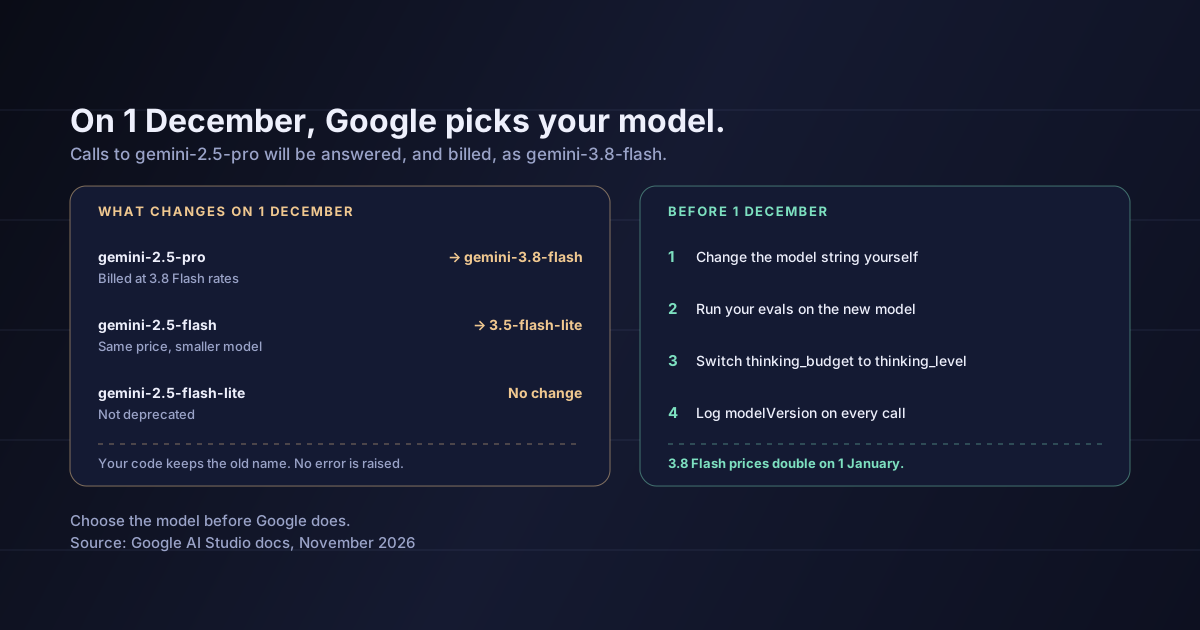 See what gets routed, and what to do firstHover to explore
Most model deprecations end with an error. Your requests fail, your alerts fire, and you migrate. Google has chosen a different ending for two of its most widely used models. From 1 December, requests to gemini-2.5-pro and gemini-2.5-flash will not fail. They will be answered by a different model, and billed at that model's price, while your code still asks for the old one. Nothing will page you. That is exactly why it needs your attention this week.
On 2 November Google marked both models as deprecated and set the same date for each:
gemini-2.5-pro: "Effective December 1, 2026, all API requests to gemini-2.5-pro will automatically route to gemini-3.8-flash and be billed at Gemini 3.8 Flash rates." It is already gone from Google AI Studio's model picker.gemini-2.5-flash: from the same date, requests "will automatically route to gemini-3.5-flash-lite and be billed at Gemini 3.5 Flash-Lite rates."gemini-2.5-flash-lite: not deprecated. Google says it "remains available through the API until further notice."thought_signature validation, thinking_level replacing thinking_budget, and removed sampling parameters and prefilled model turns."Google's advice is direct: update your model string before 1 December and read the migration guide for the new model.
A shutdown that returns errors is loud. You find out in minutes. A shutdown that routes is quiet. Your logs show successful responses, your dashboards stay green, and the only signals are the ones you were not watching: answers that read differently, a support ticket about a feature that "got worse", a cost line that moved.
Note what each route does. gemini-2.5-pro is a Pro model; its replacement is a Flash model. gemini-2.5-flash goes to a Flash-Lite model. Google may well be right that the newer, smaller models are good enough for most traffic. But "most traffic" is Google's average, not your product. If you chose 2.5 Pro because a cheaper model failed your tests, 1 December reverses that choice without asking you.
A deprecation that errors tells you it happened. A deprecation that routes only tells you if you are looking.
A different model. The routed requests are answered by gemini-3.8-flash or gemini-3.5-flash-lite. Both read up to 1,048,576 tokens and write up to 65,536, so context limits will not be the problem. Quality on your tasks is the open question.
Different defaults. Google's thinking table lists gemini-3.5-flash-lite as defaulting to minimal thinking, and gemini-3.8-flash to medium. On 3.8 Flash, Google notes that "minimal is not supported and returns an error." If you never set thinking explicitly, the amount of reasoning behind your answers will change on its own.
A different API contract. The breaking changes are not cosmetic. thinking_level replaces thinking_budget. Function calling now validates thought_signature. Sampling parameters are removed, and so are prefilled model turns. Google does not say what a routed request that still sends the old parameters will get: an error, or a silently ignored setting. Either is worth finding out before your users do.
A different bill. Requests are billed at the new model's rates. The arithmetic is in the next section, and it has a second date in it.
Per million tokens, from Google's pricing page:
| gemini-2.5-pro today | gemini-3.8-flash to 31 December | gemini-3.8-flash from 1 January 2027 | |
|---|---|---|---|
| Input, prompts up to 200K tokens | $1.25 | $0.75 | $1.50 |
| Input, prompts over 200K tokens | $2.50 | $0.75 | $1.50 |
| Output, prompts up to 200K tokens | $10.00 | $3.75 | $7.50 |
| Output, prompts over 200K tokens | $15.00 | $3.75 | $7.50 |
3.8 Flash is on an introductory price until 31 December. Take an agent step with 50,000 input tokens and 5,000 output tokens. On 2.5 Pro it costs about $0.11. Routed in December, about $0.06. From January, about $0.11 again. An input-heavy step, with 150,000 input tokens and 2,000 output tokens, costs about $0.21 today, $0.12 in December and $0.24 in January: more than you pay now.
For gemini-2.5-flash the price does not move. 2.5 Flash and 3.5 Flash-Lite are both listed at $0.30 per million input tokens and $2.50 per million output tokens. You pay the same for a smaller model.
# gemini_call.py — choose the model explicitly and log what served it
import logging
from google import genai
from google.genai import types

log = logging.getLogger("llm")
client = genai.Client()

MODEL = "gemini-3.8-flash"   # was "gemini-2.5-pro": change it before 1 December

def ask(prompt: str) -> str:
    resp = client.models.generate_content(
        model=MODEL,
        contents=prompt,
        config=types.GenerateContentConfig(
            # thinking_level replaces thinking_budget on Gemini 3 models
            thinking_config=types.ThinkingConfig(thinking_level="medium"),
        ),
    )
    # modelVersion: "the model version used to generate the response"
    log.info("requested=%s served=%s", MODEL, resp.model_version)
    return resp.text
Change the string yourself. Search your code, configuration, prompts repository and any no-code tools for gemini-2.5-pro and gemini-2.5-flash. Migrating on your own date lets you test, roll out gradually and roll back. Being routed on Google's date gives you none of that.
Test the replacement, and its alternatives. Run your evaluation set against gemini-3.8-flash or gemini-3.5-flash-lite at each thinking level. If a Pro-class task fails on Flash, test a larger model rather than accepting the route. Google's own successor is not the only option.
Fix the breaking changes first. Replace thinking_budget with thinking_level. Remove sampling parameters and prefilled model turns. Check your function-calling code against the new thought_signature validation. Run your tool-calling tests end to end, not just single prompts.
Log modelVersion on every call. The API reference describes the response field modelVersion as "the model version used to generate the response". Log it next to the model you requested. If the two ever differ, you will see it on the day it happens, not in next month's invoice.
The same day, another price changes
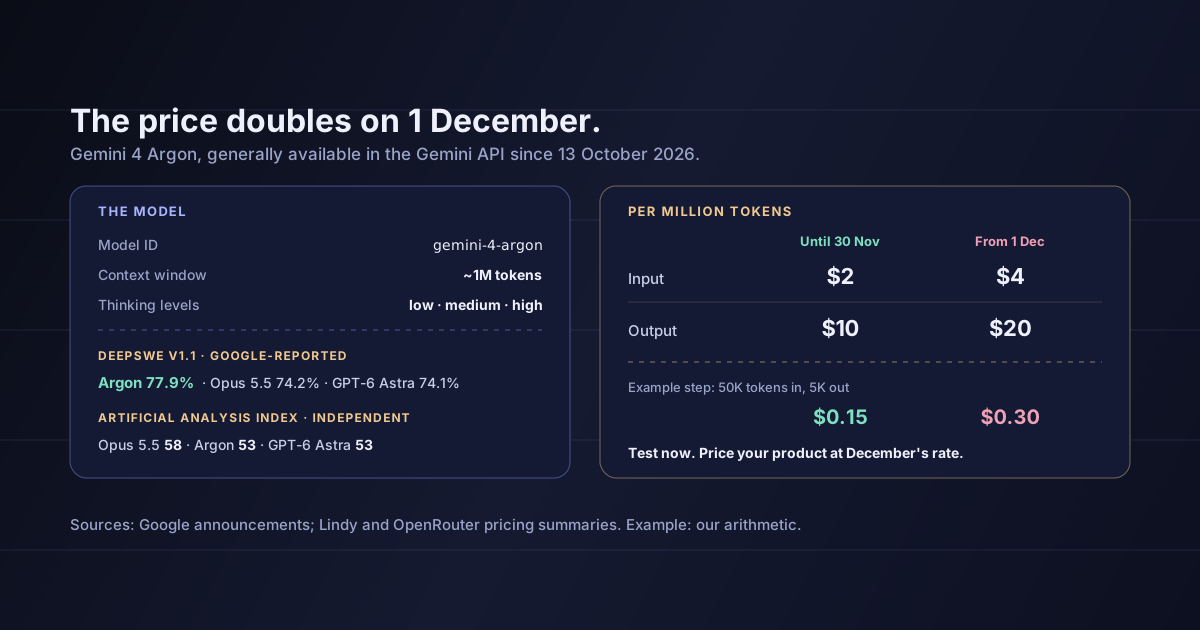
1 December is also when Gemini 4 Carbon's introductory price ends. Google's pricing page lists it at $2 per million input tokens and $10 per million output tokens through 30 November, then $4 and $20. If you moved anything to Carbon or Argon during the launch window, recheck those margins too. We worked through the same arithmetic for Gemini 4 Argon.
That 3.8 Flash is worse than 2.5 Pro for you. It is newer, and on many tasks it may be better. I have not seen Google publish a direct comparison of the two on the same tasks. Your evaluation set decides.
What happens on Vertex AI. The changelog, deprecations page and pricing page I read cover the Gemini API in Google AI Studio. They do not mention Vertex AI. If you call Gemini through Vertex, check its own deprecation schedule.
How routed requests treat old parameters. Google lists the breaking changes but does not say whether a routed request that sends thinking_budget fails or is quietly adjusted. Test it rather than assume.
That the dates are final. Google's deprecations page says shutdown dates are "the earliest possible dates on which a model might be retired." They can move later. Planning for 1 December is still the safe choice.
From 1 December 2026, Gemini API requests to gemini-2.5-pro will be answered by gemini-3.8-flash and billed at its rates, and requests to gemini-2.5-flash will be answered by gemini-3.5-flash-lite at an unchanged price. gemini-2.5-flash-lite is not affected. Google lists breaking API changes for the move, including thinking_level replacing thinking_budget, new function-calling validation, and removed sampling parameters and prefilled turns. 3.8 Flash costs less than 2.5 Pro until 31 December; from 1 January its price doubles, and input-heavy work ends up costing more than it does today.
The risk is not the new model. It is that the change happens without an error, a decision or a test.
Before 1 December, replace every gemini-2.5-pro and gemini-2.5-flash string with a model you have tested, fix the breaking changes, and start logging modelVersion so you know which model answered every request.
Sources: Google AI Studio, Gemini API changelog, entry of 2 November 2026 — the deprecation of gemini-2.5-pro and gemini-2.5-flash, the automatic routing and billing from 1 December 2026, and the list of breaking API changes. Deprecations — release and shutdown dates, the status of gemini-2.5-flash-lite, and the note that shutdown dates are the earliest possible. Pricing — the prices of gemini-2.5-pro, gemini-2.5-flash, gemini-3.8-flash, gemini-3.5-flash-lite and Gemini 4 Carbon. Gemini 3.8 Flash and Gemini 3.5 Flash-Lite — token limits and thinking levels. generateContent API reference — the modelVersion response field. All checked on 19 November 2026. The cost examples and the reading in sections 2 to 6 are mine.
IdeaToMVP Academy
4-week live cohort for founders. Learn to ship AI agents, scope MVPs, and automate your business — taught by the same team that writes these guides.