Gemini 4 Argon Is Half Price Until 30 November. Test It Now, but Price Your Product at December's Rate

By Surya Pratap
October 23, 2026
8 min read
AI & Technology

October 23, 2026
8 min read
 The price doubles on 1 DecemberHover to explore
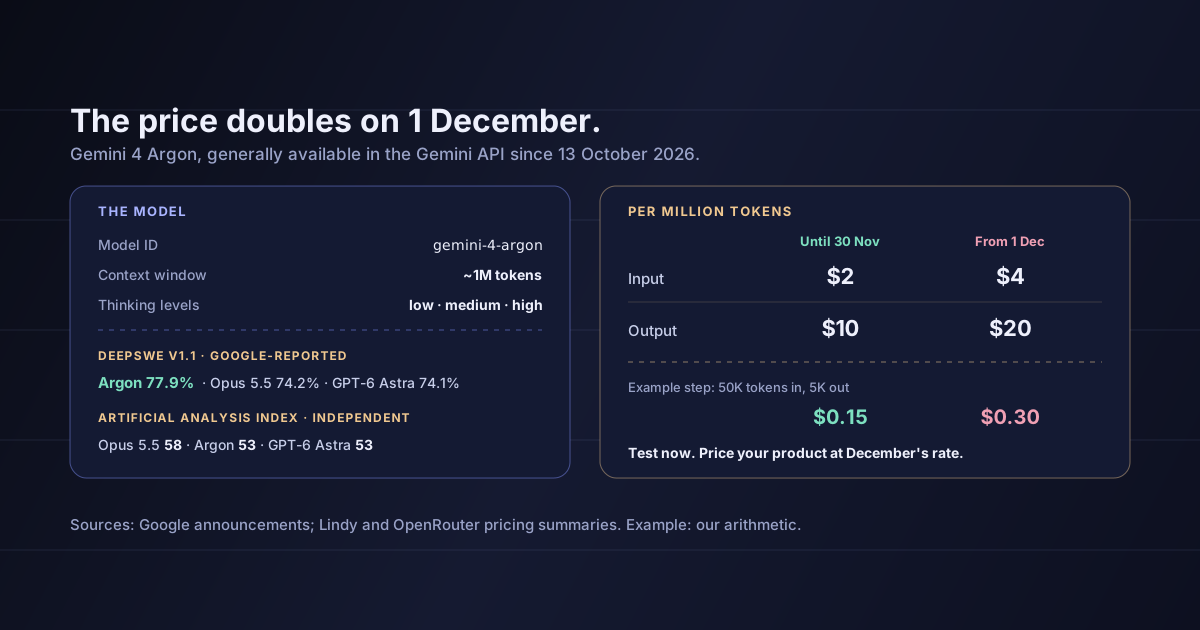
New frontier models arrive with two numbers founders pay attention to: a benchmark score and a price. Gemini 4 Argon comes with a third that matters more: a date. Its launch price lasts until 30 November, and on 1 December every token rate doubles. That changes how you should approach it.
This article is based on Google's announcements "Gemini 4 Argon: our next era of frontier intelligence" and "Gemini 4 Argon is now available for developers", the Gemini API release notes as tracked by Releasebot, and summaries of pricing and specifications by Lindy and OpenRouter. Most benchmark figures are Google's own. The reading from section 4 onward is mine.
Google announced Gemini 4 Argon on 30 September 2026, describing it as "our frontier model for real-world coding, enterprise knowledge work, and cyber defense." It became generally available on 13 October in the Gemini API, Google AI Studio, Android Studio and, for Ultra subscribers, Google's Antigravity coding environment, with model ID gemini-4-argon.
The specifications, as summarised from Google's documentation:
In the Gemini app it is available to paying Google AI Pro and Ultra subscribers; free accounts are excluded. It also rolled out first to cyber defenders through Google's Fairwind programme.
Google's own figures:
| Benchmark | What it tests | Gemini 4 Argon |
|---|---|---|
| DeepSWE v1.1 | Software engineering | 77.9% |
| Vals Index | Knowledge work | 68.9% |
| AutomationBench | Automation tasks | 51.3% |
| LVBench | Long video understanding | 91.7% |
| GraphWalks 256K–1M | Long-context reasoning | 84.2% |
On DeepSWE, coverage of Google's comparison lists Claude Opus 5.5 at 74.2% and GPT-6 Astra at 74.1%.
Independent testing gives a less one-sided picture. On Artificial Analysis's index, as reported by Lindy, Argon scores 53, tied with GPT-6 Astra, while Claude Opus 5.5 leads at 58.
Google also describes internal results: Argon agents helping migrate more than 800,000 lines of the Fuchsia Zircon kernel from C and C++ to Rust, and identifying memory optimisations that freed more than 300 TiB across Google's data centres. These are Google's accounts of its own work.
| Until 30 November 2026 | From 1 December 2026 | |
|---|---|---|
| Input | $2 per million tokens | $4 per million tokens |
| Output | $10 per million tokens | $20 per million tokens |
| Cached input | $0.10 per million tokens | — |
Take a typical agent step with 50,000 input tokens and 5,000 output tokens. At the launch price it costs about $0.15. From December, about $0.30. A feature that runs that step 20 times per user per day goes from about $3 to about $6 per user per day.
Launch pricing is a good time to test a model and a bad basis for a business plan.
Evaluate now, on your tasks. Run your own evaluation set against Argon and your current model while tokens are cheap. Compare quality, latency and cost per successful task, not benchmark tables. Try the three thinking levels; "high" may not be worth its tokens for your work.
Price at December's rate. If you adopt Argon, model your margins at $4 and $20. A plan that only works at $2 and $10 stops working in six weeks — and any customer pricing you set in November will outlast the discount.
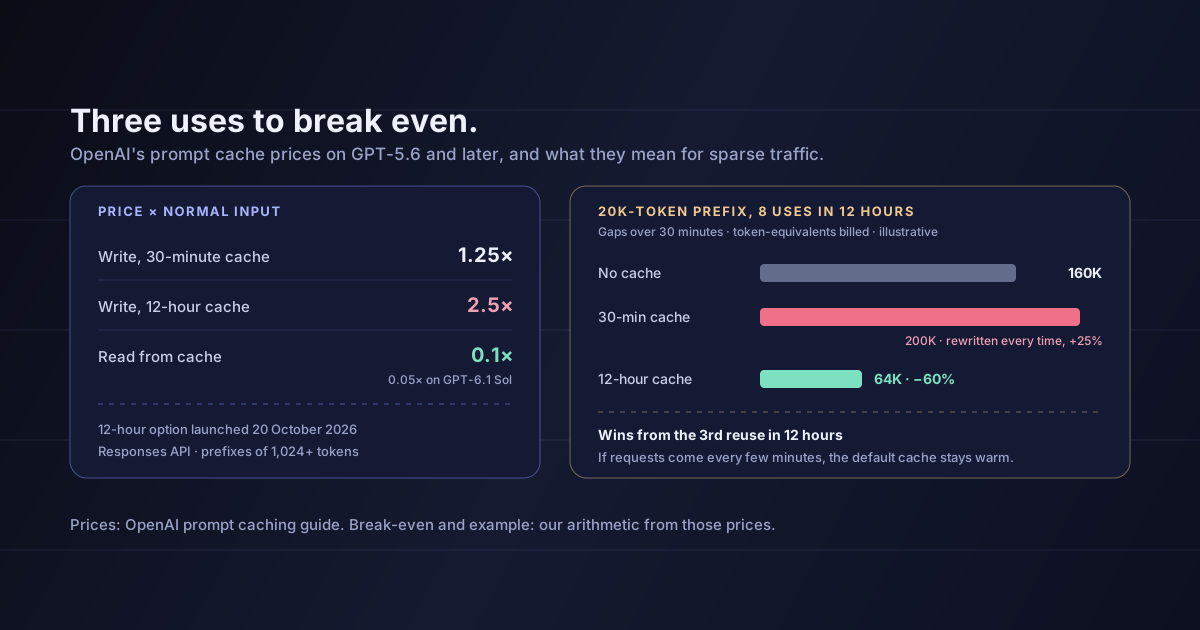
Use caching for long context. Cached input is listed at $0.10 per million tokens. If you send the same long documents or codebase repeatedly, structure prompts so the stable part comes first. We worked through the break-even logic for OpenAI's cache; the same habits apply.
Watch output length. A higher output limit is useful for migrations, long reports and large refactors, but output costs five times input. Set explicit output limits per feature so one long answer cannot surprise your bill.
Keep the switch cheap
Whatever you decide, keep the model choice in configuration, not in code. Prices, rankings and launch discounts move every few weeks. The startups that benefit are the ones that can test a new model in a day and move a feature to it — or away from it — with an evaluation run and a config change.
For short, high-volume tasks, a smaller and cheaper model will usually win on cost. Argon's own family includes Flash models for that.
That Argon is the best model for you. Google's benchmarks favour it; one independent index puts it in the middle of the frontier group. Your tasks decide.
That the prices and limits are final. The figures here come from Google's announcements and third-party summaries of its pricing pages. Check the current Gemini API pricing before committing.
That Google's internal results transfer. Migrating Fuchsia to Rust with Google's engineers and infrastructure tells you the model can do long, structured work. It does not tell you how it will do on your codebase.
That the default output limit is a million tokens. It isn't; the default is 65,536. Longer outputs have to be set explicitly, and every extra token is billed at the output rate.
Gemini 4 Argon is Google's new frontier model for coding, agents and knowledge work, generally available in the Gemini API since 13 October 2026 with a context window of about a million tokens, much longer outputs and three thinking levels. Google's benchmarks put it at or near the top for coding and long-context tasks; Artificial Analysis's independent index puts it level with GPT-6 Astra and behind Claude Opus 5.5. It costs $2 and $10 per million input and output tokens until 30 November, and $4 and $20 from 1 December.
The useful move is not to switch or to ignore it. It is to use six weeks of half-price tokens to find out, on your own tasks, whether it earns its December price.
Before 30 November, run your evaluation set on Gemini 4 Argon at each thinking level, compare cost per successful task with your current model at December's prices, and only then decide which features — if any — should move.
Sources: Google, "Gemini 4 Argon: our next era of frontier intelligence" — the description of Argon, the output limit increase from 64K, the DeepSWE, AutomationBench and LVBench figures, the Fuchsia, memory and Fairwind claims, and the introductory and standard prices. Google, "Gemini 4 Argon is now available for developers" — the 13 October availability in the Gemini API, Google AI Studio, Android Studio and Antigravity. Releasebot — the 13 October general availability and model ID. Lindy — the 30 September announcement date, subscriber availability, the context window, default output limit, thinking levels, knowledge cutoff, Vals Index, GraphWalks and other benchmark figures, the cached-input price and the Artificial Analysis index scores. OpenRouter — the pricing schedule, modalities and context length. The DeepSWE comparison with Claude Opus 5.5 and GPT-6 Astra is as reported in coverage of Google's announcement. The cost example and the reading in sections 4 to 6 are mine.
IdeaToMVP Academy
4-week live cohort for founders. Learn to ship AI agents, scope MVPs, and automate your business — taught by the same team that writes these guides.