OpenAI's 12-Hour Prompt Cache Costs 2.5× to Write. On Paper It Pays Off From the Third Request

By Surya Pratap
October 21, 2026
8 min read
AI & Technology

October 21, 2026
8 min read
 Three uses to break evenHover to explore
Prompt caching is one of the few levers that cuts an AI product's bill without touching quality. OpenAI's new option makes the cache last much longer, at a higher price for writing to it. Whether that saves you money depends on one thing most teams have never measured: how long the gaps are between requests that share the same prompt.
This article is based on OpenAI's prompt caching guide and its changelog, and on coverage by Runtime Wire. The prices are OpenAI's published multipliers for GPT-5.6 and later. The break-even figures in sections 3 and 4 are my own arithmetic from those multipliers, on simplified assumptions stated there, and are not OpenAI's.
On 20 October 2026, OpenAI let developers opt into a 12-hour prompt cache in the Responses API, next to the existing 30-minute default. OpenAI pitched it at persistent agents: "Persistent agents, like dots, reuse context throughout the day," its developer account said.
On GPT-5.6 and later models, you set it with prompt_cache_options.ttl to "12h" instead of the default "30m". Both are minimum lifetimes.
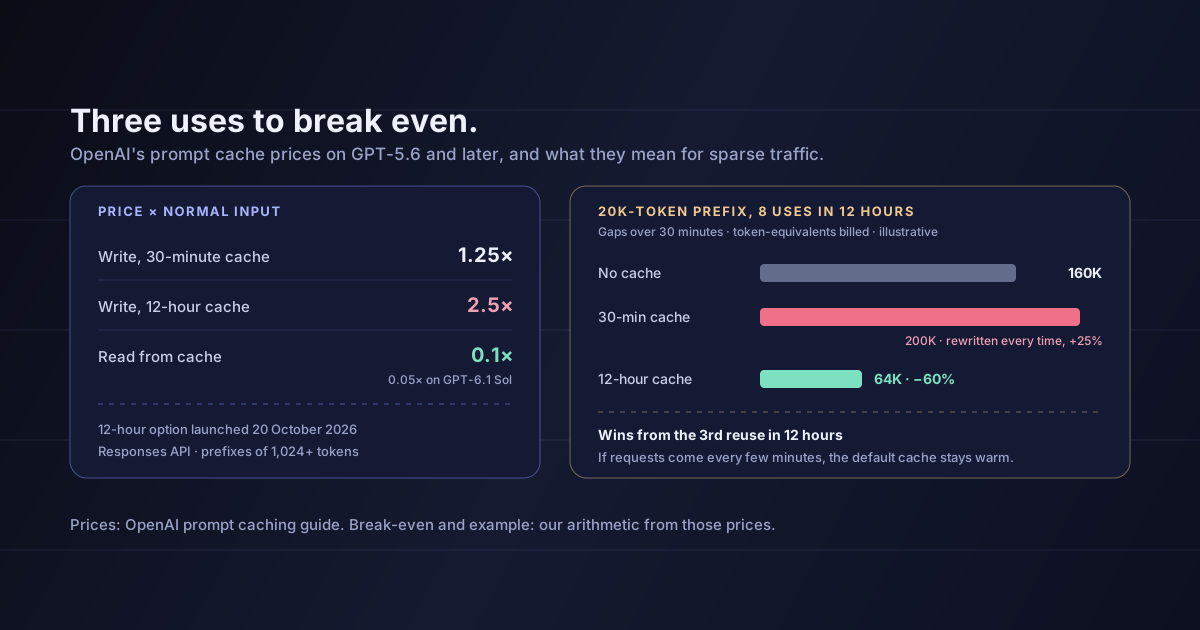
For GPT-5.6 and later, as multiples of the normal (uncached) input-token price:
| Price | |
|---|---|
| Write, 30-minute cache | 1.25× |
| Write, 12-hour cache | 2.5× |
| Read from cache | 0.1× (0.05× on GPT-6.1 Sol) |
Three other rules matter:
prompt_cache_key keeps caches separate per customer or user.On earlier models there is no extra charge for writing to the cache, and the retention options are different.
Take a prefix — system prompt, tool definitions, reference material — of size P, reused N times in 12 hours. Ignore output tokens and the part of each prompt that changes; they cost the same either way.
Solving for when the 12-hour cache is cheaper than no cache gives N > 2.7. Against a 30-minute cache that keeps expiring, it gives N > 2.1. In other words: on these simplified assumptions, from the third use of the same prefix within 12 hours, the 12-hour cache wins — as long as the gaps are long enough that the default cache would have expired.
When requests arrive every few minutes, the default cache never goes cold, and the 12-hour option simply costs 1.25 × P more per window for nothing.
A longer cache only saves money when the gaps between your requests are longer than the default cache lasts.
An illustrative support agent has a 20,000-token prefix: instructions, tool schemas and a product manual. A customer uses it 8 times over a working day, roughly once an hour or two. Billed input for the prefix, in token-equivalents:
That is a 60% cut against no caching on the prefix — and it shows something less obvious: for sparse traffic like this, the default cache can cost 25% more than not caching at all, because you pay the write premium without ever reading.
If each customer has their own reference material in the prefix, each one needs their own write. The saving still applies per customer, but only for customers who come back three or more times in the window.
Likely to benefit. Assistants and agents used a few times a day per customer, with long stable instructions or documents: internal copilots, account assistants, scheduled agents that wake every hour or two, B2B tools used in bursts across a working day.
Unlikely to benefit. High-traffic features where the same prefix is hit every few minutes — the default cache already stays warm. Also one-off requests, short prompts under 1,024 tokens, and prompts whose early part changes on every call.
Fix the prefix first. Put everything stable at the start — instructions, tool definitions, reference material — and everything that changes at the end. A timestamp in the first line of the system prompt silently defeats any cache length.
Measure before switching. Log, per prefix, how many times it is reused and the gaps between uses, and read the cached-token counts the API returns. Turn on 12 hours for the prefixes that actually match the pattern, not for everything.
Check what your default cache is costing you
If you moved to GPT-5.6 or later and your traffic per prefix is sparse, look at your bill now. The 1.25× write on the default cache is easy to miss, and for requests more than 30 minutes apart it is pure overhead. That is a cost you may already be paying, before you decide anything about 12 hours.
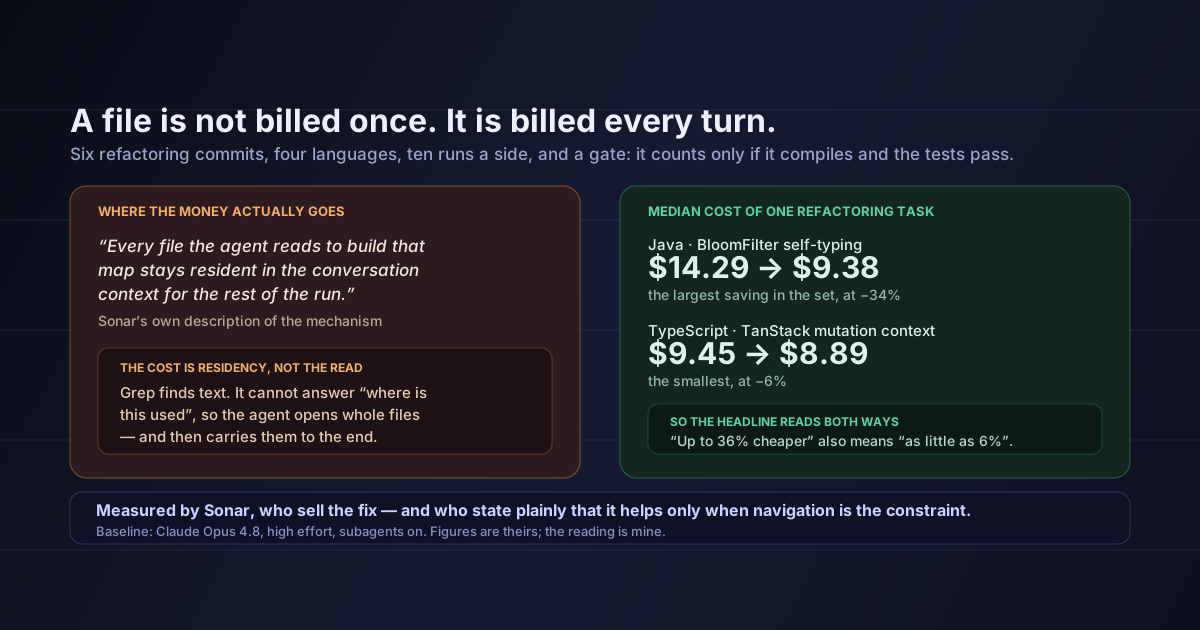
Long, repeated context is the biggest hidden cost in agent products, as we saw when one refactor cost $14.29 in tokens. Caching is the cheapest fix — but only when it matches how your users actually behave.
That the 12-hour cache always lasts 12 hours, or that cached reads are guaranteed. OpenAI describes both lifetimes as minimums, and a cache can still miss. Real savings will be somewhat lower than the arithmetic.
That the break-even figures are OpenAI's. They are my calculation from published multipliers, assuming identical prefixes and ignoring partial matches.
That these prices apply to every model. They are for GPT-5.6 and later; earlier models have no write surcharge and different retention options, and GPT-6.1 Sol reads at 0.05×.
That caching is right for sensitive data without checking. OpenAI notes that cached data may be held in GPU-local storage. If you have data-retention commitments, check how caching fits them before extending it.
OpenAI now offers a 12-hour prompt cache in the Responses API. On GPT-5.6 and later, writing to it costs 2.5× the input price, against 1.25× for the 30-minute default, and reads cost 0.1×. On simplified arithmetic, the 12-hour cache beats both no caching and an expiring 30-minute cache from the third reuse of the same prefix within 12 hours — but only when requests are more than 30 minutes apart. For high-frequency traffic it adds cost, and for sparse traffic the default cache may already be costing more than no cache.
The decision is not about the feature. It is about your traffic pattern.
This week, log how often each long prefix is reused and the gaps between uses. Move stable content to the front of your prompts. Then turn on 12 hours only for the prefixes that come back three or more times a day with long gaps.
Sources: OpenAI, Prompt caching guide — the 30-minute default and 12-hour option, the prompt_cache_options.ttl parameter on GPT-5.6 and later, the write prices of 1.25× and 2.5× and read price of 0.1× (0.05× on GPT-6.1 Sol), the 1,024-token minimum, prefix matching, prompt_cache_key, the absence of a write surcharge on earlier models and the note on GPU-local storage. OpenAI, API changelog — the 20 October 2026 launch. Runtime Wire — the Responses API scope, persistent agents as the target use, and OpenAI Developers' quote about dots. The break-even calculations and the support-agent example are mine, on the assumptions stated in sections 3 and 4.
IdeaToMVP Academy
4-week live cohort for founders. Learn to ship AI agents, scope MVPs, and automate your business — taught by the same team that writes these guides.