DeepSeek V4-Flash Went Official and Beat Its Own Flagship: A Founder's Guide (2026)

By Surya Pratap
August 4, 2026
13 min read
AI & Technology

August 4, 2026
13 min read
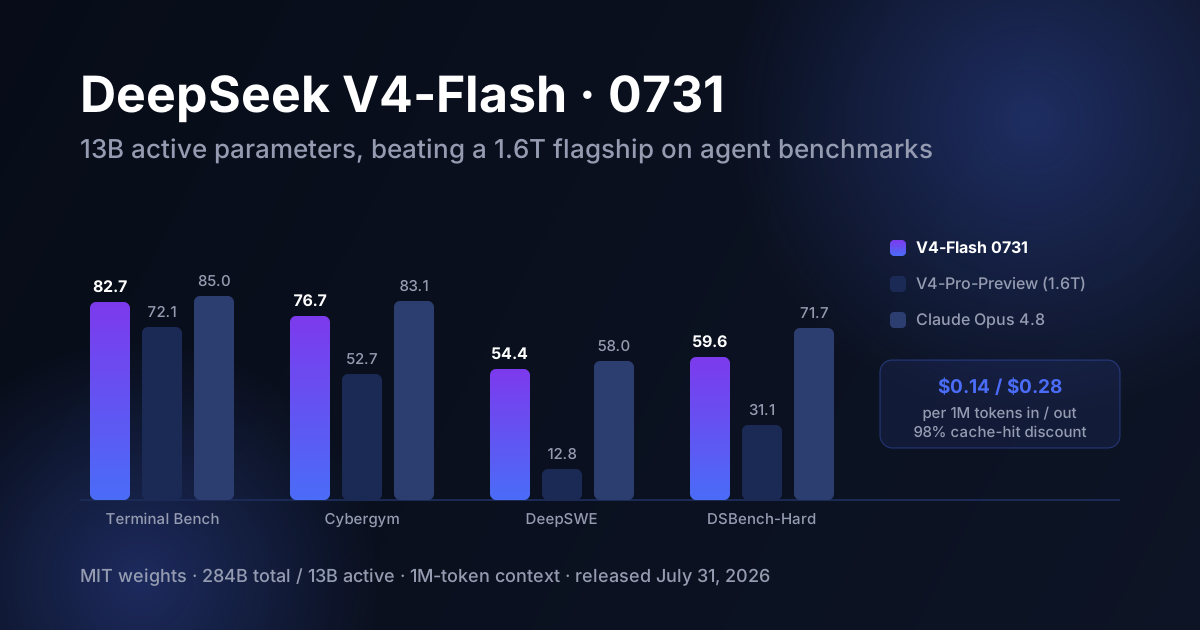
On July 31, DeepSeek moved V4-Flash out of preview. On paper this is the least interesting kind of release — no new architecture, no new parameter count, no new context window. The model shipped with exactly the same 284B/13B mixture-of-experts body it had in April. What changed was the post-training.
And that re-post-trained small model now outscores DeepSeek's own 1.6-trillion-parameter flagship, V4-Pro-Preview, on all nine published agent benchmarks — by margins between 8.7 and 41.6 points. It costs $0.14 per million input tokens and $0.28 per million output. It is MIT-licensed. You can download the weights.
There is a real lesson in there for anyone building an AI product, and it is not “switch to DeepSeek.” It is about where capability is actually coming from in 2026, and what that does to the assumption — still baked into most founders' cost models — that better agent behaviour means a bigger, more expensive model.
The changelog entry is short and worth reading literally. The deepseek-v4-flash endpoint now serves the 0731 build. Architecture and size are unchanged from the preview; the model was re-post-trained, with a DSpark speculative-decoding module attached for throughput. It gained native support for OpenAI's Responses API format and a day-one Codex adaptation. Reasoning control expanded to three explicit levels — low, high, max — which is the shape agent harnesses expect from reasoning_effort.
The specifications underneath: 284B total parameters with 13B activated, a 1M-token context window with up to 384K output tokens, a hybrid attention stack combining compressed sparse attention and heavily compressed attention, FP4 experts with FP8 elsewhere, and roughly 167GB of weights on disk under an MIT licence. The legacy deepseek-chat and deepseek-reasoner identifiers were retired on July 24, so only the two V4 endpoints work now.
The commercial context matters too. DeepSeek raised $7.4 billion at a valuation around 350 billion yuan, with Tencent and NetEase participating, and has said the money goes toward roughly doubling headcount with a focus on agents. The preview build of Flash had already spent seven consecutive weeks as the most-used model on OpenRouter. This is not a lab shipping a curiosity.
Here are the published agent numbers, with the preview build included so you can see how much of the gain is post-training rather than marketing.
| Benchmark | Flash 0731 | Flash Preview | V4-Pro-Preview | Opus 4.8 |
|---|---|---|---|---|
| Terminal Bench 2.1 | 82.7 | 61.8 | 72.1 | 85.0 |
| Cybergym | 76.7 | 38.7 | 52.7 | 83.1 |
| DeepSWE | 54.4 | 7.3 | 12.8 | 58.0 |
| NL2Repo | 54.2 | 39.4 | 38.5 | 69.7 |
| Toolathlon-Verified | 70.3 | 49.7 | 55.9 | 76.2 |
| DSBench-FullStack | 68.7 | 37.0 | 41.8 | 71.6 |
| DSBench-Hard | 59.6 | 25.8 | 31.1 | 71.7 |
| Agents' Last Exam | 25.2 | 15.8 | 16.5 | 25.7 |
| AutomationBench Public | 25.1 | 10.8 | 12.8 | 27.2 |
Two things jump out. The first is DeepSWE: 7.3 to 54.4 on identical weights. A jump that large usually means the preview model could do the task but had never been taught the harness — it was failing on format, tool-calling discipline, and knowing when to stop, not on reasoning. Post-training fixed the interface, and the capability that was already in there showed up.
The second is the Opus 4.8 column. Flash 0731 is close on Terminal Bench (82.7 vs 85.0), Agents' Last Exam (25.2 vs 25.7) and DeepSWE (54.4 vs 58.0) — and clearly behind on the two hardest: NL2Repo (54.2 vs 69.7) and DSBench-Hard (59.6 vs 71.7). That pattern is consistent and it is the pattern that should drive your routing. The gap closes on bounded, well-specified agent tasks. It stays open on long, ambiguous, whole-repository work where one bad decision at step 40 costs you the run.
Independent measurement roughly agrees. Artificial Analysis puts V4-Flash 0731 at 50 on its Intelligence Index — third among open-weights models, against a median of 25, level with Gemini 3.6 Flash, and behind Claude Opus 5 at about 59. Output speed is 113.5 tokens per second against a peer median of 61.4, with time to first token at 1.31 seconds.
Benchmarks get the headlines; the price line is what changes what you can build. Artificial Analysis measured the cost of running its full Intelligence Index battery through each model:
That is roughly a hundredfold spread for a capability gap of nine points on a hundred-point index. The cache economics are more aggressive still: a cache hit costs $0.003 per million tokens, a 98% discount and the steepest in the industry. If your agent replays a large stable system prompt and a fixed corpus on every turn — which is what most production agents do — that discount is not a rounding error, it is the difference between a workflow you can offer on a $29 plan and one you cannot offer at all.
DeepSeek also cut API costs by up to 50% with this release, and the pattern is now familiar enough that Axios framed it as a race to zero, with the observation that relentless discounting from Chinese labs puts the eventual OpenAI and Anthropic IPOs under pressure. Whether or not that thesis holds, the operational consequence for you is immediate: the floor price for competent agentic work fell again, and any pricing model you built on the assumption that inference is expensive has a shorter shelf life than you planned.
The verbosity tax
Artificial Analysis flags V4-Flash as “very verbose” — it consumed 210M output tokens across their evaluation against a peer median of 100M. Output tokens are the expensive half of the bill. A model at one-tenth the output price that emits twice the tokens is a fivefold saving, not a tenfold one, and your actual ratio depends on your prompts. Measure cost per completed task on your own traces, not cost per million tokens off a pricing page.
Second: peak-hour pricing. DeepSeek has announced a 2× multiplier during 09:00–12:00 and 14:00–18:00 Beijing time. It was not yet in effect at release, but if your traffic is European or US-morning heavy, model the multiplied rate rather than the headline one before you commit a margin to a customer.
Third, and least discussed: these are agent benchmarks, and agent benchmarks reward exactly the thing that was just post-trained. A 41-point jump on DeepSWE from re-post-training alone should make you slightly more suspicious of the benchmark, not only more impressed by the model. It tells you the score is highly sensitive to harness fit. Your harness is not their harness. Run your own evaluation set — the small one built from real user tasks — before you route production traffic anywhere new.
The comparison is not quite fair, and understanding why is the useful part. Flash 0731 is a finished, agent-tuned product. V4-Pro-Preview is a preview — a base capability demonstration that has not had the same treatment. DeepSeek says the official V4-Pro release is imminent, with Responses API and Codex support arriving in early August, and when it lands, the ordering will almost certainly flip back.
But “the comparison is unfair” is the finding. What separated the two models on nine benchmarks was not five and a half trillion parameters of raw capacity. It was whether anyone had taught the model how to behave inside an agent loop: when to call a tool, how to format the call, when to stop reasoning and act, how to recover from a failed step. Scale bought the underlying ability. Post-training was what converted it into completed tasks.
That maps almost exactly onto what founders keep discovering one level up the stack. The demo works because the model is capable. Production fails because nothing around the model knows how to run a loop reliably — the same reason context engineering, evaluation sets, and permission systems keep turning out to matter more than which frontier model you picked. DeepSeek just demonstrated the identical principle inside the weights themselves.
V4-Pro is the 1.6T sibling, released as an open-weight preview under MIT on April 24 and priced at $0.435/$0.87 per million tokens. It scores around 80.6 on SWE-bench Verified in maximum reasoning mode — competitive, not leading. The architecture story is genuinely impressive on efficiency grounds: at a 1M-token context, V4-Pro reportedly needs about 27% of the single-token inference FLOPs and 10% of the KV cache that V3.2 required, which is what makes million-token context economically plausible rather than merely advertised.
One cost comparison from a practitioner analysis is worth carrying around: a representative medium-sized feature implementation runs roughly $0.12 on V4-Pro against about $10.00 on a frontier premium tier. Even discounted by the verbosity caveat and by whatever failure rate you observe, that is a different category of unit economics — and it is the reason “use the best model for everything” stopped being a defensible default about a year ago.
The temptation with a release like this is to treat it as a buy signal for one vendor. It is not. DeepSeek trails Moonshot's Kimi K3 at 2.8 trillion parameters, Kimi will be undercut by something in October, and the cheapest competent model in any given month is a moving target that you should never build a product identity around.
What is durable is the direction. Capability at a given price point is falling fast, the open-weights tier is now close enough to the frontier on bounded agent work that the choice is a routing decision rather than a quality decision, and the marginal cost of the model layer is heading toward the floor. If your product's advantage is that you have access to a good model, that advantage is being priced away in public, one release at a time.
The advantage that survives is the thing DeepSeek itself just proved matters: the work of making a capable system reliable inside a specific loop, on a specific domain, for a specific user. That was the gap between 7.3 and 54.4 on the same weights. It is also, more or less exactly, the gap between an AI demo and an AI business.
IdeaToMVP Academy
4-week live cohort for founders. Learn to ship AI agents, scope MVPs, and automate your business — taught by the same team that writes these guides.