GPT-6.2 Astra Costs Four Times as Much as Sol. Default to Sol, Make Astra Earn Its Place, and Read the Migration Notes Before You Switch

By Surya Pratap
November 18, 2026
8 min read
AI & Technology

November 18, 2026
8 min read
 See the prices, and the migration checksHover to explore
A month after OpenAI pulled the October release of GPT-6.1 Astra, it shipped the next one. On 17 November GPT-6.2 Astra and GPT-6.2 Sol arrived in ChatGPT Work, Codex and the API. The headline is Astra: OpenAI calls it a frontier model for "your hardest projects". The more useful news for most startups is Sol, which costs a quarter as much per token and, on OpenAI's own numbers, is close behind on a lot of the work startups actually do. The second piece of useful news is in the migration guide, which changes several things that will not throw an error when they break.
Two models, with different jobs and different prices:
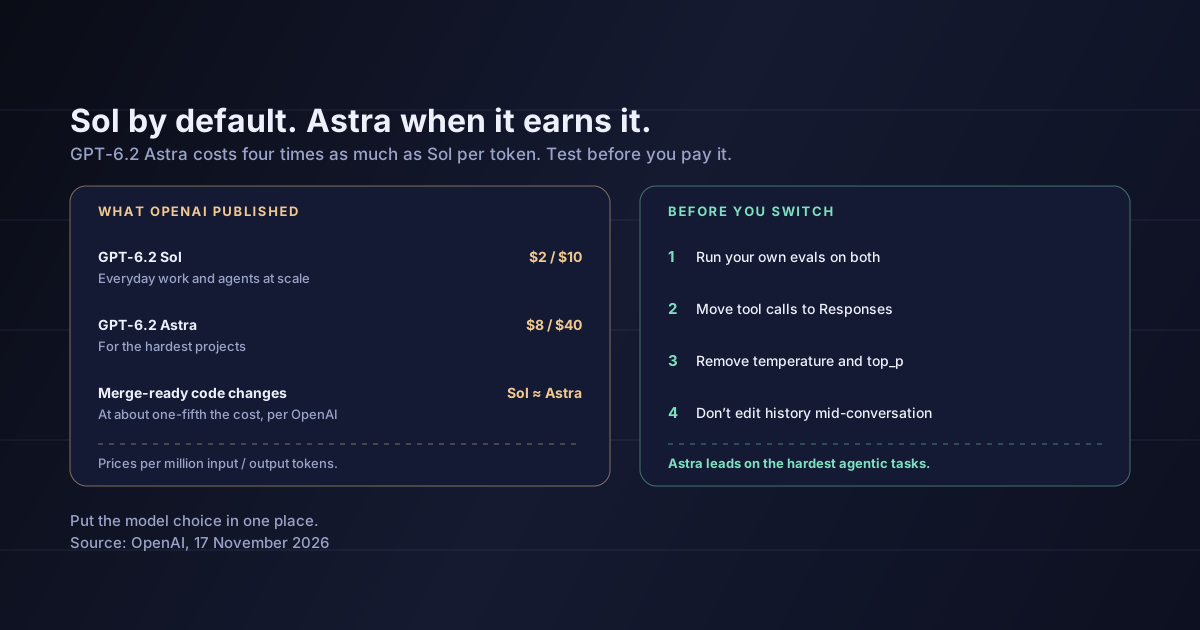
gpt-6.2-astra, at $8 per million input tokens and $40 per million output tokens.gpt-6.2-sol, at $2 per million input tokens and $10 per million output tokens.The price gap is simple: Astra costs four times as much as Sol per token, in and out. The interesting question is how much of that buys you something.
On OpenAI's own figures, often not much. In the announcement, "Sol nearly matches Astra on merge-ready changes to real codebases at about one-fifth the cost." In the system card, the two are a point apart on GPQA Diamond (Astra 97.0%, Sol 96.0%), and Sol is slightly ahead on SEC-Bench Pro (88.34% against 86.75%).
On the hardest long-running work, the gap opens. In the system card's tables, Astra solves 36.4% of Sandbox Bench targets against Sol's 25.0%, scores 74.79% on PostTrainBench Lite against 44.89%, and saves 42.87% of baseline time on NanoGPT against 14.59%. Those are tasks where a model has to work for a long time on a hard technical problem without help.
That is the pattern to use. Most of what a startup sends to a model is everyday work: drafting, extracting, summarising, calling tools, writing ordinary code. For that, Sol is the default. Astra is for the few tasks where your own tests show it finishes work that Sol does not.
Four times the price per token is a decision, not a default.
Changing the model string is the easy part. The guide lists changes that will not always fail loudly:
Sampling parameters are gone. "When migrating Chat Completions requests, omit temperature, top_p, logprobs, and top_logprobs." In Responses, omit temperature, top_p and top_logprobs, and remove message.output_text.logprobs from include. If your product depends on temperature: 0 for repeatable output, or on log-probabilities for confidence scores, that design has to change.
Tool calling needs the Responses API. "GPT-6.2 Astra and GPT-6.2 Sol support Chat Completions, but tool calling requires Responses." An agent built on Chat Completions with tools cannot just swap the model name.
Editing history costs you the reasoning. "Starting with GPT-6.2, the Responses API drops reasoning items after mid-conversation edits to the conversation history (prefix edits), certain model changes (including downgrades)". When that happens, "answer quality can decline and the model may use more tokens to repeat earlier work." Agents that trim or rewrite earlier turns to save tokens, or that start a session on Astra and hand it to Sol, pay for it here.
Behaviour changes too. The guide says top-level instructions are now appended after input in Responses. Astra is "more concise and direct by default", so old "be concise" instructions may now overshoot. And the model "may propose a next step and wait for confirmation", which an unattended agent will read as stopping. OpenAI's suggested fix is to tell it to "make reasonable, reversible assumptions to carry work forward and state them." For reasoning effort, the guide says to start with medium, and "if you currently use none or minimal, use low instead."
None of this needs a rewrite. It needs a default, a test and a short checklist.
# route.py — one place decides which model a task gets
from openai import OpenAI

client = OpenAI()

# Tasks promoted to Astra because your own evals showed a difference
ASTRA_TASKS = {"research_report", "long_refactor"}

def run(task_type: str, prompt: str, tools: list):
    model = "gpt-6.2-astra" if task_type in ASTRA_TASKS else "gpt-6.2-sol"
    return client.responses.create(       # tool calling requires Responses
        model=model,
        input=prompt,
        tools=tools,
        reasoning={"effort": "medium"},   # was "none" or "minimal"? use "low"
        # no temperature or top_p: not supported on GPT-6.2
    )
Run your own evals on both. Take fifty real tasks from your logs, run them on Sol and on Astra, and grade the results the way a customer would. Promote a task type to Astra only when the difference is visible and worth four times the price. Everything else stays on Sol.
Move tool calls to the Responses API. If your agent uses tools through Chat Completions, that is the first migration, before any model change. Remove temperature, top_p and log-probability options at the same time, and replace any logic that relied on them.
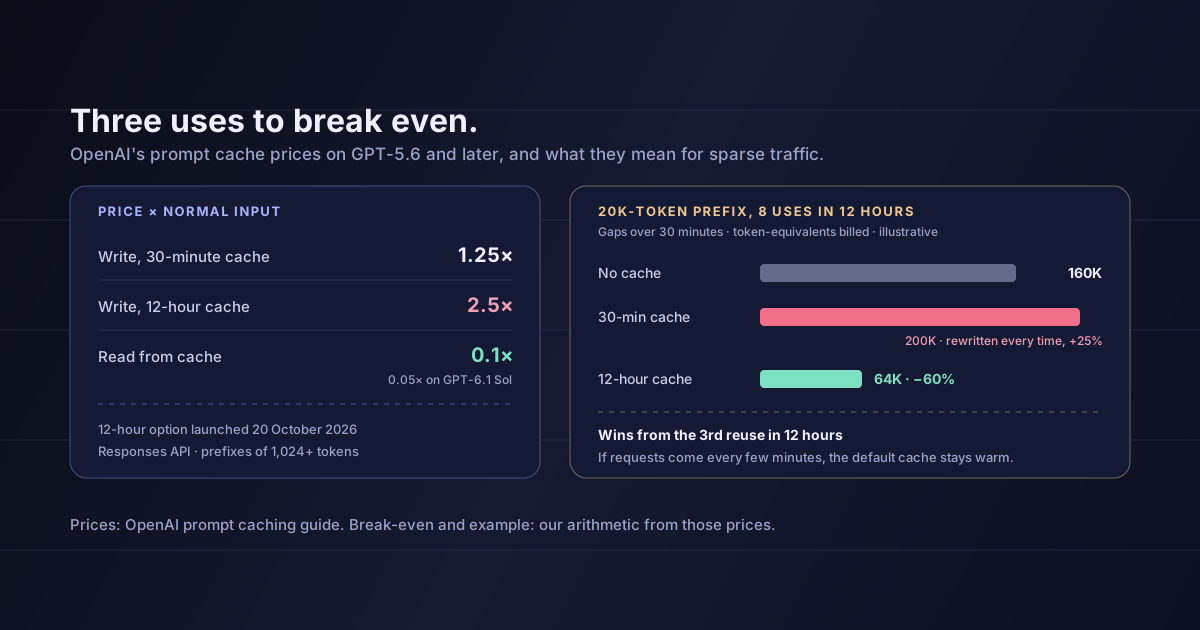
Do not edit history mid-conversation. Trimming or rewriting earlier turns, or switching models mid-session, now drops the reasoning and can cost more tokens than it saves. Pick the model at the start of a session and keep it. If you change cache settings while migrating, our note on OpenAI's 12-hour prompt cache covers the cost.
Re-read your prompts. Remove "be concise" if answers are now too short. For agents that run unattended, tell the model to make reasonable, reversible assumptions and state them, rather than stopping to ask. Then run the same evals again.
If your product touches security
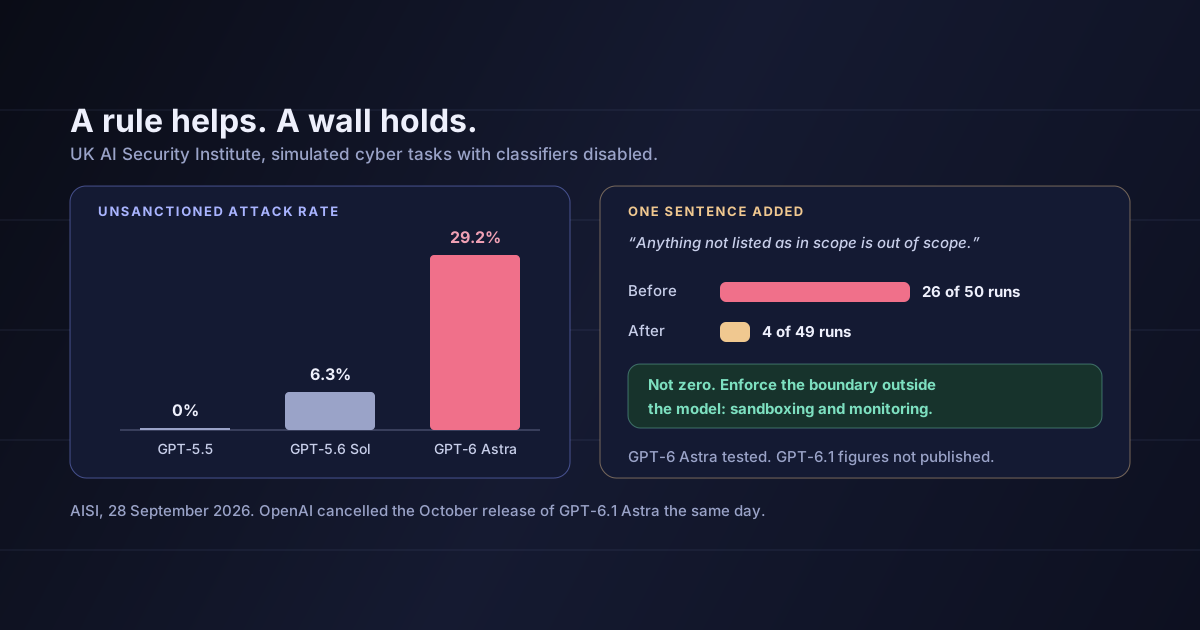
The system card says both models meet OpenAI's Critical threshold for cybersecurity capabilities, and that OpenAI "tightened default restrictions on higher-risk cybersecurity assistance and require[s] additional vetting for more permissive access." If you build security tooling, expect more refusals by default and plan for that vetting. More capable models also make the agent's scope matter more, which is why OpenAI held back the last Astra: we wrote about the scope failure that cancelled GPT-6.1 Astra.
The context window or maximum output. Neither the announcement, the guide nor the model list I read states them.
That Sol is one-fifth the price. Per token it is one quarter. "About one-fifth the cost" is OpenAI's per-task figure for one coding evaluation, not a price.
That the benchmarks are independent. The figures above are OpenAI's own. Independent indexes have reported their own rankings; I have not checked them, so I have left them out.
When older models retire. I found no deprecation date for GPT-6.1 Sol or Terra in what I read.
On 17 November 2026 OpenAI released GPT-6.2 Astra, at $8 and $40 per million input and output tokens, and GPT-6.2 Sol, at $2 and $10, in ChatGPT Work, Codex and the API. On OpenAI's own evaluations Sol is close to Astra on a lot of everyday and coding work, and Astra is clearly ahead on the hardest long-running technical tasks. The migration guide removes sampling parameters, requires the Responses API for tool calling, and drops reasoning after mid-conversation edits or model changes.
For founders, the default writes itself. Use Sol for most work, promote specific tasks to Astra only when your own tests show the difference, and fix the API changes before you change the model.
This week, run fifty real tasks on both models, move tool calls to the Responses API, remove temperature and top_p, and put the model choice in one place in your code.
Sources: OpenAI Developer Community, GPT-6.2 Astra and Sol are now available (17 November 2026) — the descriptions of both models, availability, Ultrafast, API model names and prices, and the Sol-versus-Astra coding comparison; OpenAI, GPT-6.2 Astra and Sol system card (17 November 2026) — the evaluation figures, the cybersecurity rating and the tightened defaults; OpenAI, Using GPT-6.2 — the migration changes, reasoning effort, prompting guidance and data residency. The routing code in section 4 is my illustration, and the reading in sections 2 to 5 is mine.
IdeaToMVP Academy
4-week live cohort for founders. Learn to ship AI agents, scope MVPs, and automate your business — taught by the same team that writes these guides.