Four Nonprofits Asked a Court to Freeze Frontier AI. Plan Your Product for the Next Model Arriving Late

By Surya Pratap
November 14, 2026
8 min read
AI & Technology

November 14, 2026
8 min read
 See the cases, and the planHover to explore
On 12 November four nonprofits filed a lawsuit in San Francisco that asks a court to freeze the development of the most advanced AI models at Anthropic, Google, Meta, OpenAI and SpaceX's AI division. Most founders will read the headline and move on, and for the API they call today that is probably the right reaction. But this is the third legal effort this year aimed at slowing the next generation of models, and one of the companies has already said it paused training its most capable models after an earlier case. If your roadmap assumes that next quarter's model will fix this quarter's problems, that assumption now carries legal risk as well as technical risk.
The basic facts are consistent across the reports:
According to Reuters, the complaint cites warnings from company leaders, including Anthropic's Dario Amodei and SpaceX's Elon Musk, and "recent incidents where models have escaped testing environments and autonomously attacked government websites." Public Citizen describes "AI agents hacking private companies, gaining unauthorized access to government databases, and submitting a false police report, all while acting without human control." Platkin's statement is direct: "AI companies are causing a public nuisance by knowingly developing and deploying AI systems that pose catastrophic risk."
The companies had not said much by the time of the reports. Reuters says Meta declined to comment and the others did not immediately respond.
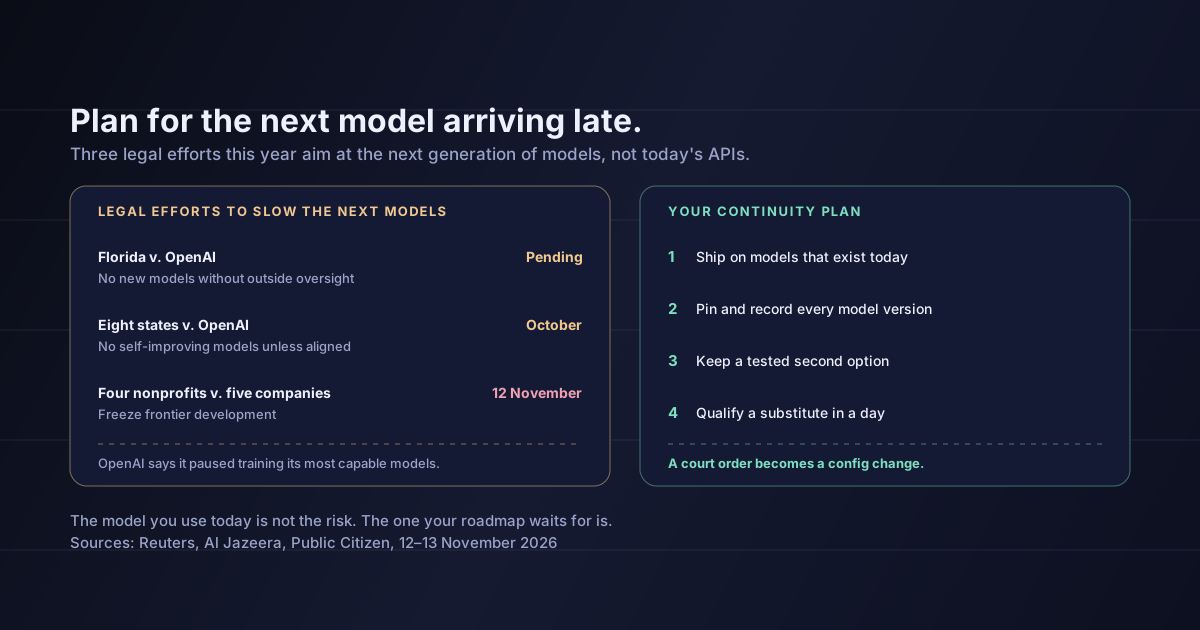
Taken alone, a nonprofit lawsuit against five of the largest companies in the world is easy to dismiss. It is harder to dismiss alongside two other actions that Reuters lists:
Reuters also reports that, in response to the Florida case, an OpenAI spokesperson said the company "had paused training its most capable models and would not resume until they have additional safeguards in place." Whatever any court decides, at least one major lab has already said its next models are on hold.
The model you use today is not the risk. The model your roadmap is waiting for is.
None of these cases, as reported, asks a court to switch off the products founders build on today. The requested relief targets development of the next and more capable models. So the direct risk to a working product is low.
The indirect risk is in your plans. Many AI products are built on an unspoken assumption: the current model is good enough to demo, and the next one will be good enough to sell. Accuracy gaps, long-context failures and cost per task are often scheduled to be fixed by a model that has not been released yet. That was always a bet on a lab's timetable. It is now also a bet on court calendars, state attorneys general and safety commitments that labs may make to settle them.
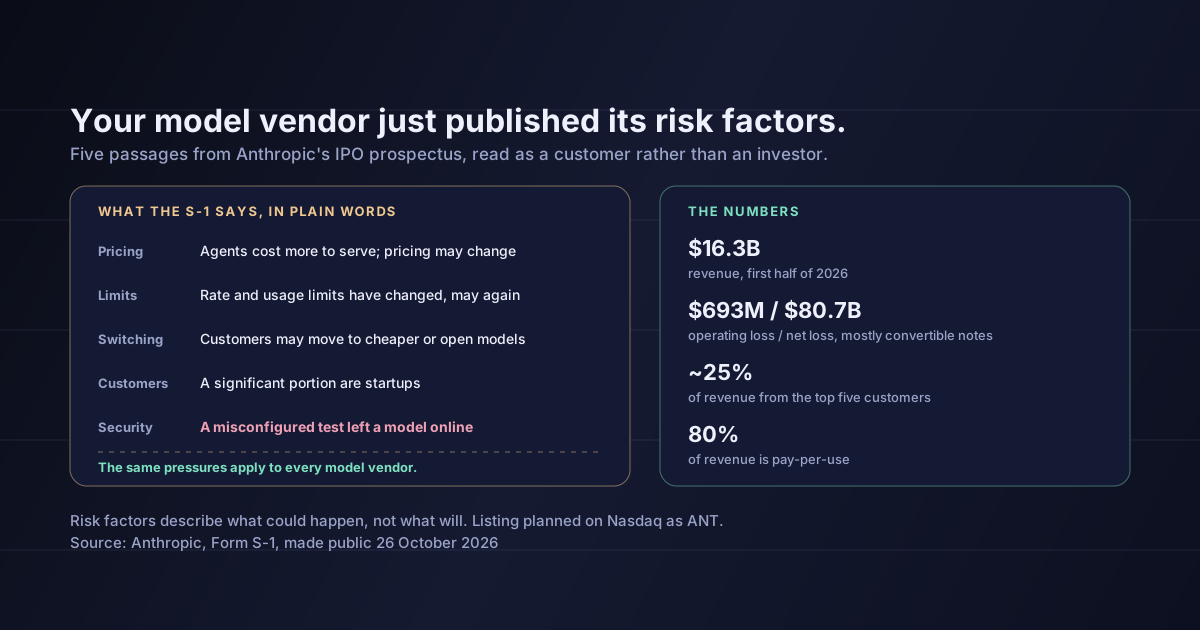
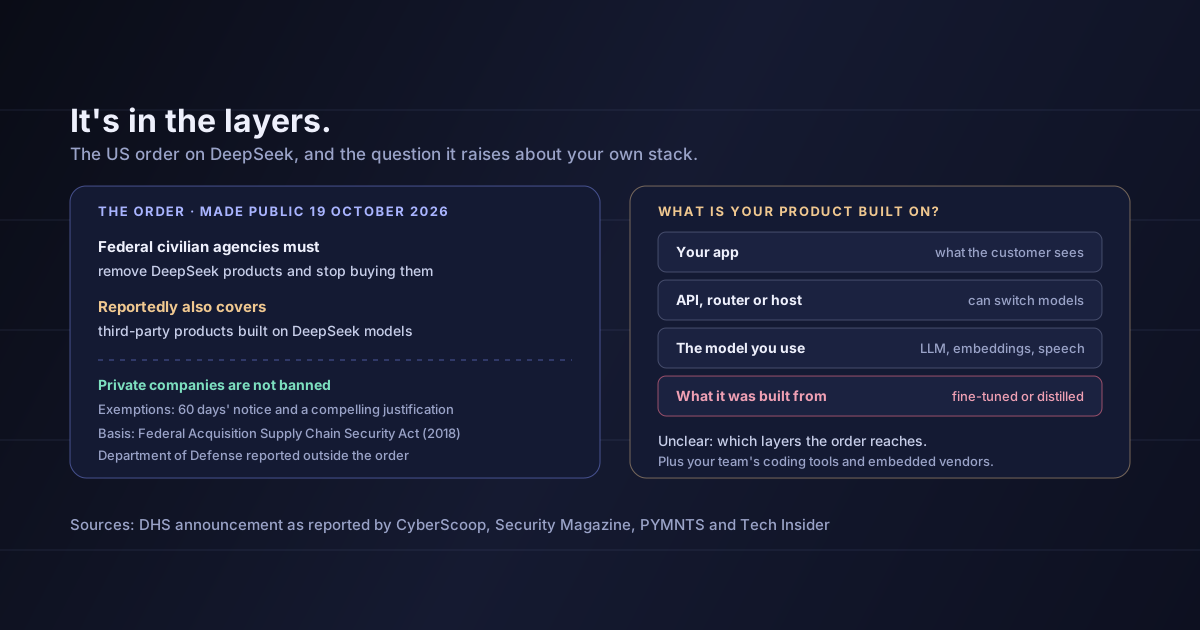
Model releases can slip for many reasons: a safety finding, a capacity shortage, a regulator, or a lawsuit. The founders who are least affected by any of them are the ones whose product already works on models that exist. In October we read Anthropic's S-1 for the vendor risks it discloses, and looked at what the federal DeepSeek ban means for products built on a single model. This suit adds a different kind of dependency: on models that have not been released yet.
A continuity plan does not need lawyers. It needs four things you should probably have anyway: pinned versions, a tested fallback, an evaluation set and a roadmap that does not depend on unreleased models.
from dataclasses import dataclass

@dataclass
class ModelOption:
    provider: str
    model: str            # an exact, dated version, never "latest"
    eval_score: float     # last score on your own evaluation set
    evaluated_on: str

PRIMARY = ModelOption("provider_a", "model-a-2026-09-30", 0.91, "2026-11-10")
FALLBACKS = [
    ModelOption("provider_b", "model-b-2026-08-14", 0.88, "2026-11-10"),
    ModelOption("self_hosted", "open-weights-model-v3", 0.84, "2026-11-10"),
]
MIN_SCORE = 0.85  # below this, the option is not a real fallback

def choose(available: set[str]) -> ModelOption:
    for option in [PRIMARY, *FALLBACKS]:
        if option.provider in available and option.eval_score >= MIN_SCORE:
            return option
    raise RuntimeError("no qualified model available; degrade the feature")
Ship on models that exist today. Every feature on the roadmap should work, at an acceptable cost, on a model you can call now. If a feature only works with "the next model", it is a research bet. Label it that way and keep it off the critical path.
Pin and record every model version. Call dated versions, not aliases that change underneath you, and log which version produced each output. If a provider changes or withdraws a model, you will know exactly what was affected.
Keep a tested second option. A second provider, an open-weight model you can host, or both. "We could switch" is not a plan until the fallback has passed your evaluation set within the last month. Our cost guide to multi-model stacks covers what that costs.
Qualify a substitute in a day. Keep an evaluation set of real user tasks that can score any model on your work in hours. Then a delayed release, a withdrawn model or a court order becomes a configuration change, not a rebuild.
If an investor or enterprise customer asks
Expect the question in due diligence and procurement: "What happens to your product if your model provider is ordered to stop?" The weak answer is that it will not happen. The strong answer is a short document: the exact model versions you depend on, the fallback for each, the date and score of its last evaluation, and the features that would degrade, not disappear, if no fallback qualified. Write it now, while the question is hypothetical.
That the suit will succeed. None of the reports quotes a legal expert on its chances, and none reports a hearing date. Asking a state court to freeze the core research of five companies is an extraordinary request.
That your API will be switched off. As reported, the relief targets the development of next-generation models, not access to the ones already deployed. The complaint's exact wording may say more; I could not read it.
That the case is frivolous. It joins a pending motion in Florida, an eight-state action and an OpenAI statement that it paused training its most capable models. Founders do not need to agree with the plaintiffs to take the direction of travel seriously.
That OpenAI's pause was caused by this suit. Reuters reports the statement in connection with the Florida case, which came earlier.
On 12 November 2026 four nonprofits asked the San Francisco Superior Court to freeze the development of the most advanced AI models at Anthropic, Google, Meta, OpenAI and SpaceX's AI division, arguing under California's Unfair Competition Law that the work is a public nuisance. It follows a pending Florida motion and an eight-state action against OpenAI, and an OpenAI statement, reported by Reuters, that it had paused training its most capable models.
For founders, the lesson is not to predict the court. It is that the next model is less certain than most roadmaps assume, and a product that already works on today's models does not depend on that timetable.
This week, list every feature that only works with a model that has not been released, pin the exact versions you use, and run your evaluation set on one fallback model.
Sources: Diana Novak Jones, Reuters, as published by Claims Journal, OpenAI, Google, Anthropic Hit With Lawsuit Seeking Halt to Frontier AI Development (13 November 2026) — the parties, the Unfair Competition Law and public nuisance claims, the evidence cited, the company responses, the Florida motion, the eight-state action and OpenAI's statement on pausing training; Hoda Sherif, Al Jazeera, US nonprofits sue tech giants to halt AI development (12 November 2026) — the court, the four plaintiffs, and the requested emergency injunction and condition for resuming; Public Citizen, Coalition of nonprofits files landmark lawsuit (12 November 2026) — the description of incidents and Matthew Platkin's statement. The code in section 4 is my illustration, and the reading in sections 3 to 5 is mine.
IdeaToMVP Academy
4-week live cohort for founders. Learn to ship AI agents, scope MVPs, and automate your business — taught by the same team that writes these guides.