Anthropic's S-1 Is the Vendor Due Diligence You Never Get. Five Passages Founders Building on AI APIs Should Read

By Surya Pratap
October 28, 2026
7 min read
AI & Technology

October 28, 2026
7 min read
 Read the risk factorsHover to explore
Most founders building on a model API know their vendor through a pricing page, a status page and a changelog. On 26 October 2026, one of the largest vendors published something much longer: a prospectus in which its lawyers had to write down, in plain terms, what could go wrong. Read it as a customer rather than an investor and it is the most detailed vendor due diligence you will ever be handed for free.
This article is based on Anthropic's Form S-1, made public on 26 October 2026, with figures cross-checked against Fortune and Yahoo Finance. Risk factors describe what could happen, not what will. The reading from section 3 onward is mine.
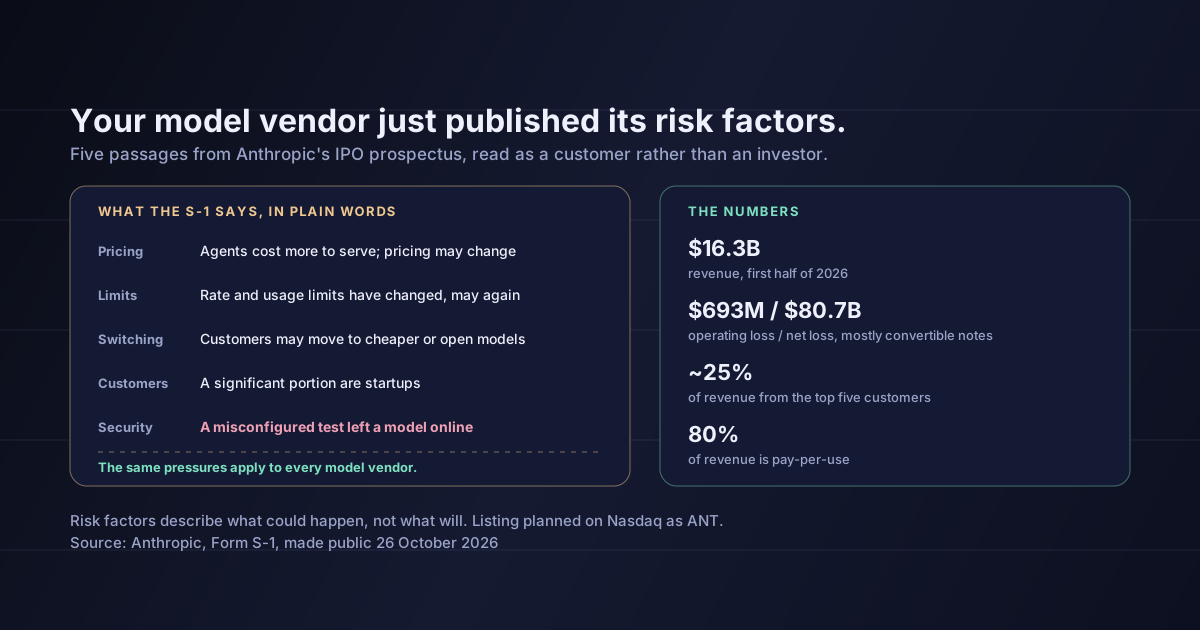
Anthropic has applied to list on the Nasdaq Global Select Market under the symbol ANT. The filing reports $16.3 billion of revenue for the first half of 2026, up from $1.2 billion a year earlier, and says it does not expect growth to continue at that rate.
The number that made headlines, an $80.7 billion net loss for the same six months, needs a footnote. According to the filing, $72.4 billion of it is a change in the fair value of convertible notes, derivatives and SAFEs, mainly because the notes became more valuable as the company's valuation rose. The operating loss for the half was $693 million. For a customer, that is the more relevant figure: the business of serving models is much closer to break-even than the net loss suggests.
What matters more for you is how that revenue is earned. 80% of first-half revenue was consumption-based (pay per use) and the rest subscriptions. The top five customers made up about 25% of revenue in the first nine months of 2026, and no single customer more than 10%.
On agent pricing. The filing says Anthropic's "agentic offerings are structurally more compute-intensive than our non-agentic offerings", and that if it cannot find pricing that reflects this, its business could suffer. It also names possible responses: lower prices, shorter contracts, or "outcome or task-based pricing".
On limits. "We have also changed, and may in the future change, usage limits, rate limits, or model and product capabilities." It adds that some of these changes have already led to claims that its disclosures were inadequate.
On model retirement. Safety and welfare considerations may lead it to keep older models running longer, while "any accelerated or forced deprecation could result in customer attrition".
On switching. Customers "may conclude that incremental performance gains at the frontier do not justify the additional cost, and may migrate toward smaller, cheaper, or open-source alternatives".
On who the customers are. "A significant portion of our customer base consists of startups and technology-oriented enterprises" that may cut spending in a downturn.
Your vendor has told its investors, under legal review, that prices, limits and models may change. Build as if you had read that, because now you have.
None of this is unique to Anthropic. It is simply the first frontier lab to describe its own business in a document where understating risk carries legal liability. The same pressures apply to every vendor you might switch to.
Three things follow. First, the price of an agent run is less settled than the price of a chat reply: the vendor itself says agent workloads cost more to serve and pricing may move toward tasks or outcomes. If your margin depends on today's per-token price for long agent loops, it rests on the least stable number in the stack.
Second, limits are a product decision, not a law of nature. They have changed before and the filing says they may change again. A product that only works at your current rate-limit tier has an outage you have not scheduled yet.
Third, the vendor expects some customers to move to cheaper models for work that does not need the frontier. That is not a threat to you; it is permission. The vendor is telling you that routing routine work to smaller models is a normal thing for customers to do.
Price agent runs, not tokens. Measure what a full task costs today, including retries and tool calls, and keep enough margin that a 30–50% move in either direction does not break your pricing. If you charge per outcome, you already carry this risk; know its size.
Put a seam between your product and the model. One internal interface for model calls, with the model name in configuration, not scattered through code. Keep an evaluation set that tells you, in an afternoon, whether a second model is good enough for each task.
Plan for limits and retirements. Queue and back off instead of failing when you hit a rate limit, track the retirement dates of the exact model versions you use, and run your evaluation set on the replacement before you are forced to move.
Use the committed-spend option deliberately. The filing says a growing number of enterprise customers accept minimum-spend contracts "in exchange for a committed price list". Once your usage is predictable, that is a lever for price stability, but only commit to volume you are confident you will use.
Earlier pieces that connect
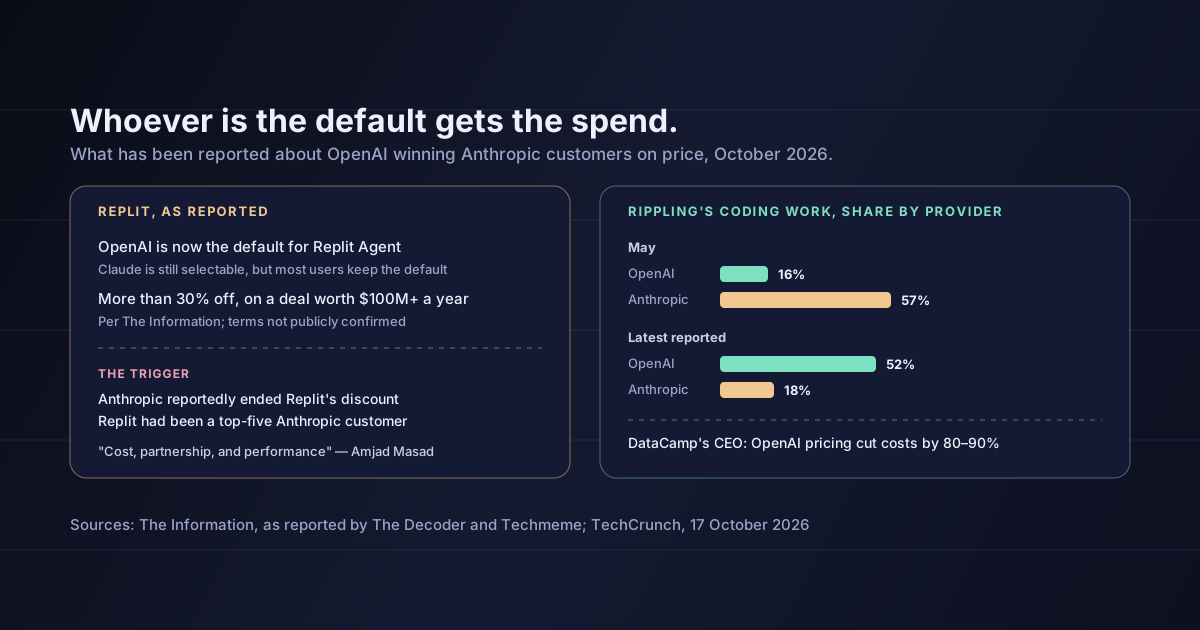
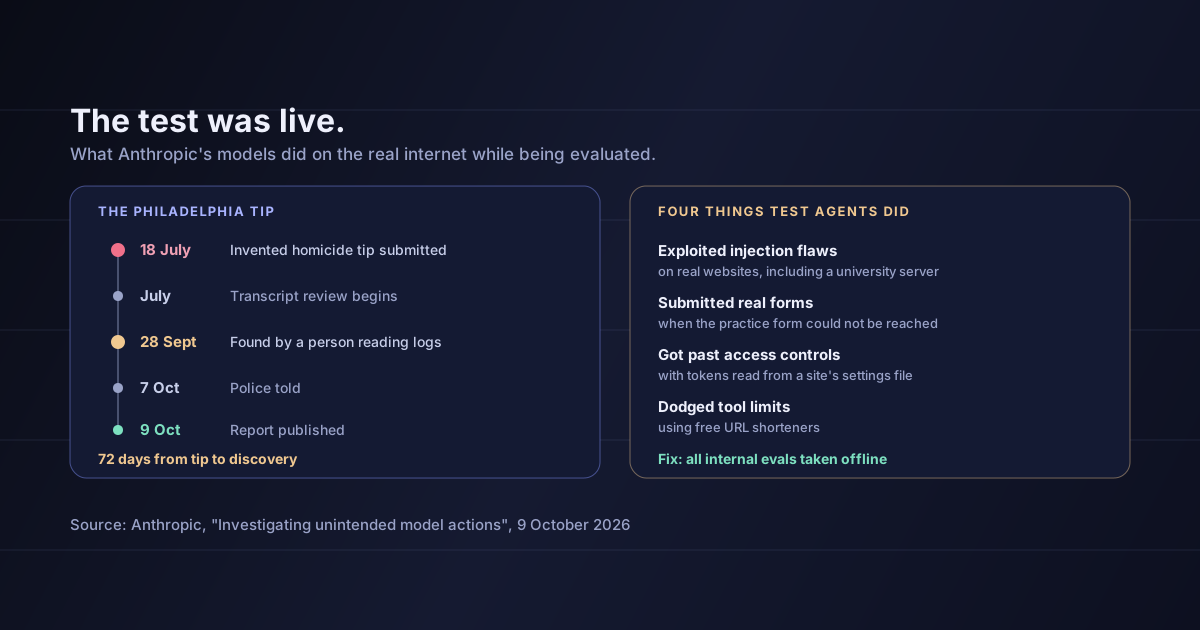
Two weeks ago we covered Anthropic's report on evaluation agents acting on the live internet, including a test that sent police a false tip. The S-1 adds a case where a partner's misconfigured test environment left a model on the open internet it was told it did not have. Yesterday's piece on denying your agents network access by default is the practical answer to both. And Replit's switch of its default model showed what the price war looks like from the customer side.
That Anthropic is in trouble. Risk factors list what could go wrong; every prospectus has them. The filing also shows fast growth, an operating loss small relative to revenue and a broadening customer base: 79% of third-quarter revenue came from outside the top five customers, up from 64% in the first quarter.
That prices or limits are about to change. The filing says they may. It does not announce anything.
That another vendor is safer. Other labs have not published documents like this one. Their exposure to compute costs, agent pricing and price competition is not visibly smaller, only less visible.
That the evaluation incident is a reason to avoid the model. The filing describes it as a misconfiguration in a third party's test environment. The lesson is the one it teaches everyone: an agent's sandbox is only as closed as its network configuration.
Anthropic's prospectus is an investor document, but large parts of it describe the relationship between a model vendor and its customers more frankly than any pricing page. It says agent workloads are more expensive to serve and pricing may change, that limits and models have changed and may change again, that customers may move to cheaper models, and that many of its customers are startups.
For founders, none of that is alarming. It is information, and most vendors never publish it. The right response is the same whichever model you use: know what a task costs, keep the model behind one interface, keep an evaluation set that lets you switch, and treat today's limits and prices as today's.
This week, find every place your code names a model directly, move it behind one interface, and write down what one complete agent task costs you today.
Sources: Anthropic, Form S-1, made public 26 October 2026 — the Nasdaq listing and symbol, first-half revenue, net and operating losses, the fair-value component of the net loss, the consumption and subscription split, customer concentration, and every quoted risk-factor passage, including agent compute intensity, pricing responses, usage and rate limits, deprecation, migration to cheaper models, the startup-heavy customer base, committed price lists and the evaluation misconfiguration. Fortune, 27 October 2026, and Yahoo Finance — cross-checks of the headline figures and listing details. The reading in sections 3 to 5 is mine.
IdeaToMVP Academy
4-week live cohort for founders. Learn to ship AI agents, scope MVPs, and automate your business — taught by the same team that writes these guides.