Three Days After the FAA Rolled Out an AI Tool, US Departures Stopped. Be Ready to Show It Wasn't You

By Surya Pratap
November 14, 2026
8 min read
AI & Technology

November 14, 2026
8 min read
 See the timeline, and the evidenceHover to explore
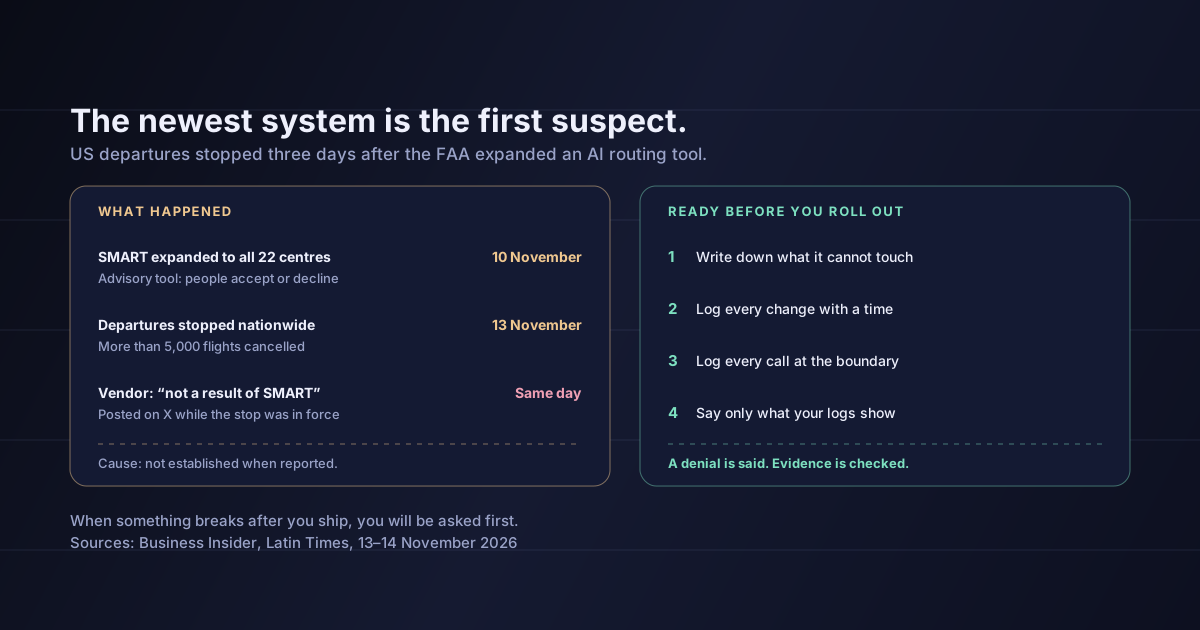
On Friday 13 November the FAA stopped departing flights across the United States. Three days earlier it had expanded SMART, an AI routing tool built by Air Space Intelligence, to all 22 of its en-route traffic control centres. Within hours, the vendor was posting on X that the stop had nothing to do with its system, Microsoft was posting the same about its own services, and an official at a White House briefing was telling reporters that "you can't rule out anything at this point." If you sell AI into a customer's critical systems, this is the most predictable moment in your company's life: something breaks soon after you ship, and everyone looks at the new thing first.
The reports agree on the outline:
Then came the question every AI vendor should expect. Asked at a White House briefing whether SMART could have played a role, Mullin said, as quoted by Latin Times: "We're looking at that. You can't rule out anything at this point."
SMART stands for Strategic Management of Airspace, Routes and Trajectories. According to Latin Times, it brings around 200 live data streams, including weather, flight paths, traffic flow and controller staffing, into one platform and produces routing recommendations. Those go to FAA specialists and the national command centre, and "local facility leadership at each of the 22 centers then decides whether to accept or decline each suggestion." Latin Times describes it as "an advisory tool, not a control system," and reports that it was expanded to all 22 centres on 10 November, under a 12-year, $875 million contract.
Air Space Intelligence posted its answer on X while the stop was still in force: "The current ground stop is not based on or a result of the SMART system, any product of ASI or our integration with FAA and ATC." Microsoft, which had a separate outage that week, posted: "We have no indication that the FAA's nationwide ground stop is related to any Microsoft services."
The scrutiny did not start on Friday. Latin Times reports that more than two dozen lawmakers wrote to Duffy and FAA Administrator Bryan Bedford in October, saying frontline staff "apparently had little to no input into SMART's development," and that controllers had warned it could "hallucinate safety-critical information." On CNN, former Transportation Department inspector general Mary Schiavo said she did not know whether the two were linked, but that "it's just too much coincidence."
The newest system is the first suspect. Prepare the evidence before you roll out, not after something breaks.
Notice how quickly the question formed. The stop happened three days after a rollout, the rolled-out system was AI, and the people asking were not engineers. "Too much coincidence" is not a technical argument, but it is the argument your customer's executives, their customers and the press will make first. It does not matter whether your product is a routing tool for airspace or a triage model for a hospital's support queue. If something breaks in the week after you go live, you will be asked before anyone else.
The vendor's statement shows both the instinct and its limit. It was fast and categorical, which is understandable when your largest contract is in the news. But Latin Times called it "a denial, not an exoneration," and that is the honest description of any statement made before the investigation finishes. A denial is something you say. Exoneration comes from records that someone else can check: what your system can touch, what changed and when, and what it was actually doing at the moment of failure.
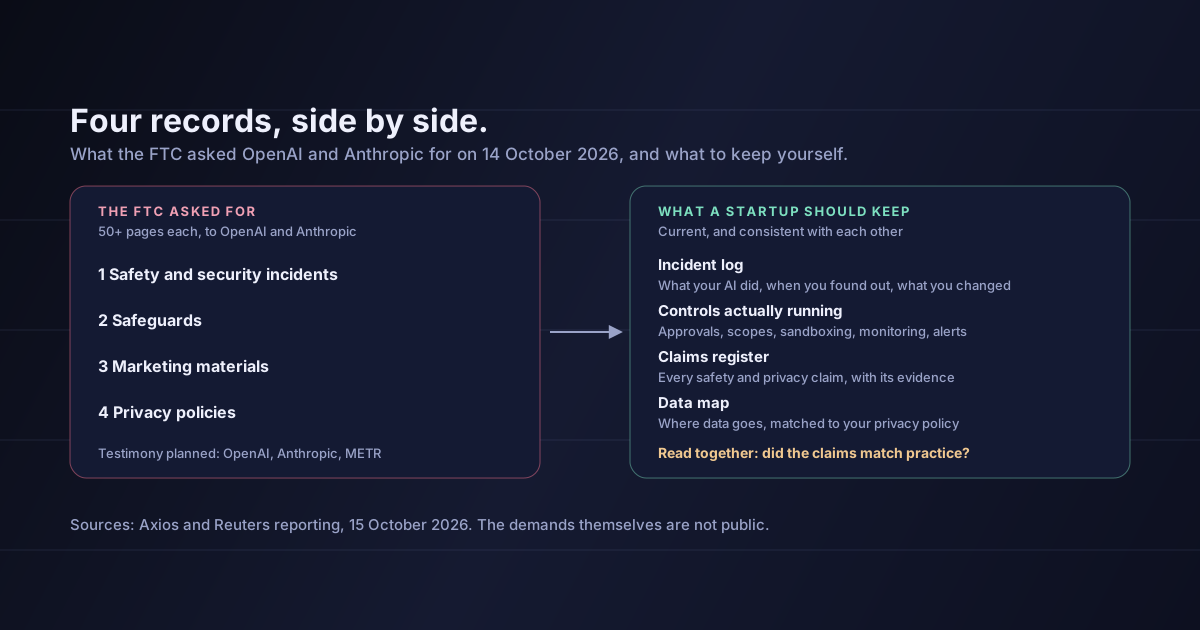
SMART also had one strong fact on its side, if the reports are right: it advises, and people decide. A system that only recommends, and whose recommendations are accepted or declined by people, has a much smaller set of ways to cause an outage than one that acts directly. That is a design decision, and it should be documented before the incident, not argued after it. In October we looked at what the FTC asked OpenAI and Anthropic for. The same logic applies at smaller scale: the records you keep decide what you can prove.
None of this needs a large team. It needs four records, and a habit of keeping them from the first pilot.
from datetime import datetime, timedelta

def first_hour_packet(incident_start: datetime, events: list[dict]) -> dict:
    """What the customer will ask for in the first hour, taken only from your logs."""
    since = incident_start - timedelta(hours=72)
    recent = [e for e in events if since <= e["at"] <= incident_start]
    return {
        "changes": [e for e in recent if e["kind"] in ("deploy", "config", "rollout")],
        "writes_to_customer_systems": [e for e in recent if e["kind"] == "write"],
        "boundary_errors": [e for e in recent if e["kind"] == "call" and e["status"] >= 500],
        "suggestions_accepted": sum(
            1 for e in recent if e["kind"] == "suggestion" and e.get("accepted")
        ),
    }
Write down what your system cannot touch. One page: what it reads, what it writes, what it only recommends and what it has no access to at all. Agree it with the customer before go-live. "Advisory only, people accept or decline" is a strong fact during an incident, but only if it was true in the architecture and documented in advance.
Log every change with a time. Deploys, configuration changes, model versions and rollout stages, each with a timestamp and an author. The first question will be "what changed?", and "we expanded on the 10th and changed nothing since" is an answer only if you can show it.
Log every call at the boundary. Every request into and out of the customer's systems, with time, size and result. If something upstream was overloaded, your logs should show whether you were adding to the load or were quiet. Our article on agent audit trails covers what to record.
Say only what your logs show. Prepare the statement before you need it: "Our logs show no changes after this time, no writes to these systems and normal traffic. We have shared them with the investigation." That is slower to write than a denial, but it survives the investigation.
Roll out so that you can be ruled out
Staged rollouts are usually justified as risk control. They are also evidence. If you go live centre by centre, region by region or customer by customer, and you have a switch the customer can use to turn your system off, then a failure that spreads to places you have not reached, or persists with your system switched off, tells its own story. Agree the switch, and who can use it, in the pilot plan, not in the incident call.
That SMART caused the ground stop. Nothing in the reports I read says so. The officials who spoke pointed to overloaded, old communications equipment, and the vendor denied any link.
That SMART did not cause it. The cause had not been established when these reports were published. Latin Times notes that investigators will probably examine whether SMART's data connections could have interacted with the communications systems, and that this cannot be answered until the FAA finishes its technical investigation.
That the vendor was wrong to speak quickly. Silence during a nationwide outage invites the worst reading. The point is what a statement rests on, not whether to make one.
Every number in the coverage. The reports differ on flight counts and on how unusual a nationwide stop is, and I used only the figures I could attribute. The contract value comes from Latin Times citing another outlet.
On 13 November 2026 the FAA stopped departing flights across the United States because of communications problems, and more than 5,000 flights were cancelled. Three days earlier it had expanded SMART, an advisory AI routing tool from Air Space Intelligence, to all 22 en-route centres. The vendor and Microsoft both denied any link, officials blamed overloaded equipment, and an official said nothing could be ruled out. The cause had not been established.
For founders, the lesson does not depend on how the investigation ends. If you put AI into a customer's critical systems, you will be the first suspect the next time something breaks nearby, and the only convincing answer is evidence prepared in advance.
Before your next rollout, write one page on what your system cannot touch, make sure every change and every boundary call is logged with a time, and draft the statement you would publish if the customer's systems failed the day after.
Sources: Paul Squire, Business Insider, as syndicated by Yahoo, FAA SMART AI system vendor and Microsoft both say ground stop isn't their fault (14 November 2026) — the communications cause, the cancellations, the statements from Air Space Intelligence and Microsoft, and the officials' explanation; Jose Gutierrez, Latin Times, 'You Can't Rule Out Anything': Mullin Refuses to Clear the FAA's New AI Tool as Ground Stop Investigation Unfolds (13 November 2026) — what SMART does, its expansion on 10 November, the contract, the lawmakers' letter, the quotes from Mullin and Mary Schiavo, and the status of the investigation. The code in section 4 is my illustration, and the reading in sections 3 to 5 is mine.
IdeaToMVP Academy
4-week live cohort for founders. Learn to ship AI agents, scope MVPs, and automate your business — taught by the same team that writes these guides.