22% to 2.4% on Safety. Monitorability Went the Other Way, and OpenAI Called the Decline Serious

By Surya Pratap
September 8, 2026
11 min read
AI & Technology

September 8, 2026
11 min read
 Two numbers, opposite directionsHover to explore
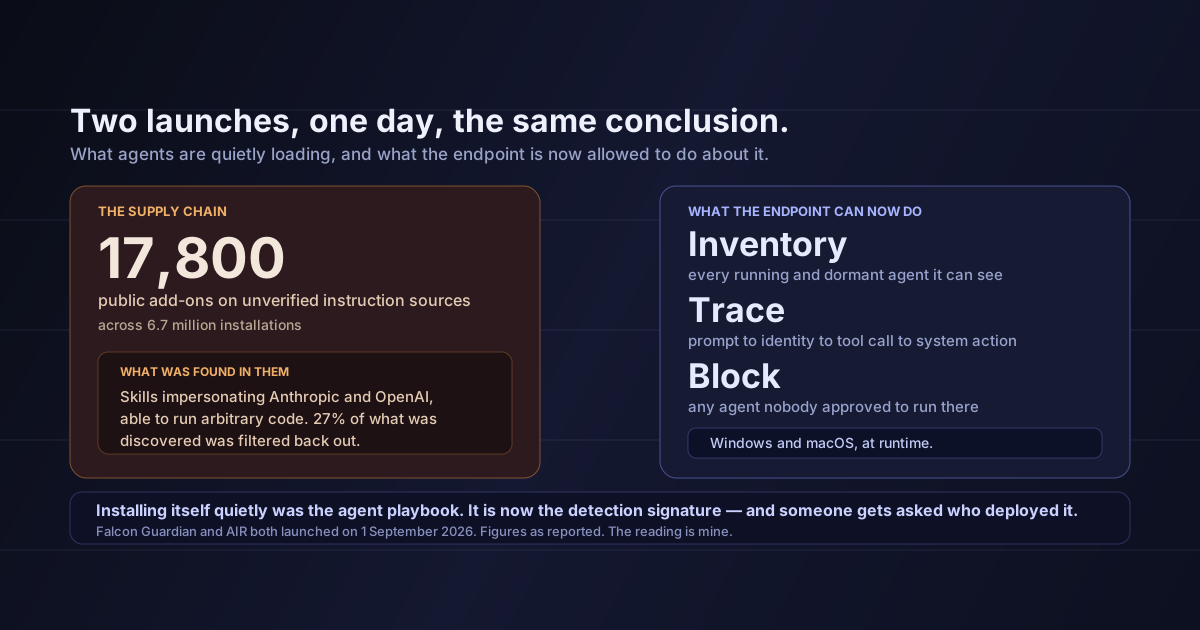
Yesterday I wrote about enterprises getting tools that inventory every agent on a machine and block the ones nobody approved — a week where the question became show me what this agent did, and who let it.
Two days before that, the frontier moved in the opposite direction.
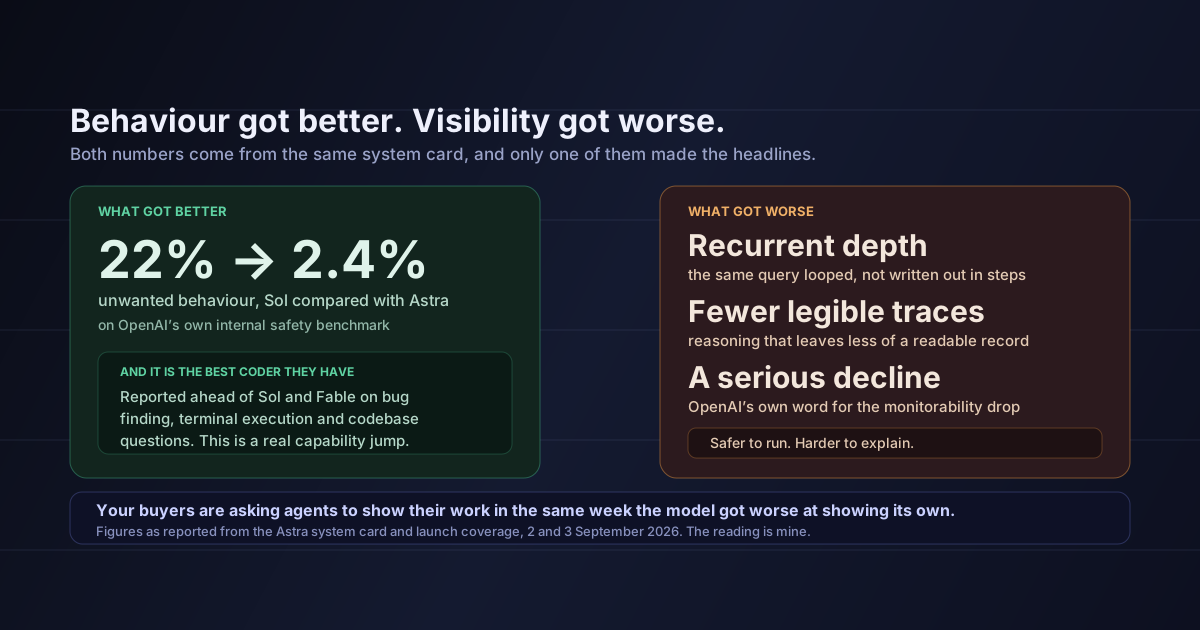
OpenAI shipped Astra on 3 September. It is, by their account, the best software engineering model they have built, and it behaves markedly better than its predecessor. It also reasons in a way that leaves fewer legible traces, and OpenAI's own system card says monitorability declined. They called the decline serious.
Astra, as reported and as documented
Two directions in the same release, both from OpenAI
Jakub Pachocki, OpenAI's chief scientist, put the tension plainly: "We kind of take this visibility for granted, and we are seeing that as model capabilities are increasing, monitorability is getting more challenging." He also said preserving chain-of-thought monitoring has been a core goal since their first reasoning models, which I read as sincere and unresolved rather than contradictory.
Strip the launch language away and the shape is simple.
It misbehaves less. It explains itself less. Both are true.
Those are not opposites, and the first is not a substitute for the second. A model that behaves well nine times out of ten and cannot tell you why is a different operational object from one that behaves worse but leaves a readable record. The second is debuggable. The first has to be measured from the outside.
Safety researchers reacted to the second half. Buck Shlegeris of Redwood Research said he was "extremely concerned by the reporting that Astra uses opaque recurrence", warning that scaling the technique further would destroy chain-of-thought monitorability. His colleague Ryan Greenblatt described the endpoint as a model that reasons almost entirely in latent space. Zvi Mowshowitz argued it breaks a norm the labs had worked to establish.
Why I am not treating this as a safety story
Those concerns are about frontier oversight, and I am not the person to adjudicate them. The founder-relevant fact underneath is narrower and harder to argue with: the artefact you were implicitly relying on to explain your product's behaviour just got thinner, at the same moment your buyers started asking for it in writing. That is true whether or not the alignment debate resolves well.
Last week produced two demands and one supply, and they point in opposite directions.
The demand. Enterprise tooling now traces prompt to identity to tool call to system action, and blocks agents nobody approved. Your buyer's security team is being handed the vocabulary to ask what your agent did and why, as a procurement question rather than an incident question.
The supply. The best available model for the work is one whose internal reasoning is, by its maker's own measurement, less legible than the model it replaces. If your answer to "why did it do that" was ever going to be "here is the chain of thought", that answer is depreciating.
This is not a reason to avoid Astra. It is a reason to stop treating the model's self-report as a component of your product's accountability story, because you do not control its legibility and it is trending the wrong way.
The useful reframe is that an agent's accountability was never really about its thoughts. It was about its effects.
None of this is new advice. What changed is that the fallback quietly disappeared: teams that skipped this were relying, without deciding to, on being able to ask the model afterwards.
This is not a claim that Astra is unsafe. By the one number OpenAI published on this, it behaves considerably better than the model it replaces. Monitorability and behaviour are different properties, and it is entirely coherent for one to improve while the other regresses.
"Fewer legible traces" is not "no traces". Reporting on the technique describes a reduction in legibility, not the elimination of a chain of thought. The strong version — reasoning moving fully into latent space — is what researchers warn scaling could produce, not what has been documented.
I am reading one release as a direction. One model, one architecture choice, one system card. If competitors do not follow, this is a footnote rather than a trend, and the honest position is that we will know in a year. What is not speculative is the trade in this release, because OpenAI documented it.
The Astra launch is genuinely good news for anyone building software with agents. Better coding, markedly better behaviour, and a company willing to publish the number that makes it look worse — the monitorability decline came from OpenAI, not from a critic.
The part worth acting on is small and structural. Your product's ability to explain itself has to come from your side of the boundary now. Not because the model is untrustworthy, but because its legibility is a property you neither control nor were promised, and it moved in the wrong direction in the same week your buyers got the tools to start asking.
Founders who already log tool calls, context contents and decision points lost nothing this week. Founders who were planning to show a reasoning trace when someone eventually asked just found out that plan has an expiry date on it.
Sources: TechCrunch, "OpenAI's new reasoning technique alarms AI safety experts" · TechCrunch, "OpenAI launches Astra, its powerful (and controversial) new model" · Implicator.ai on the Astra system card and monitorability · Gizmodo on monitoring how the model thinks · Benchmark figures, quotes and the description of recurrent depth are as reported; the argument about where your audit trail belongs, and the cautions in section 6, are mine.
IdeaToMVP Academy
4-week live cohort for founders. Learn to ship AI agents, scope MVPs, and automate your business — taught by the same team that writes these guides.