
Is the AI Revenue Actually There? The Demand-Side Answer to the Bubble Question (2026)

By Surya Pratap
August 3, 2026
12 min read
Startup Strategy

August 3, 2026
12 min read
Every serious version of the AI bubble argument eventually reduces to one unresolved question. The capex is enormous, the financing is circular, the depreciation is coming—and all of it is survivable if the revenue curve steepens on schedule. Does it? That question cannot be answered from the supply side, because the companies building the infrastructure are the last people who can tell you whether their customers are getting value. It has to be answered from the demand side: are enterprises actually paying, and are they getting anything for it?
The data on this is better than the discourse suggests, and it says something more interesting than either “it's all hype” or “adoption is exploding.” Enterprises are committing money at scale and intend to keep doing so. That money is then getting stuck at a specific, identifiable, well-documented point in the funnel. If you sell AI to businesses, that stuck point is simultaneously the biggest risk to the whole thesis and the clearest description of your market that exists.
Start with the top line. Global enterprise AI spending is projected at roughly $407 billion in 2026, up about 34.8% from $302 billion in 2025. Corporations plan to spend around 1.7% of revenues on AI this year, up from 0.8% in 2025—a doubling of the share of the business devoted to it. In many enterprises AI is expected to consume 25–50% of total IT budgets within two years. Financial services and technology lead adoption; education lags.
The single most important number for the bubble question, though, is this one: 94% of organisations say they are committed to continued AI investment even without immediate returns. That is a statement about conviction rather than results, and it cuts both ways. Bulls read it as durable demand that will not evaporate on one bad quarter. Bears read it as precisely the belief-driven spending that defines a bubble, and note that “committed regardless of returns” is not a phrase that survives a recession intact. Both are fair. What it does establish is that near-term demand is not primarily gated on ROI, which matters enormously if you are forecasting the next eighteen months.
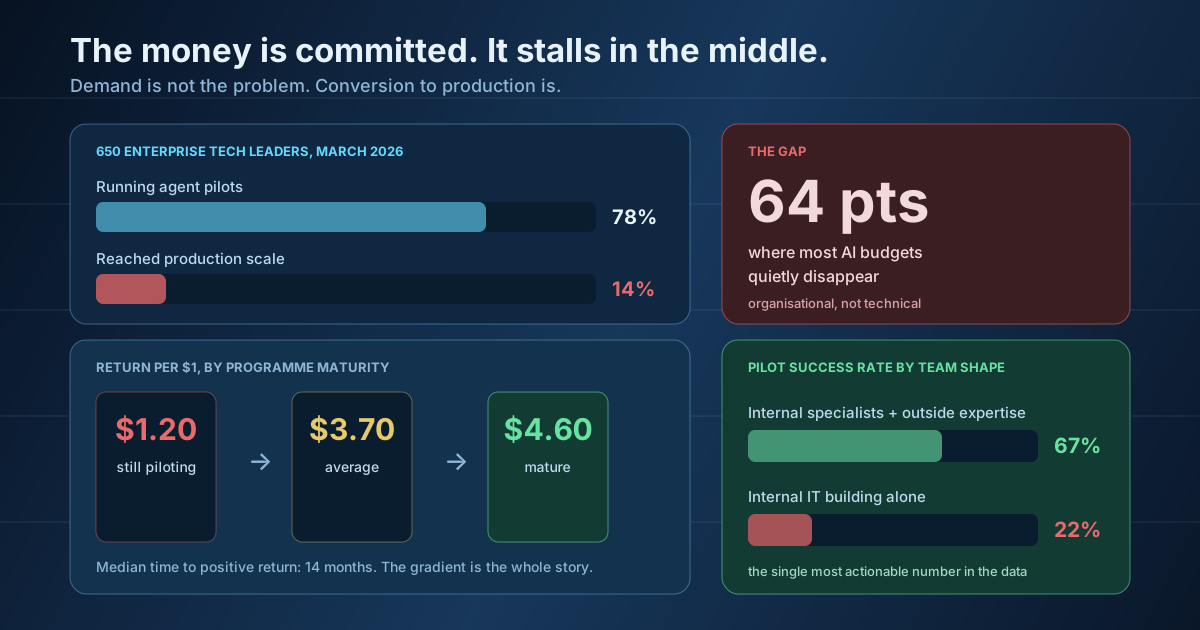
Here is where the money goes. A March 2026 survey of 650 enterprise technology leaders found that 78% of enterprises have AI agent pilots running, and only 14% have reached production scale. That 64-point gap is where most AI budgets quietly disappear—not into failed technology, but into initiatives that work in a demo and never become part of how the business operates.
Other measurements land in the same territory from different directions. IDC has found that 88% of AI pilots fail to reach production. RAND's analysis found 80.3% of AI projects fail to deliver their intended business value, with a useful breakdown: 33.8% abandoned before production, 28.4% completed but underdelivering, and 18.1% delivering some value that could not justify the cost. That last category is the quietly damning one, because those projects worked.
On the “95% of AI pilots fail” statistic
You will see this everywhere; it comes from MIT's GenAI Divide report, based on 52 executive interviews, surveys of 153 leaders, and analysis of 300 public deployments. It has also been widely criticised for how it defines failure—“no measurable P&L impact” is a demanding bar that many legitimately useful internal tools would fail. Treat 95% as directionally informative rather than precise. The 78/14 production-scale split is the sturdier number, and it tells the same story with less drama.
The returns data resolves the apparent contradiction between “most pilots fail” and “everyone is spending more.” Averages first: IDC and Microsoft put the return at roughly $3.70 per dollar spent on generative AI, with a median time to positive ROI of about 14 months. That is a good return on a slow clock—slower than most quarterly planning cycles, which is itself a large part of why programmes get killed.
But the average conceals the finding that matters. Enterprises with mature AI programmes report about $4.60 back per dollar. Companies still in the pilot phase report $1.20. Same technology, same vendors, nearly four times the return—the variable is not the model, it is how far through deployment the organisation got. Set against that, the disappointing headline figures make sense: only about 25% of initiatives delivered the ROI executives expected, only 39% of organisations report measurable EBIT impact, and while over 70% report “positive” ROI, fewer than 1% report returns above 20%, with most seeing 1–5% and often measured as productivity rather than money.
In other words: the value is real and it is concentrated in the minority who finished. Most of the spending is sitting in the part of the curve where returns are barely above break-even, because most of the spending has not crossed the gap.
Five causes account for roughly 89% of scaling failures: integration complexity with legacy systems, inconsistent output quality at volume, absence of monitoring tooling, unclear organisational ownership, and insufficient domain training data. Read that list again and notice that only one and a half of those are really about AI. The rest are integration, operations, and organisational design—the same reasons enterprise software projects have failed for thirty years.
MIT's researchers reached the same conclusion by a different route. Executives tend to blame regulation or model performance; the research pointed instead at a “learning gap” in how organisations absorb the tools, and at flawed enterprise integration. The 5% of deployments that created significant value shared three traits: tightly scoped initiatives, domain-specific focus, and smart partnerships. Nothing about model choice.
There is also a cost-shape problem worth flagging, because it kills projects that are otherwise working. Uber reportedly exhausted its full-year 2026 AI budget by April—an illustration of the token trap in consumption-based pricing, where success increases usage, usage increases cost, and a finance team that budgeted annually discovers the line item has quadrupled mid-year. A pilot that scales into an unbudgeted cost is a pilot that gets cancelled by someone who never doubted it worked.
One finding deserves to be pulled out of the pile. Pilots that blended internal AI specialists with external expertise achieved a 67% success rate. Internal IT teams building alone achieved 22%. A threefold difference, from team composition rather than technology.
If you sell AI implementation, that number is your entire pitch and you should probably lead with it. But it is more broadly useful than that. It says the binding constraint on enterprise AI is a specific, purchasable kind of experience—people who have crossed the pilot-to-production gap before and know where it eats projects. That capability is scarce, it does not come bundled with a model subscription, and it is why the “systems of action” and forward-deployed-engineering patterns keep reappearing as the shape of companies that work.
So does the revenue curve steepen? The honest answer is that it depends on something quite different from what the bubble debate usually focuses on. It does not depend on whether the next model is better—capability is not the constraint, and has not been for a while. It depends on whether a large number of enterprises get from 14% production scale to something substantially higher, which is an execution question about integration, ownership, monitoring, and cost discipline rather than a research question.
That is genuinely unresolved, and it is a reasonable thing to be uncertain about. But it is worth noticing that it is a solvable kind of problem, that the organisations who solved it are getting $4.60 per dollar, and that the gap between those two states is a market. If the AI trade is going to be vindicated, it will be vindicated by unglamorous deployment work rather than by a model release—which is a fairly good description of what the companies worth building right now actually do.
IdeaToMVP Academy
4-week live cohort for founders. Learn to ship AI agents, scope MVPs, and automate your business — taught by the same team that writes these guides.