
The AI Bubble Question Is Being Asked at the Wrong Altitude: A Founder's Guide to Which Layer Actually Deflates

By Surya Pratap
August 3, 2026
12 min read
Startup Strategy

August 3, 2026
12 min read
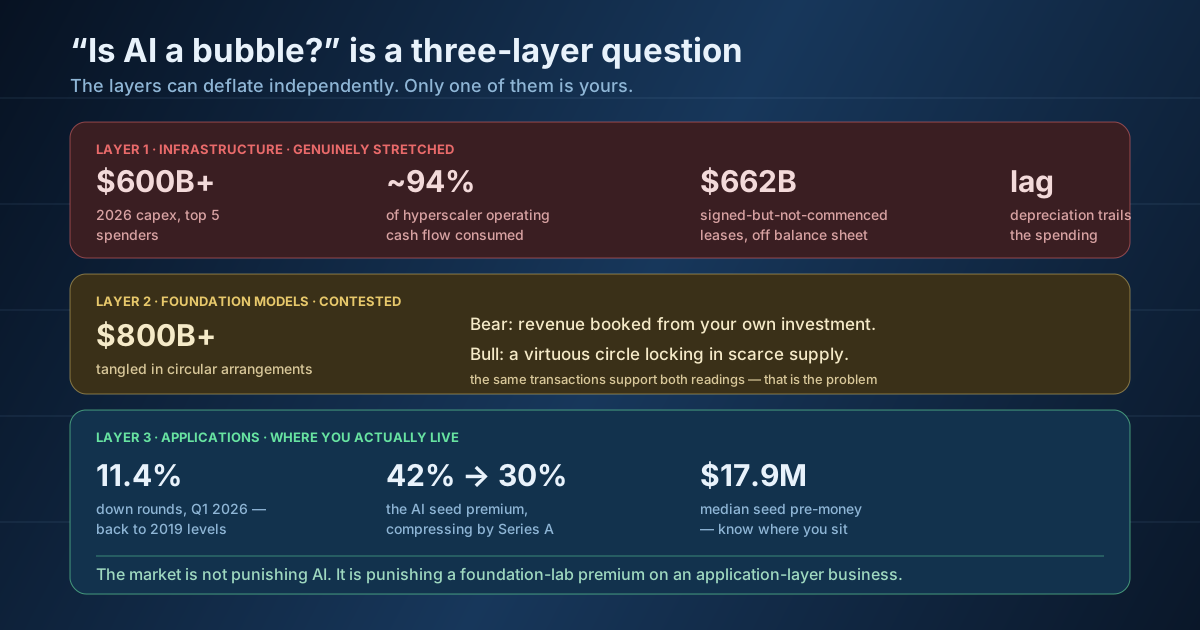
A founder asked me last week whether it is a bad time to start an AI company, because everything he reads says the bubble is about to pop. It is a reasonable question built on an unreasonable premise: that “AI” is one market with one valuation and one fate. It is not. There are at least three distinct layers here—infrastructure, foundation models, and applications—with different economics, different capital structures, and different levels of stress. They can deflate independently, and the layer generating almost all of the alarming headlines is not the layer most readers of this blog operate in.
This is not an argument that nothing is overheated. Some of it plainly is, and the numbers are worth understanding properly rather than through headlines. But the useful version of the question for a founder is narrower and answerable: which layer am I exposed to, and what specifically breaks me? Here is the state of each layer, and the one risk that actually sits on your cap table.
Start where the stress is real. The five largest US technology spenders are on course to commit over $600 billion in capital expenditure in 2026, with roughly 75% of aggregate hyperscaler capex going to AI infrastructure—about $450 billion of AI-specific spending in a single year. The question is not whether that is a large number. It is where the money comes from and what happens to it on the balance sheet.
On the first: PIMCO estimates combined hyperscaler capex will consume approximately 94% of operating cash flow across 2026–2027. That is a company spending nearly everything it earns, which is why the funding is increasingly coming from debt. Moody's has flagged roughly $662 billion of signed-but-not-commenced data-centre leases sitting off balance sheet—obligations that are real but not yet visible in the way a bond issuance would be. PIMCO's own May 2026 assessment is admirably plain: AI is in a capex boom with genuine risks including uncertain monetisation, potential overbuild, shortening asset lives, and growing reliance on debt.
On the second, there is a mechanic worth understanding because it explains why the reported numbers look better than the underlying economics. When capex triples inside three years, reported depreciation mechanically lags—the spending hits now, the charges arrive over the following years. So margins today reflect an asset base that has not finished being expensed. Analysts project Alphabet's depreciation rising by roughly $57 billion over four years. That is not a scandal or an accounting trick; it is how depreciation works. But it does mean the margin picture at this layer gets worse from here even if demand holds perfectly, and anyone forecasting off current margins is forecasting off a number with a known expiry.
The most-cited bubble evidence is circular financing: a chipmaker invests billions in an AI company, that company spends the money buying the chipmaker's chips, and the chipmaker books it as revenue. Analysts have identified more than $800 billion in criss-crossing arrangements across the AI supply chain, with Nvidia, OpenAI, Oracle, AMD and Microsoft appearing on multiple sides of the same transactions.
The bear reading is that this makes demand look larger than it is, and creates a self-reinforcing loop: rising valuations justify heavier capex, heavier capex signals explosive future demand, and that signal reinforces the valuations. The loop holds only while the revenue curve steepens on schedule. The bull reading, argued by asset managers including Janus Henderson, is that this is a virtuous circle—building AI is extraordinarily expensive, supply of advanced compute is genuinely scarce, and pairing long-term purchase commitments with financing is how you lock in capacity you would otherwise lose to a competitor.
Both readings fit the same transactions, which is precisely the problem. Vendor financing is normal industrial practice and it is also a classic late-cycle warning sign, and you generally cannot tell which one you are looking at until the demand either materialises or does not. A founder does not need to resolve this. What is worth taking from it is that this layer's stability depends on assumptions about future revenue that no one outside those companies can currently verify.
Two things that are both true
A painful valuation correction can arrive and the infrastructure being built can become the foundation of the most important platform of this generation. That is roughly what happened with the late-1990s fibre buildout: the capital was destroyed, the fibre stayed in the ground, and the companies that used it later were mostly not the ones that laid it.
Now the layer most founders reading this actually occupy—and the numbers here look nothing like the headlines. Down rounds across all venture fell to 11.4% in Q1 2026, back to 2019 and 2020 levels. That is not a market in the middle of a bust. That is a market that already reset and largely finished resetting.
The nuance is that a low average is cold comfort if you are in the specific population that got over-marked. Seed-stage AI startups have generally carried valuations about 42% above non-AI peers, on the belief that they grow faster. That premium compresses hardest at exactly the moment it matters—the seed-to-Series-A transition—falling from north of 40% toward roughly 30%. Median seed pre-money sits near $17.9 million; if your round priced well above that, you have taken on materially more growth pressure than the headline number suggests.
Which produces the sentence that should reorganise how founders think about this entire topic: the market is not punishing AI broadly. It is punishing AI companies that took a foundational-model premium on an application-layer business. The risk is not that you built in AI. It is that you were priced as though you were a different kind of company than you are, and the next round will price you as what you actually are.
If layer one wobbles, the transmission into your business runs through three channels, and it is worth being specific rather than anxious.
Inference pricing. The consensus assumption baked into most startup models is that token costs keep falling. That has been true and may continue. But a capital pullback at the infrastructure layer is exactly the scenario in which it stops—capacity gets scarcer and providers stop subsidising. If your unit economics only work at next year's assumed price, you have written a forecast, not a business model.
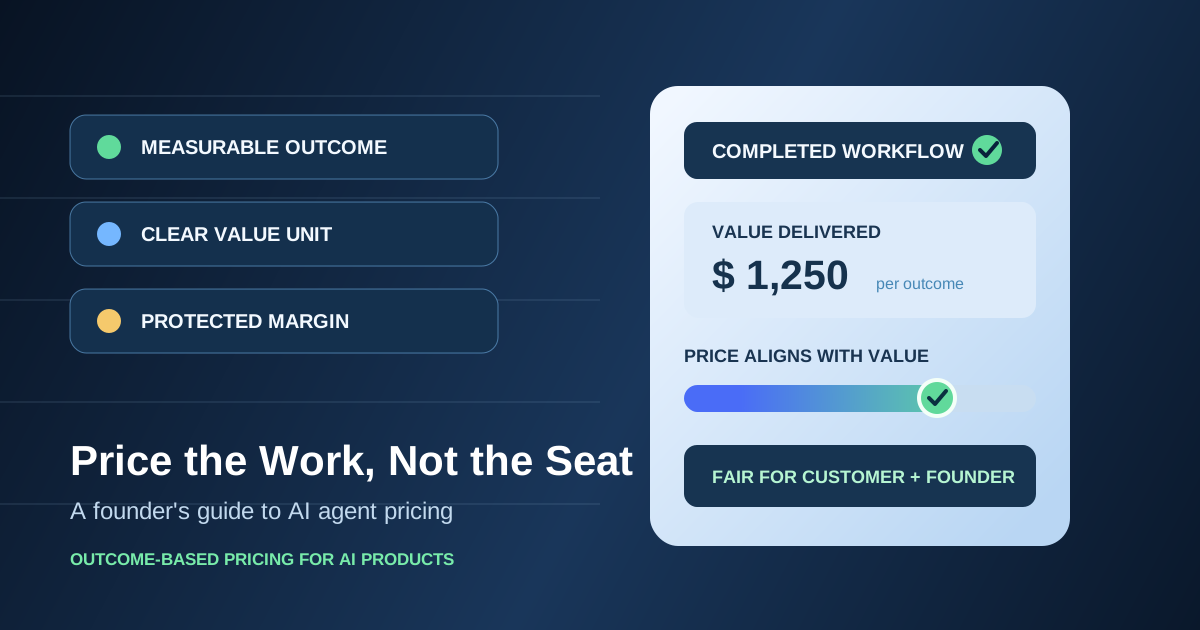
Capital availability. Venture funding for the application layer is not directly tied to hyperscaler capex, but sentiment is correlated and LPs read the same headlines. The practical consequence is not that money disappears; it is that the bar moves toward retention, gross margin, and pricing power, and away from growth narratives. Investors have signalled 2026 as the year the market weeds out young AI startups, with thin-margin companies most exposed.
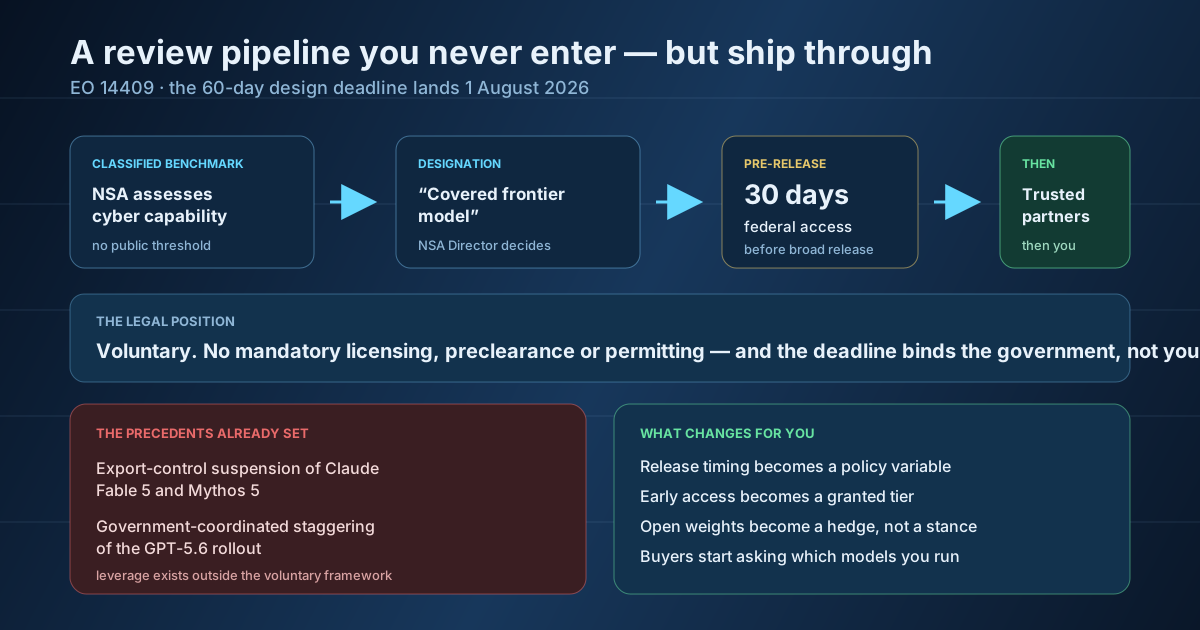
Provider concentration. This is the one most within your control, and it compounds with the policy risk covered elsewhere on this blog. A company whose entire product depends on one provider's pricing, availability, and release schedule has an exposure it did not choose and cannot hedge after the fact.
The honest summary is that the alarming numbers are real and mostly belong to someone else's balance sheet. Hundreds of billions in capex funded increasingly by debt, depreciation charges arriving on a known schedule, and $800 billion of transactions that look different depending on which way demand breaks—those are genuine risks, concentrated in a handful of very large companies. Meanwhile the layer where a founder builds a product looks like a normal, somewhat selective venture market that already had its correction.
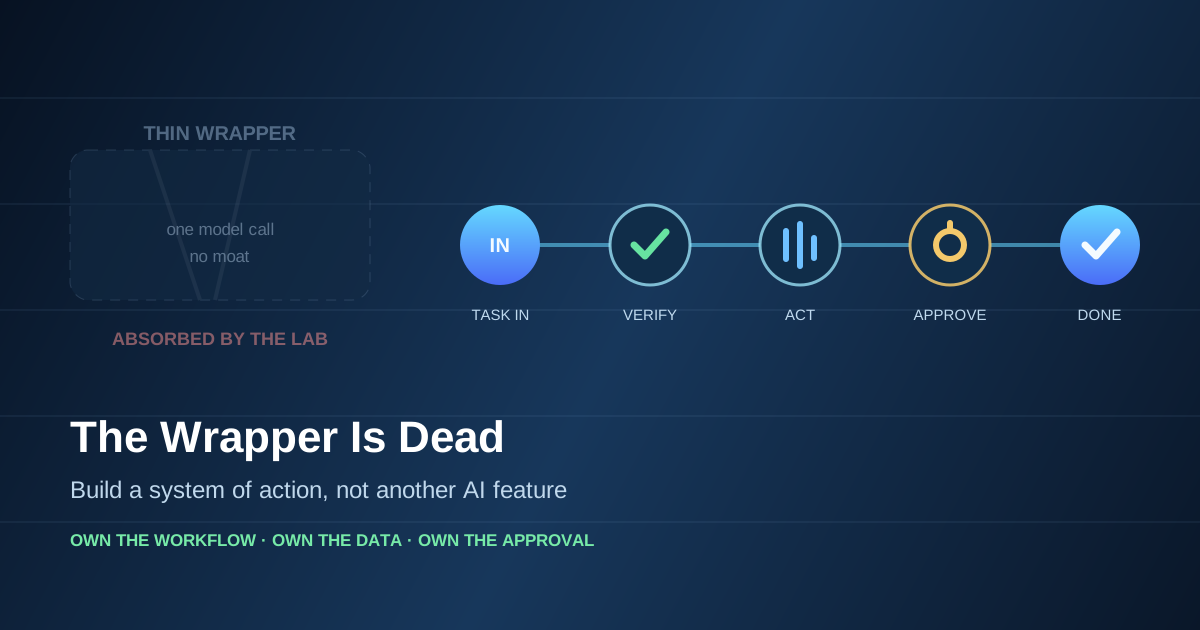
So the answer to the founder who asked me: it is not a bad time to start an AI company. It is a bad time to start one whose economics only work if compute keeps getting cheaper, whose valuation was borrowed from a different layer of the stack, and whose product has no answer to the question of what it does that a model provider will not simply absorb. Those were always the wrong companies to build. The bubble discourse has just made the consequences arrive sooner.
IdeaToMVP Academy
4-week live cohort for founders. Learn to ship AI agents, scope MVPs, and automate your business — taught by the same team that writes these guides.