The Best Gen AI Course for a Complete Beginner? Answer Three Questions First

By Surya Pratap
September 26, 2026
9 min read
Guides & Tutorials

September 26, 2026
9 min read
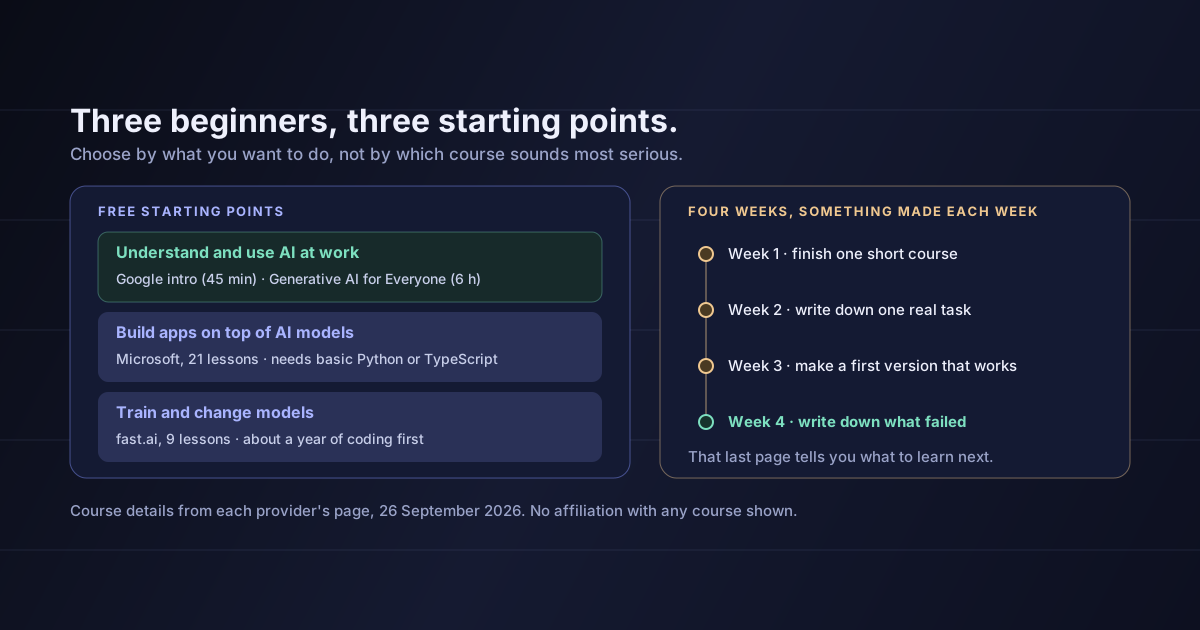 Three beginners, three starting pointsHover to explore
"What's the best Gen AI course for a complete beginner?" turns up on Reddit every few months, in different subreddits, worded almost the same way. The replies are nearly always a list of course names. This article is a different kind of answer. We sell AI training, and for a complete beginner our honest advice is not to pay anyone yet.
The question is taken from two Reddit threads asking it months apart, in r/ArtificialInteligence and in r/learnmachinelearning. I cite them as evidence that the question keeps coming back, not for what their commenters recommended. Course details come from each provider's own page as at 26 September 2026 and will change. Completion research is cited in section 1. We have no affiliation with any course named here.
Before choosing a course, it is worth knowing how people usually fail to learn from one. Mostly, they never finish, and often they never start.
In 2019 Justin Reich and José Ruipérez-Valiente published an analysis in Science of every MOOC offered on edX between 2012 and 2018. It found that most learners never came back after their first year, and that completion rates, which were low from the beginning, had not improved in six years. A 2024 study that cites their work summarises another of its findings: 52% of people who register for a MOOC never start the course.
How low "low" is depends on what you count. A 2024 study of four MOOCs by Berkan Celik and Kursat Cagiltay, covering 15,805 enrolments, found an overall completion rate of 30.02% of everyone who enrolled, 43.08% of those who actually started, and 48.13% of those who said they intended to finish. So even among people who planned to finish, fewer than half did.
Choosing a course feels like progress, but it isn't the hard part. Finishing the course, and then using what you learned, is.
Nothing on the list below is bad. Several of them are excellent and free. What decides the outcome is usually the three questions that come before the list.
What will you do with it? "Learn generative AI" can mean understanding enough to use it well in your current job. It can mean building software that calls an AI model. Or it can mean training and changing models yourself. These are three different skills with three different starting points, and a course built for one is frustrating for the other two.
Can you code, honestly? Not "I did a tutorial once". Can you write a short Python or JavaScript script that reads a file and calls a web API, without copying every line? If yes, the building track is open to you. If no, start with the understanding track. In our experience, trying to learn to code and learn AI at the same time is one of the most common ways beginners stall.
What is one real task you want to change? A report you write every week. An inbox you sort. A spreadsheet you clean. Pick it before you start. A course with no task to apply it to is entertainment, and it will lose to your other commitments by week two.
There are three tracks: understanding, building and training. All of these are free to start, from providers whose names you will recognise.
| If you want to… | Start with | Time | Needs code? |
|---|---|---|---|
| Understand and use AI at work | Google's Introduction to Generative AI | 45 minutes | No |
| …and go a level deeper | DeepLearning.AI's Generative AI for Everyone, taught by Andrew Ng | About 6 hours over 3 modules | No |
| Build apps on top of AI models | Microsoft's Generative AI for Beginners | 21 lessons | Basic Python or TypeScript |
| Train and change models | fast.ai's Practical Deep Learning for Coders | 9 lessons of about 90 minutes | About a year of coding |
A few notes on each, from their own pages:
A common wrong turn
In our experience, many people who say "complete beginner" belong on the understanding track, but choose a course from the building track because it sounds more serious. They then spend three weeks setting up Python environments and API keys, and conclude that AI is not for them. It is — they started on the wrong track.
The course is week one. The rest is where the learning actually happens.
Pick the track that matches your answers in section 2 and finish it, including the parts that feel obvious. Finishing a six-hour course is worth more than starting a forty-hour one.
What goes in, what comes out, how long it takes you now, and what "good" looks like. That description is most of a prompt, most of a specification, and most of an evaluation, whichever track you are on.
On the understanding track, that is a written prompt or workflow you actually use three times. On the building track, it is a small script or app. On the training track, it is a model trained on your own examples. Ugly is fine. Working on a real input is the bar.
Where it was wrong, what it made up, what took longer than doing it by hand. This page is the most valuable thing you will produce in the month, because it is what tells you what to learn next — and it is the thing no course can give you.
By the end you have a finished course, a real task, a working first attempt, and a list of where it breaks. That is a better position than three half-watched courses and a certificate.
Paid courses are not bad. Some of them are the best way to learn, including ours. But for a complete beginner, a few signs are worth taking seriously.
It sells the certificate harder than the skill. A certificate that says you watched videos does not show that you can do anything. If the sales page leads with the credential, the course is organised around finishing, not learning.
It is a tour of tools. "Twenty AI tools in ten hours" dates within months, because the tools change. Look for a course that teaches something that lasts, like how to specify a task or how to check an output.
Nothing is made at the end. If you cannot say what you will have built or written when you finish, you will not have built or written anything.
It does not say who it is not for. A good course tells you who should skip it. A course that claims to suit complete beginners and experienced engineers equally is probably right for neither.
We run the IdeaToMVP Academy, and I would not send a complete beginner to it first.
Our masterclass says on its own page that it is not for people who want a no-code overview of agents. It assumes you can follow an implementation. Our corporate programmes are for teams, scoped with an organisation, and they assume people who will build or run AI systems at work. Both work best for someone who has already done the four weeks above — someone who has written that page of failures and wants help with the problems on it.
So the order we recommend: do a free course, apply it to one task, write down what broke, and then decide whether paid training is worth it. At that point you will know what you need.
IdeaToMVP Academy
4-week live cohort for founders. Learn to ship AI agents, scope MVPs, and automate your business — taught by the same team that writes these guides.
I have not reproduced the Reddit threads' answers. They are cited to show the question keeps coming back. Anything recommended in them is not reflected here.
The course details will change. Enrolment counts, ratings, lesson counts and prices are what each provider's page showed on 26 September 2026. Check the page before you enrol.
The completion research is not about these courses. The Science analysis covers edX MOOCs up to 2018, and the 2024 study covers four courses on Turkey's Bilgeİş MOOC portal. They describe a general pattern in online learning, not the completion rate of any course named here.
The three-track split is a simplification. Plenty of people move between tracks, and some learn to code and learn AI at the same time successfully. The split describes where most beginners should start, not where they have to stay.
We sell training. This article recommends free courses first, which is the opposite of our commercial interest in the short term. Read the section 6 advice with that in mind either way.
The best generative AI course for a complete beginner is the short, free one that matches what you want to do, finished in a week, and then applied to one real task. For most people that means Google's 45-minute introduction or Generative AI for Everyone. For people who already code, it means Microsoft's course. For people who want to train models, it means fast.ai.
The course is not the hard part. Finishing it is, and so is using what you learned on something real in the weeks afterwards.
Pick one track, finish one course, and have something you built by week four. Then decide what to learn next.
Sources: the question, as asked in r/ArtificialInteligence and r/learnmachinelearning. Justin Reich and José A. Ruipérez-Valiente, "The MOOC pivot", Science 363 (2019), 130–131 — edX MOOCs, 2012 to 2018; the finding that completion rates had not improved in six years. Berkan Celik and Kursat Cagiltay, "Uncovering MOOC Completion: A Comparative Study of Completion Rates from Different Perspectives", Open Praxis, 2024 — the 30.02%, 43.08% and 48.13% completion rates across 15,805 enrolments, and its citation of the 52% never-start figure. Course details from each provider's own page as at 26 September 2026: Google Skills, Introduction to Generative AI; Coursera, Generative AI for Everyone; Microsoft, Generative AI for Beginners on GitHub; fast.ai, Practical Deep Learning for Coders. Masterclass audience from our own masterclass page. For how teams measure AI skills, see only 13% can work with AI agents. For why company training often fails to land, see 47% of employees say the AI training is there to automate their job.
IdeaToMVP Academy
4-week live cohort for founders. Learn to ship AI agents, scope MVPs, and automate your business — taught by the same team that writes these guides.