AI Training More Than Doubled This Year. 56% of Employees Still Get No Time at Work to Do It

By Surya Pratap
October 1, 2026
9 min read
AI & Technology

October 1, 2026
9 min read
 The course grew. The calendar didn't.Hover to explore
Our earlier articles on corporate AI training were about what goes into a programme: the skills gap it leaves, the fear it creates, the managers it skips. Three surveys published in the last week of September point at something more basic. The training now exists. The time to take it mostly does not.
Figures come from Workera's 2026 State of Skills Intelligence Report (23 September 2026), PwC's 2026 Global Workforce Hopes and Fears Survey as reported by The Next Web (29 September 2026), and Businessolver's State of Workplace Empathy research (29 September 2026). All three publishers sell products or services in this area, which is noted in section 6. The reading from section 3 onward is mine.
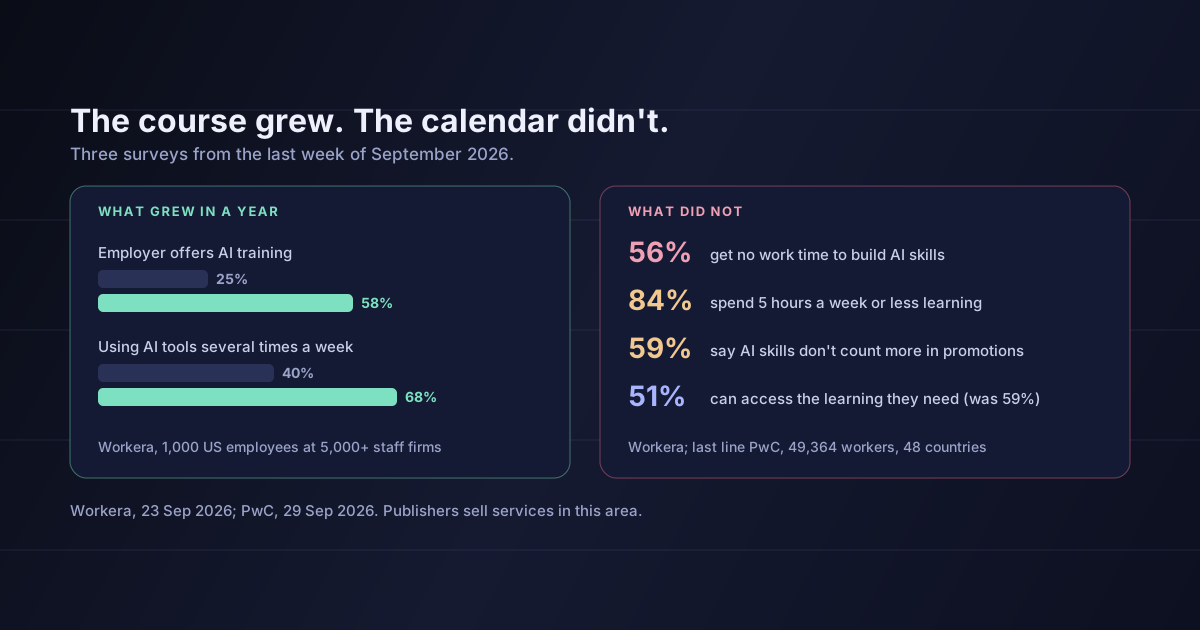
Workera surveyed 1,000 full-time salaried employees at US companies with more than 5,000 staff in July 2026, and compared the results with a similar survey of 800 people in March 2025.
Two numbers moved sharply in that time:
PwC's global survey, covering 49,364 workers in 48 countries and regions between May and June 2026, shows the same direction. 64% used AI at work in the past year, up ten points, and the share using generative AI every day rose from 14% to 22%.
By any measure, employees are being offered more AI training, and they are using AI more.
The same surveys show what did not keep pace.
56% of Workera's respondents say they get no time during work hours to build AI skills, and 84% spend five hours a week or less on skill development of any kind.
In PwC's survey, the share of workers who can access the learning and development they need fell from 59% to 51%. Among the largest group PwC identifies — the 56% of workers it calls the "engine room", with neither scarce skills nor much AI experience — it was 40%.
Businessolver, surveying 300 C-suite leaders and 1,000 employees, found 49% of employees say they have been left to figure out AI on their own. Workera found only 27% get regular coaching from their manager, and 22% never get individual coaching at all.
59% of Workera's respondents say AI skills get equal or no weight in promotions and assignments. 43% say they have been passed over for an opportunity because their skills were misjudged.
A course that has to be taken in someone's own time, for no credit, without a coach, is not a training programme. It is a reading list.
A year ago, the obvious problem was supply. Most employees at large companies said they were not offered any AI-specific training. That has largely been fixed: the share who are has more than doubled.
What has not been fixed is the assumption underneath most of those offers — that learning happens somewhere outside the working week. In practice, that means evenings, which means it does not happen for most people, and happens unevenly for the rest.
PwC's segmentation shows where that unevenness leads. The workers who already use AI daily are more confident about their jobs (68% against 57% of infrequent users), more likely to trust management, and more likely to believe they can learn new skills. The ones without access fall further behind. Peter Brown, PwC's global workforce leader, put it directly: "There is a real risk that the global workforce is starting to move at different speeds."
That is the outcome a no-time training offer produces. The people who would have learned anyway learn. The people the programme was meant for do not.
Businessolver's survey adds an uncomfortable finding. 27% of the executives it surveyed list cost savings through headcount reduction as a top goal for AI. Among those executives, only 18% prioritise AI upskilling, against 35% of the other executives surveyed.
Its chief AI officer, Sony SungChu, summarised the problem: "AI does not create value on its own. People create value when enabled with skills and confidence."
The logic is easy to see from the inside. If AI is expected to reduce headcount, investing in the people who remain looks like the opposite of the plan. But the efficiency only arrives if the remaining people can actually use the tools well. Cutting the training budget to fund the AI budget removes the part that makes the AI work.
If you are buying or designing AI training this quarter, the surveys suggest four things to specify that most programmes leave out.
Protected hours, written down. A number of hours per person per week, in the working week, agreed with each participant's manager before the programme starts. If the programme cannot say how many hours it needs, it has not been scoped.
Learning on real work. Exercises built on tasks the participant already does, so the hours spent learning also move real work forward. A recurring report drafted and checked with AI is training and output at the same time.
A coach who is not a video. Only 27% get regular coaching from their manager. Pair the programme with a named person who reviews participants' work — a manager briefed for it, or a facilitator — so practice gets feedback.
Visible credit. If 59% say AI skills do not count in promotions, people will rationally treat training as optional. Tie completion to something observable: a reviewed piece of work, a changed process, a line in the review cycle.
One test is worth applying to any programme, including ours: ask the provider how many working hours per participant the programme needs, and ask yourself whether those hours have been found. If either answer is vague, the programme will be one more offer that most people cannot take.
Every source here has something to sell. Workera sells skills measurement, Businessolver sells benefits technology, and PwC sells workforce consulting. The three findings point the same way, which helps, but the framing of each release suits its publisher.
Workera's sample is US large companies only. 1,000 employees at organisations with more than 5,000 staff. The year-on-year comparison is between two different samples, of 800 and 1,000.
None of the surveys links time to outcomes. Workera's release does not show that people with protected learning time became more proficient. That time matters is a reasonable inference from the other figures, not a measured result.
"No time during work hours" is self-reported. Some respondents may have time available that they do not recognise as such. The figure describes how employees experience the offer, which matters, but it is not a timesheet.
Our own programmes are not evidence here. We design training around participants' real work because we think that is how learning time becomes productive time. That is a design choice, not a measured outcome, and we cannot give your people time — only you can.
Companies spent the past year solving the supply problem in AI training, and largely solved it. The share of employees offered it more than doubled. What they have not supplied is the time, the coaching and the credit that let people take it.
The result is predictable. The employees who would have learned on their own time do so and pull further ahead. The majority the training was bought for do not, and the gap PwC describes — a workforce "moving at different speeds" — widens.
Before you buy more AI training, find the hours. A programme that fits inside the working week will reach more people than a better one that does not.
Sources: Workera, "AI Training More Than Doubled This Year, but 56% of Employees Report No Time at Work to Build the Skills", 23 September 2026 — the 2026 State of Skills Intelligence Report, 1,000 full-time salaried employees at US organisations with more than 5,000 staff, surveyed in July 2026 and compared with 800 in March 2025; the 25% to 58%, 40% to 68%, 56%, 84%, 27%, 22%, 59% and 43% figures are as reported there. PwC, 2026 Global Workforce Hopes and Fears Survey, 49,364 workers in 48 countries and regions, May–June 2026, as reported in "PwC survey of 49,000 workers finds most are falling behind on AI skills", The Next Web, 29 September 2026, and PwC's release — the 64%, 14% to 22%, 59% to 51%, 40%, 56% engine-room and 68% against 57% figures, and Peter Brown's quote. Businessolver, "New Data Finds Executives Focused on Cutting Jobs for AI Efficiency Are Half as Likely to Invest in AI Upskilling", 29 September 2026 — 300 C-suite leaders and 1,000 employees; the 27%, 18% against 35% and 49% figures and Sony SungChu's quote. The reading in sections 3 to 5 is mine. For the earlier pieces in this series, see 82% of companies run AI training and 59% still report a skills gap, 50% of CHROs don't trust managers to guide AI use and our enterprise AI training, specified.
IdeaToMVP Academy
4-week live cohort for founders. Learn to ship AI agents, scope MVPs, and automate your business — taught by the same team that writes these guides.