How Founders Can Get Discovered in AI Search: A Practical GEO Playbook for 2026

By Surya Pratap
July 23, 2026
8 min read
Startup Strategy

July 23, 2026
8 min read
A prospect no longer has to start with ten blue links. They can ask an AI assistant, “What tools help a small operations team reconcile invoices?” or “Which product should I use to prepare customer-security questionnaires?” The answer may name products, compare approaches, and link to a handful of sources. For an early-stage founder, that changes distribution: being understandable and trustworthy to an answer engine is becoming as important as being indexable by a search engine.
Generative engine optimization—GEO—is not a trick for forcing a mention. It is the discipline of making your product information sufficiently clear, specific, and supported that a system can use it when answering a real buyer question. The strongest approach is also good marketing: say precisely who the product is for, what job it completes, what evidence supports the claim, and where a buyer can verify it.
A generic homepage statement such as “the leading AI platform for modern teams” gives an answer engine almost nothing to work with. It does not identify the user, the workflow, the inputs, the outcome, or the reason to believe the claim. Replace it with a concrete statement: “Acme helps accounts-payable teams match purchase orders, invoices, and receipts before approval.” Then show how it works, where it fits, and which limitations apply.
This is especially important for a new company. You may not have decades of brand authority, but you can publish the clearest primary explanation of a narrow customer problem. Specificity is an advantage when larger competitors are still speaking in categories.
A one-sentence product test
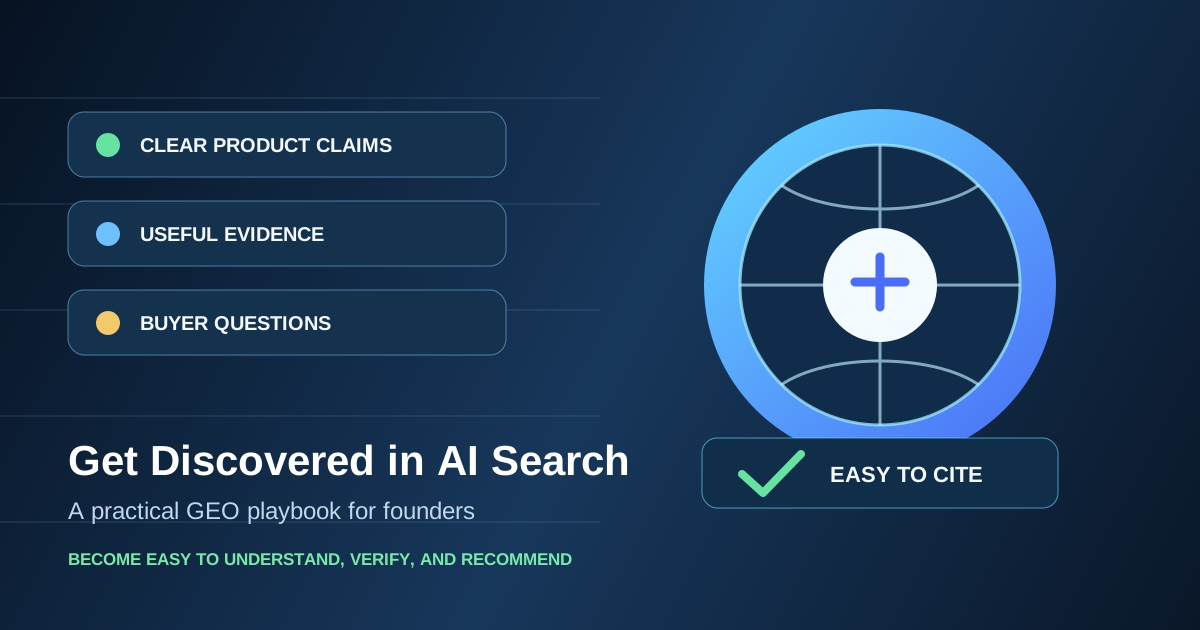
A visitor—and an AI system—should be able to answer four questions from one page: who is it for, which job does it complete, what does the workflow look like, and what proof supports the result?
Your navigation might call a feature “Autonomous Resolution Engine.” A buyer asks, “Can this reduce first-line support tickets without giving an AI access to everything?” Those are different languages. Create focused pages that answer the buyer's question directly: the use case, the setup required, the operating boundaries, alternatives, and the expected result.
Do not manufacture dozens of thin pages for every phrase. Publish a small set of pages your sales team would confidently send to a serious prospect: a use-case page, an integration page, a comparison page when the comparison is fair, a pricing explanation, and a technical or security overview where relevant.
Inconsistent names create needless ambiguity. Use the same company name, product name, logo, short description, and primary URL across your website, social profiles, directories, and product listings. Keep founder bios and company facts current. Include a clear contact path and real authorship on substantive content.
Structured data helps machines interpret a page, but it cannot rescue unclear content. Add accurate organization, product, article, and FAQ markup where it genuinely reflects visible page information. Never mark up reviews, prices, or capabilities that are not presented honestly to a human visitor.
AI answer engines are more likely to use material that can be traced to a reliable source. Publish original material that earns a citation: a transparent benchmark methodology, a documented workflow, a customer case study with permission, an implementation guide, or a useful template. Cite primary sources when you make market or technical claims. Date content that can become stale and update it when the facts change.
Trust also comes from boundaries. If your product does not replace a licensed professional, say so. If a feature requires human approval, explain it. A cautious, specific claim is easier to recommend than a broad promise that cannot survive a buyer's follow-up question.
There is no single authoritative GEO score. Start with a list of high-intent buyer questions and review how your product appears in relevant answer experiences over time. Use web analytics to identify referral traffic, assisted conversions, branded-search growth, and the landing pages that turn visitors into conversations. Ask new customers how they first heard about you, then record the wording they use to describe the problem.
The objective is not a screenshot of your product appearing in one answer. It is a repeatable path from a credible answer to a useful product page to a qualified conversation.
The real advantage in AI search is not gaming an answer engine. It is becoming easy to understand and safe to recommend. Founders who make their product claims precise, publish proof, and answer buyer questions better than anyone else create a distribution asset that works in conventional search, sales conversations, and the next generation of discovery tools.
IdeaToMVP Academy
4-week live cohort for founders. Learn to ship AI agents, scope MVPs, and automate your business — taught by the same team that writes these guides.