Shopify Just Let Any AI Agent Shop a Billion Products. Your Product Data Is Now Your Storefront

By Surya Pratap
October 15, 2026
9 min read
AI & Technology

October 15, 2026
9 min read
 Two doors, both openHover to explore
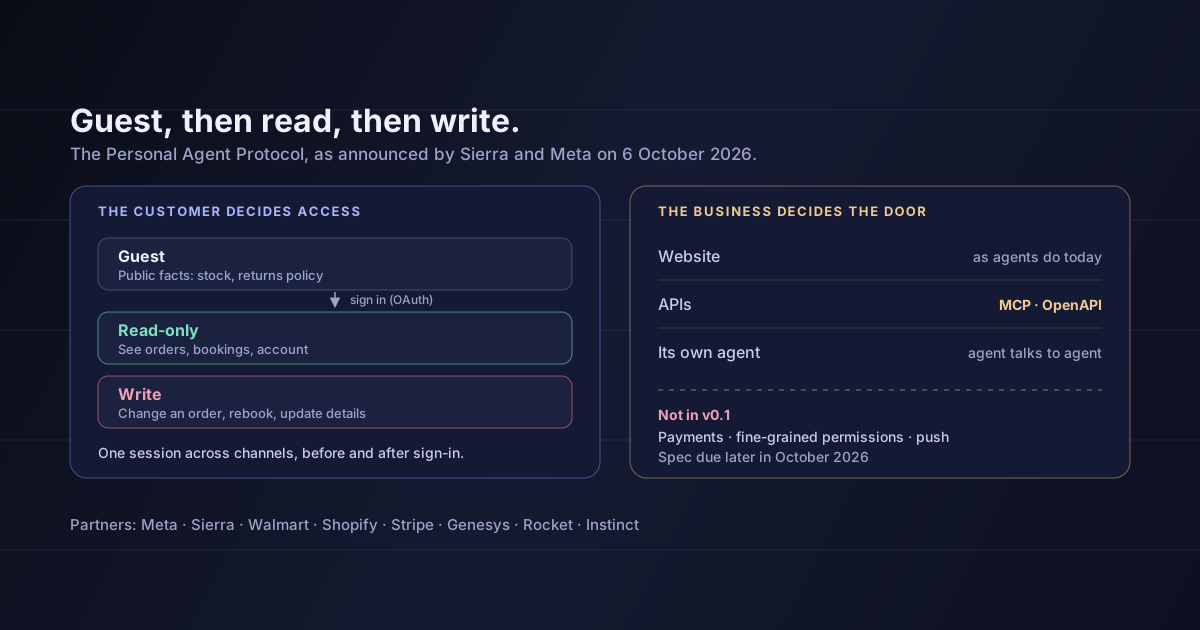
A week ago we wrote about the Personal Agent Protocol, a standard for how AI agents should sign in to businesses — with no spec published yet. Shopify, one of its partners, has not waited. In about two weeks it has opened checkout to browser agents and its entire catalog to any agent that speaks MCP.
This article is based on Shopify's announcements as reported by TechCrunch and Search Engine Journal (28 September 2026), and by The Verge and Fintechnize (13 October 2026). The performance figures are from Shopify's own test and have not been independently checked. The reading from section 4 onward is mine.
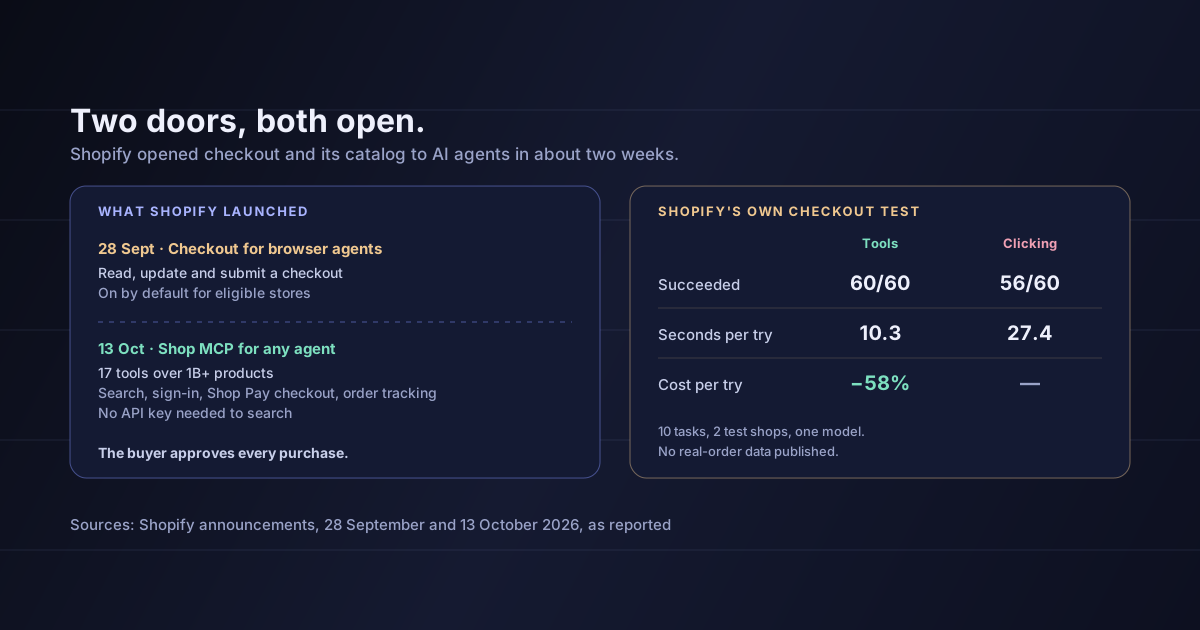
28 September: checkout for browser agents. Shopify added three tools — get_checkout, update_checkout and complete_checkout — to the WebMCP support already on its storefronts. A browser-based agent can now read a checkout, change contact, shipping and payment details, apply discount codes and submit the order after the buyer confirms. It cannot change the items in the order. The tools are on by default on eligible stores: merchants do not install an app or change a setting.
13 October: Shop MCP. Any MCP-compatible agent can now connect once and get 17 tools across a catalog of more than a billion products: product discovery, shopper authentication, Shop Pay checkout and order tracking. Searching the catalog needs no API key. The catalog includes products sold off Shopify, too.
How purchases work depends on where the product is sold:
Either way, the buyer approves every purchase. Shopify pitches it as a personal shopper you can give rules to, such as a budget limit or "only show items with fast shipping".
Both launches sit on the Universal Commerce Protocol's checkout capability, a standard Shopify backs. Meta's Muse and Instinct have direct agentic commerce partnerships with Shopify.
Shopify published a comparison when it launched checkout for browser agents. Using GPT-6 Sol on ten checkout tasks across two test shops, it compared its structured tools with an agent clicking through the checkout page like a person:
| Structured tools (WebMCP) | Browser automation | |
|---|---|---|
| Successful attempts | 60 of 60 | 56 of 60 |
| Time per attempt | 10.3 seconds | 27.4 seconds |
| Cost per attempt | 58% lower | — |
Gil Greenberg, a staff product manager for agentic commerce at Shopify, summed up the point: "Shopping with an agent shouldn't feel like watching paint dry."
An agent that can call a checkout tool finishes faster, cheaper and more reliably than one that has to read the page. Whoever offers the tool gets the order.
If you sell on Shopify, agents can already reach your checkout and your catalog, whether or not you did anything. The agent will not see your homepage, your photography or your brand story. It sees your product data.
Fix the data an agent reads. Accurate titles, full variant data, real stock levels, clear shipping times and an explicit returns policy. If a shopper tells their agent "fast shipping only" and your delivery estimate is missing, you are filtered out before anyone sees you.
Tag agent orders yourself. Until Shopify reports them separately, look for patterns — checkout speed, the Shop app approval path, single-use cards — and tag what you can. You will want to know whether agent orders return more, or churn less, before they are a large share.
Price for comparison. A person may stop at the first good option. An agent with a budget rule will compare. Expect more price-sensitive traffic on commodity products and make sure your differentiation is in the data — warranty, bundle, delivery — not just in the copy.
Decide your position on defaults. Agent checkout is on by default. That is probably good for most merchants, but it is a decision you should make on purpose — for example, if you sell age-restricted, regulated or made-to-order products.
Our GEO playbook covers being cited in AI answers. This is the step after: being chosen and bought by an agent that never shows the shopper your page.
A year ago, an AI shopping assistant's hardest job was integrations: deals with retailers, scrapers that broke every week, checkout flows that needed a human. One MCP connection now gives any agent search, sign-in, checkout and order tracking across a billion products.
That moves the competition somewhere else:
Build on the tools, not around them
If you are building a shopping or procurement agent, start with Shop MCP for search and checkout instead of writing scrapers or browser automation. Spend the time you save on the parts no catalog provides: understanding the buyer, enforcing their rules and handling what happens when an order goes wrong.
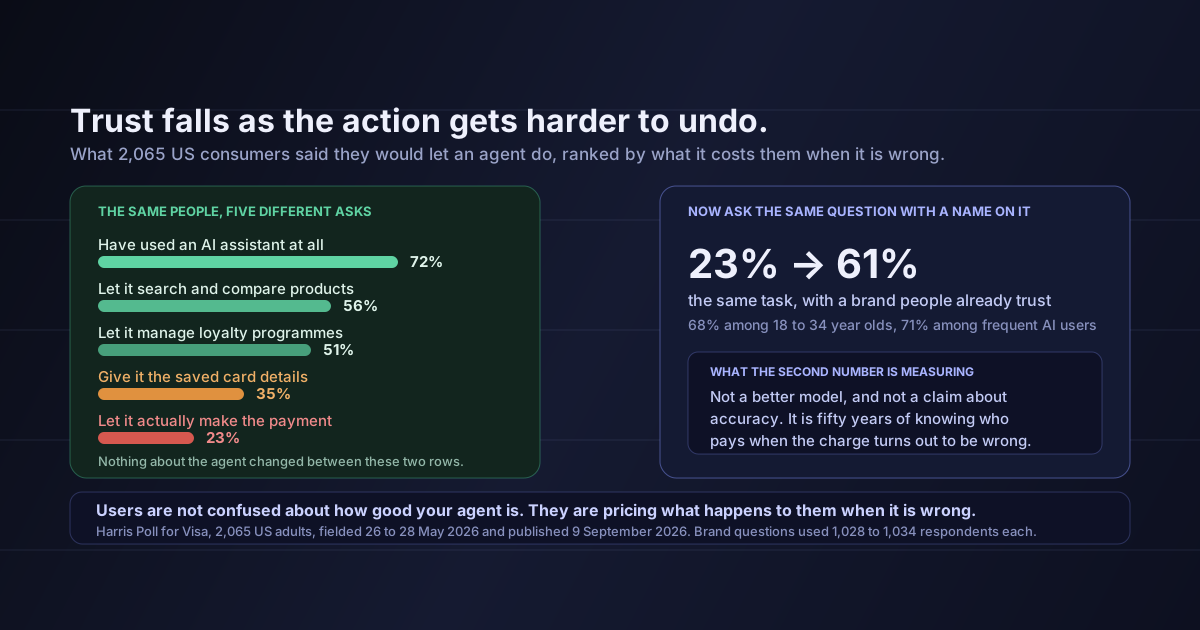
That agents will drive meaningful sales soon. Shopify has published no real order data, and most shoppers are still cautious about letting software spend their money.
That the 58% and 60-of-60 figures will hold. They come from Shopify's test of ten tasks on two shops with one model. Real stores, real catalogs and other models will vary.
That Shopify has settled the standard. Shopify backs UCP, ACP and the Personal Agent Protocol at the same time. Shop MCP is Shopify's own infrastructure on top of those standards, not the end of the contest between them.
That merchants are protected by approval. The buyer approves each purchase, which protects the buyer. Merchant-side controls are still not described.
In about two weeks, Shopify let browser agents complete checkout on eligible stores by default, and then gave any MCP-compatible agent 17 tools across more than a billion products — search without an API key, Shop Pay checkout and order tracking, with the buyer approving every purchase. In Shopify's own test, structured checkout was faster, cheaper and more reliable than an agent clicking through the page.
For sellers, product data has become the storefront an agent actually sees. For agent builders, access to products is no longer the hard part; trust and judgement are.
If you sell, read your top ten product listings as an agent would — data only, no images — and fix what is missing. If you build agents, replace your scrapers with Shop MCP and put the time into the buyer's rules.
Sources: TechCrunch, 28 September 2026 — the three checkout tools, buyer authorisation, UCP and Shop Pay support, the Muse and Instinct partnerships, and Gil Greenberg's quote. Search Engine Journal, 28 September 2026 — what agents can and cannot change at checkout, the tools being on by default, the absence of documented merchant controls, and Shopify's test: ten checkout tasks on two test shops with GPT-6 Sol, 60 of 60 against 56 of 60, 10.3 against 27.4 seconds, 58% lower cost at OpenAI list prices, and no real-order data. Fintechnize, 13 October 2026 — Shop MCP's 17 tools, the catalog of more than a billion products including off-Shopify items, search without an API key, and the Shop Pay and single-use card payment paths. The Verge, via Wilson's Media, 13 October 2026 — buyer approval of every purchase and the budget and fast-shipping rules. The reading in sections 4 to 6 is mine.
IdeaToMVP Academy
4-week live cohort for founders. Learn to ship AI agents, scope MVPs, and automate your business — taught by the same team that writes these guides.