72% Have Used an AI Assistant. 23% Trust One With Money. The Gap Is Your Product Spec

By Surya Pratap
September 10, 2026
11 min read
AI & Technology

September 10, 2026
11 min read
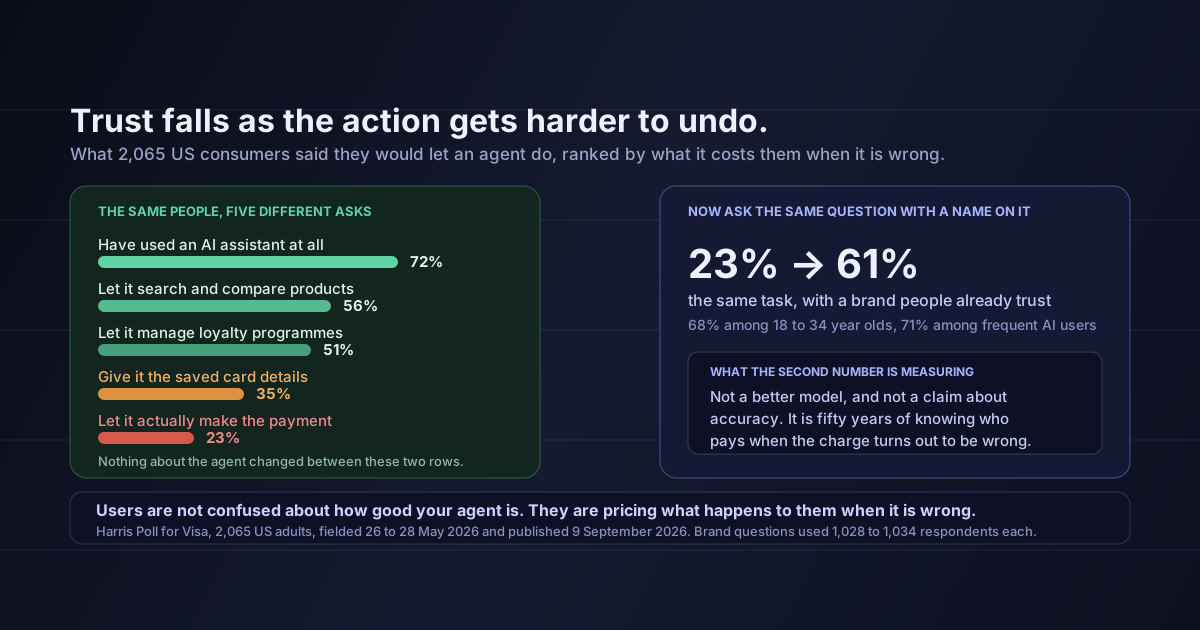 The same agent, five different asksHover to explore
Most survey coverage picks the scary number and stops. This one has five numbers, and the order they come in is the finding.
Visa published its Trust Index for agentic commerce on 9 September 2026. The headline everyone ran was that 23% of US consumers trust generative AI to handle a payment on their behalf. The interesting part is what sits above that number.
The Visa Trust Index, as published
One sample, asked to delegate progressively more
Read down that list and notice what is not varying. It is the same technology in every row. Comparing products across a dozen retailers is arguably a harder inference problem than pressing pay on a cart the user already assembled. Willingness still halves between them.
Users are not rating your agent's competence. They are rating their own exposure when it is wrong.
Sort those five actions by how hard they are to perform and you get one order. Sort them by how hard they are to undo and you get the survey.
A bad product comparison costs nothing — you scroll past it. A mismanaged loyalty balance is annoying and usually recoverable. Saved card access is a standing risk rather than a single event, which is why it sits lower than the reversible tasks and above the irreversible one. A wrong payment is money that has left, and getting it back is a process you have to run, against a counterparty, on someone else's timetable.
That is a coherent risk model. It is the correct one. And it means the 23% is not a verdict on model quality that better models will fix.
The uncomfortable implication
If accuracy were the binding constraint, the number would move when the models improve. It mostly has not, across three years of models that got dramatically better at exactly this class of task. Consumers are answering a question about recourse, and no benchmark score is an answer to it.
Here is the part worth sitting with. The same respondents, the same delegated action, a different name on it — and the number nearly triples.
Nobody in that sample believes a payment network writes better agent code than a frontier lab. That is not the claim. What a payment network has is fifty years of established answer to "what happens to me if this is wrong": a dispute process, a chargeback, a liability rule that puts the loss somewhere other than on the cardholder.
61% is not trust in the agent. It is trust that someone else eats the mistake.
Which is genuinely good news for founders, because that is a buildable property. Accuracy is a research problem you are mostly a consumer of. Recourse is an engineering and business decision you control entirely.
The survey is also a launch order, and most agent products get it backwards by leading with the most impressive demo rather than the most delegable action.
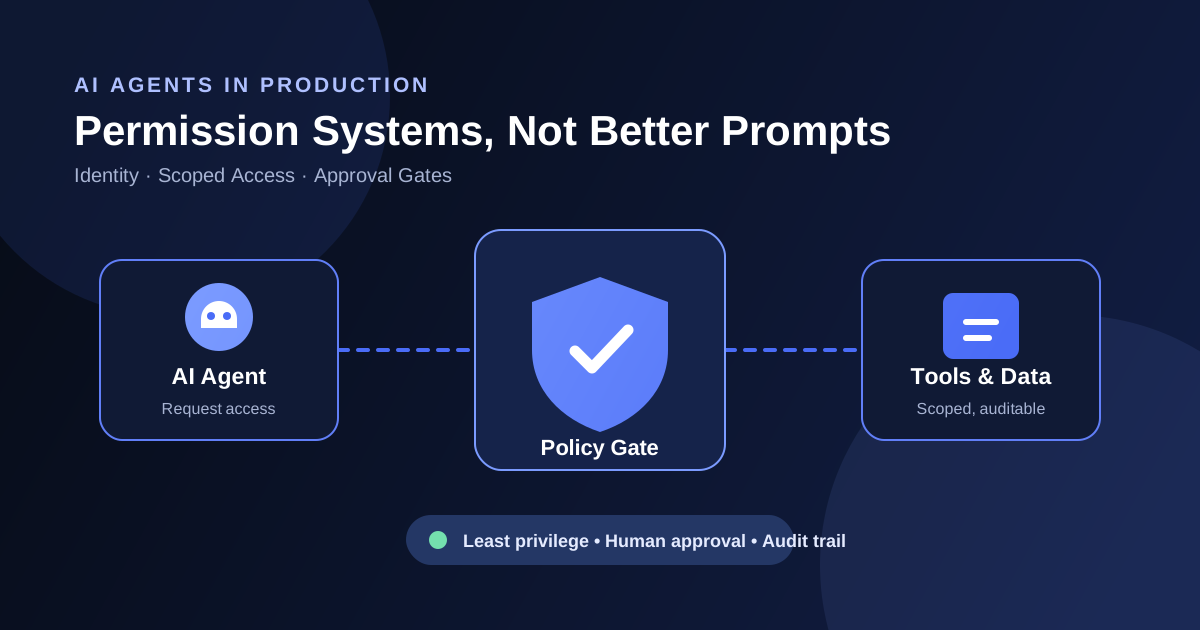
The mechanics of the middle tier — scoped credentials, approval gates, audit trails — are a solved engineering problem, and I have written about what an agent permission system needs to contain. The sequencing question is the one founders get wrong.
This is Visa's research, and it finds Visa most trusted. That is not disqualifying — the Harris Poll methodology is disclosed, the sample is census-matched, and the brand question was run across multiple brands. But the framing of a study commissioned by an incumbent will tend to land on the conclusion that incumbency is valuable. Take the staircase, which is a general finding, more seriously than the specific 61%.
The fieldwork is older than the publication. Responses were collected 26 to 28 May and published on 9 September — over three months in a field where three months is a long time. Treat every figure as a May reading.
Stated willingness is not behaviour. Survey respondents systematically under-report what they will actually do once a flow is smooth and a default is set. The staircase's shape is robust; its absolute heights are soft, and probably conservative.
And 23% is not a small market. A quarter of US adults is an enormous addressable population for a product that only needs early adopters. The number is a design constraint, not a verdict on the category.
Consumers have already accepted AI assistants — 72% have used one. What they have not accepted is agents taking actions they cannot take back, and their willingness declines in near-perfect order with irreversibility.
The gap between 23% and 61% is the whole product opportunity, and it does not close by waiting for better models. It closes by building the thing a payment network spent fifty years building: a clear, published, funded answer to what happens to the user when the agent gets it wrong.
Most teams are competing on the capability half of that sentence. The survey says the other half is where the customers are.
Sources: Visa, "New Visa Research Finds Consumer Trust is Accelerating the Path to Agentic Commerce" · PYMNTS, "Consumers Use AI Assistants but Hesitate to Hand Over Their Wallets" · Finextra, "Consumer trust in agentic payments continues to lag" · All percentages and the Harris Poll methodology are as published by Visa; the reading of the staircase as a function of irreversibility, and every design recommendation, is mine. For the parallel finding among engineers rather than consumers, see the gap between how much developers trust their agents and how often those agents fail.
IdeaToMVP Academy
4-week live cohort for founders. Learn to ship AI agents, scope MVPs, and automate your business — taught by the same team that writes these guides.