An Agent Browser 7x Cheaper Than Chromium — and a Payment Rail Down 93% (2026)

By Surya Pratap
August 19, 2026
12 min read
AI & Technology

August 19, 2026
12 min read
 Two meters, opposite directionsHover to explore
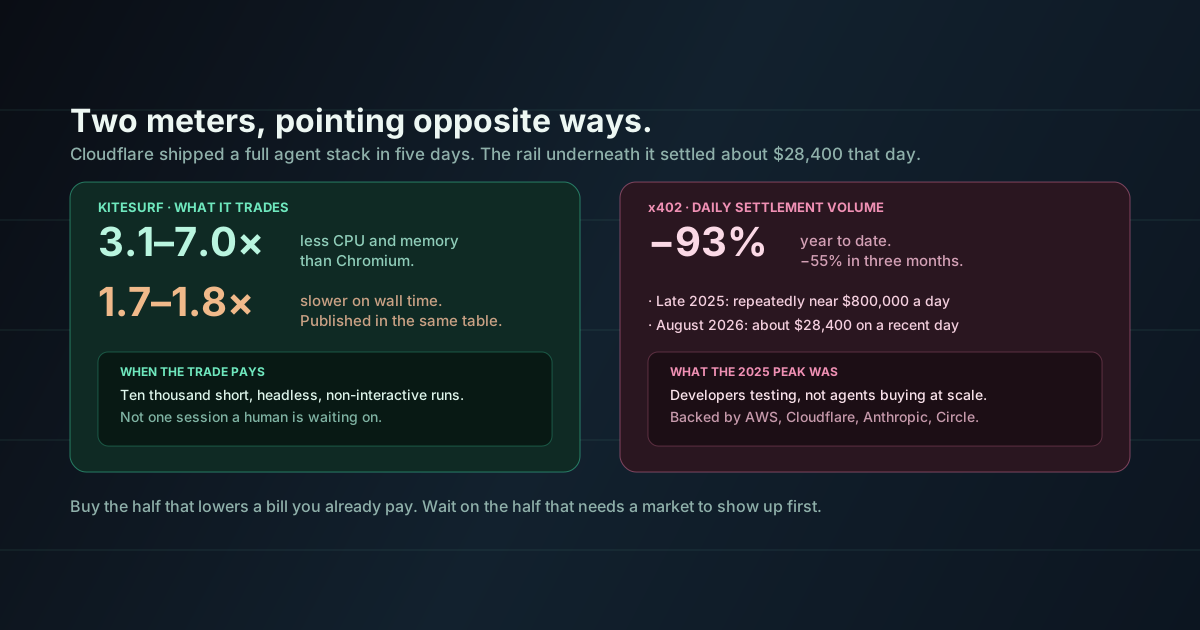
Between August 3 and 7, Cloudflare ran Agents Week and shipped roughly two dozen things. Two of them matter to anyone building on agents, and they point in opposite directions.
The first is Kitesurf, a browser built for agents rather than people, which uses three to seven times less CPU and memory than Chromium and runs about 1.8 times slower. The second is the payments half — Cloudflare Wallets, plus the Monetization Gateway that launched on July 1 — which completes a loop where agents can pay for APIs and you can charge them.
The loop is real. The traffic on it is not, yet. x402, the settlement protocol underneath, is down 93% in daily volume this year. Both facts deserve to sit in the same article, because a founder reading only the launch posts would take away exactly the wrong conclusion.
Not a fork of Chromium. Not headless Chrome in a container. Kitesurf is a browser engine written to run inside Cloudflare Workers' V8 isolates — the same sandboxing primitive already executing edge functions at scale — with the rendering path built in Rust and WebAssembly.
The design premise is that an agent does not need what a person needs. It does not need pixel-perfect compositing, smooth scrolling, or 60fps. It needs the DOM, the text, occasionally a screenshot, and it needs those at a cost that survives being called ten thousand times in a loop.
Compatibility is better than that premise suggests. It passes around 215,000 Web Platform Tests and speaks the Chrome DevTools Protocol, so Puppeteer, Playwright, chrome-remote-interface and MCP clients drive it without a rewrite. That last part is what makes it evaluable at all — you can point your existing automation at it and measure.
Cloudflare published medians across 14 URLs. These are vendor-run benchmarks on a vendor-chosen URL set, so treat the shape as informative and the precise multiples as directional.
| Measure | Kitesurf | Chromium | Ratio |
|---|---|---|---|
| CPU, screenshot | 380 ms | 1,173 ms | 3.1x less |
| CPU, HTML extraction | 229 ms | 877 ms | 3.8x less |
| Memory, screenshot | 57.8 MiB | 271.0 MiB | 4.7x less |
| Memory, HTML extraction | 39.4 MiB | 273.7 MiB | 7.0x less |
| Wall time, screenshot | 1,148 ms | 637 ms | 1.8x slower |
| Wall time, HTML extraction | 820 ms | 472 ms | 1.7x slower |
Read the last two rows first. Most infrastructure launches bury the row where they lose; Cloudflare published it in the same table, which is worth acknowledging.
Why slower can still be correct
Latency and cost are different budgets, and agents spend them differently from apps. A human waiting on a page render notices 500 ms. An agent in a scraping loop does not notice anything — but the CPU-seconds and the resident memory it holds are what you are billed for, and what caps how many of it you can run at once. Kitesurf is priced in the currency that a fleet actually spends. It is a bad trade for one interactive session and a good one for ten thousand concurrent headless ones.
Cloudflare is unusually direct about what Kitesurf will not do. If you need to play video, render WebGL, negotiate a bot-challenge handshake, or hold a ten-minute authenticated session, it says plainly that Kitesurf "isn't yet the right option."
That list is not a disclaimer. It is a scoping tool, and it is worth more than the benchmark table, because it tells you in about fifteen seconds whether this is even a candidate for your workload.
Where it fits today
The bot-challenge line deserves its own thought. A large and growing share of the commercially interesting web sits behind exactly that handshake. If your agent's job is to reach pages that actively resist automation, Kitesurf does not solve your problem — and neither does anything else on this list. That is a product problem wearing an infrastructure costume, and no browser runtime fixes it.
The payments story is more ambitious and much less proven.
Monetization Gateway, launched July 1, lets you charge for pages, APIs, datasets and MCP tools, with pricing enforced at the network edge and settlement in stablecoins over x402. Cloudflare Wallets, announced August 4, closes the other side: agents get a funded, spend-capped, identifiable way to pay.
Together those are a coherent two-sided market. And the institutional backing is not trivial — the x402 Foundation launched under the Linux Foundation in April 2026 with AWS, Cloudflare, Anthropic, Circle and more than twenty other members, and Cloudflare and AWS shipped edge support within two weeks of each other.
Then there is the meter.
x402 daily settlement volume is down 93% year to date and 55% over the past three months. The seven-day average is roughly $41,800, with a recent provisional day around $28,400. In late 2025 it repeatedly approached $800,000 a day and occasionally cleared $1 million.
The analyst read, from Jamie Coutts, is that the late-2025 peak "came from developers testing the technology rather than agents purchasing services at scale," and that the decline is a reality check on the idea that an agentic economy is already operating.
I think that is right, and I want to be careful about what it does and does not mean. It is not evidence that agent payments will fail. It is evidence that the 2025 numbers were never demand in the first place — they were a benchmark of curiosity. Infrastructure is being built against a load curve that has not arrived, by companies large enough to wait for it. That is a rational thing for Cloudflare and AWS to do. It is usually not a rational thing for you to do.
Every few years a platform layer arrives before the workload that justifies it. Sometimes the workload shows up and the early adopters look prescient. Sometimes it does not, and the early adopters spent a quarter integrating a settlement protocol into a product with forty customers.
The way to tell them apart is not to forecast. It is to ask which side of the launch you are on.
There is a narrower version of the payments story that is worth attention even today, and it is the sell side rather than the buy side. If crawlers and agents are already consuming your content or your API, the Monetization Gateway is a way to price that traffic rather than absorb it. That is not a bet on the agentic economy — it is a bet that you are already paying for something you could charge for, which is a claim you can verify from your own logs this week.
Three things, none of which require you to believe any particular forecast.
Your browser runtime is now a cost decision, not a default. For years "headless Chrome" was the only answer, so it was not a choice. It is now. Know what fraction of your compute is browser automation, because if it is meaningful, a 3-7x reduction on that line is worth an afternoon of measurement — and if it is negligible, you can stop reading about agent browsers entirely.
Latency budgets need to be stated per workload, not per system. The Kitesurf trade is only legible if you know which of your agent calls are user-blocking and which are not. Most teams have never written that down. It takes an hour and it is the input to every infrastructure decision in this space for the next two years.
Do not couple your product to a settlement protocol yet. Use ordinary billing. If x402 volume turns and agentic commerce becomes real, the gateway will still be there and your integration will be a week's work against a market that actually exists. We made a related argument about not coupling to one provider's economics in the multi-model stack cost breakdown, and it applies with more force here, because the volatility is in demand rather than price.
If your agents touch the open web at all, the single most useful hour this month is instrumenting what your browser automation actually costs — CPU-seconds, peak memory, concurrency ceiling. Nearly every claim in this article resolves to "it depends on your numbers", and most teams cannot currently produce them.
An agent-driven browser is still an agent reaching untrusted content, and a cheaper one means you will run more of it. Kitesurf's isolate model is a genuinely better sandbox story than a container full of Chromium, but the threat that matters for agents is not process escape — it is the model acting on instructions it read on a page it fetched.
Nothing in this release addresses that, and nothing was claimed to. If you are widening your web surface because it just got cheaper, the controls in our agent security guide are the ones that have to widen with it.
Cloudflare shipped the most complete agent infrastructure stack anyone has put out in a single week, and published the benchmark row where it loses. Kitesurf is a real, evaluable, reversible improvement for one specific and reasonably common workload: high-volume, short-lived, non-interactive web access. If that is your workload, test it this month against your own traffic.
The payments half is well-designed, well-backed and running at about $28,400 a day. That is not a criticism of the design. It is a statement about where the demand is, and it means the correct posture is to watch the meter rather than to integrate.
Buy the part that lowers a bill you are already paying. Wait on the part that needs a market to show up first.
Sources: Cloudflare, introducing Kitesurf — architecture, benchmarks and limitations · Cloudflare, the Agents Week review · Cloudflare Agents docs, x402 · x402 settlement volume down 93% year to date · InfoQ, on Cloudflare and AWS embedding x402 at the edge · MarkTechPost, on the Kitesurf release
IdeaToMVP Academy
4-week live cohort for founders. Learn to ship AI agents, scope MVPs, and automate your business — taught by the same team that writes these guides.