
Anthropic Now Lets Customers Self-Host Claude's Agent Harness. Know What Still Leaves the Network Before You Promise It Doesn't

By Surya Pratap
November 16, 2026
8 min read
AI & Technology

November 16, 2026
8 min read
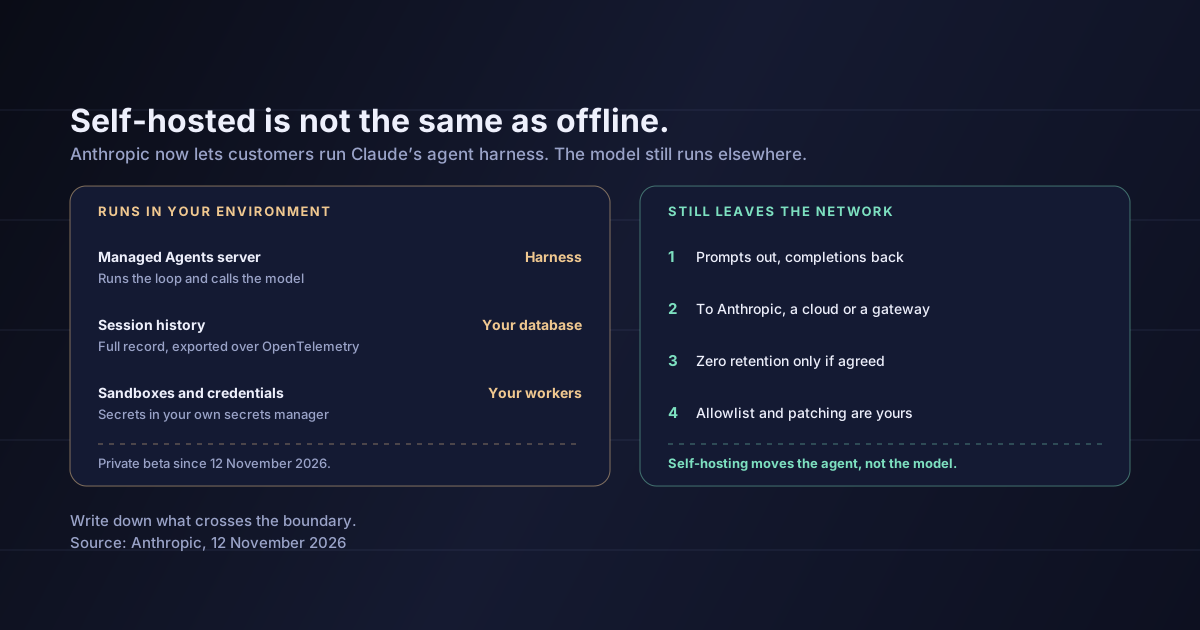 See what stays, and what leavesHover to explore
If you sell AI agents to banks, hospitals or governments, you have heard the question in every security review: where does our data go? On 12 November Anthropic gave founders a better answer than they had a week ago. Its new private beta of self-hosted Claude Managed Agents lets a customer run the whole agent service in their own cloud or on-premise, including the credentials and the record of everything the agent did. What it does not do is bring the model inside the building. The prompts still go out. Getting that sentence right is now the difference between passing a security review and failing an audit later.
Until now, customers of Claude Managed Agents could host the sandbox where an agent runs its code, but, as Help Net Security puts it, "Anthropic ran everything else, including the credential handling and the record of what each agent did." The self-hosted version moves the rest:
It is a private beta. Access is by request through an Anthropic account team, and neither source gives a price or a date for general availability.
Help Net Security states the limit plainly: "Claude itself still runs outside the customer's network, so prompts go out and completions come back." Anthropic's own wording is that the harness "calls Claude" at whichever destination the customer picks.
That matters because, in an agent, the prompt is not just the user's question. It is whatever the harness assembles to decide the next step: the instructions, the conversation so far, and the results of the tools the agent has called. If the agent read a contract, a patient note or a ledger, the parts it needs to reason about go out in the next request. Self-hosting changes who stores the history and who holds the keys. It does not change the fact that the model has to see the content to work on it.
The terms on that traffic are whatever the customer already has. "If your organization has zero data retention (ZDR) in place with Anthropic, it applies to the requests sent to Claude in the same way as any other Messages API call." If the requests go to Bedrock, Google or Foundry instead, the buyer's agreement with that cloud is the one that governs them. That is often the easier conversation, because a regulated buyer may already have one.
Self-hosting moves the agent. It does not move the model.
The other half of self-hosting is operational. Help Net Security's closing line is the one to keep: "The server, the database, and the firewall rules are now the customer's to run, and so is the job of keeping them patched and set up correctly."
The network rules are the clearest example. Anthropic lets each environment be limited "to a list of allowed hosts", and "when you host the sandbox yourself, you set the same limits in your own firewall." Help Net Security notes that, for an agent that fixes broken builds, Anthropic suggests the list "might be just the git host and the package registry," and that this "makes the allowlist their configuration to get right."
The credential proxy has a boundary too. It covers "MCP tools and supported API calls." Help Net Security's caution is fair: "any other service an agent reaches is worth checking before the agent goes live."
If you are the startup building the agent, this is where you either win the deal or lose it. A buyer who self-hosts is taking on work they used to rent. They will want to know who patches the server, who writes the allowlist, and what happens when the agent needs a host that is not on it.
The safest thing to give a security team is not a promise. It is a one-page description of the data flow they can check.
# data-flow.yaml — what runs where, and what crosses the boundary
agent_runtime:
  harness: customer-vpc            # Managed Agents server
  session_history: customer-postgres
  sandboxes: customer-workers
  credentials: customer-secrets-manager

model_requests:
  destination: amazon-bedrock      # or: anthropic | google | microsoft-foundry | gateway
  leaves_network: true             # prompts out, completions back
  retention: per-existing-agreement

egress_allowlist:                  # default deny
  - github.com
  - registry.npmjs.org

audit_log:
  export: opentelemetry            # to the customer's own monitoring
Draw the line on one page. List what runs in the customer's environment and what crosses the boundary, as in the example above. Say "prompts and tool results go to the model provider" in plain words. A reviewer who finds that out on their own stops trusting the rest of the document.
Route model calls through a contract the buyer already has. If the buyer already uses Bedrock, Google or Foundry, sending requests there keeps the traffic under terms their legal team has read. Mention zero data retention only if the agreement exists; it is not a feature of self-hosting.
Write the allowlist before the agent goes live. Start from deny-all and add only the hosts the task needs. Test what the agent does when a host is blocked, because a blocked call that is retried forever or worked around is a bug you want to find before the customer does.
Check what the credential proxy covers. It covers MCP tools and supported API calls. For anything else your agent calls, find out where the credential lives and whether the sandbox can read it. Our security guide for AI products covers scoping the rest.
The sentence to avoid
Do not write "your data never leaves your environment" in a proposal for an agent that calls a hosted model. Write what is true: the agent, its credentials and its history stay in the customer's environment, and the content the model needs goes to the provider they choose, under the terms they already have. The same question applies to any rented harness, and we looked at it when OpenAI gave away the agent loop.
What it costs. Neither source gives a price for the self-hosted option.
When it is generally available. It is a private beta, requested through an account team. There is no date for wider release.
That it carries a compliance certification. The announcement describes design principles. It does not name SOC 2, ISO, HIPAA or FedRAMP coverage for the self-hosted deployment.
Exactly what each model request contains. Neither source lists the data classes sent, or says whether Anthropic receives any operating telemetry from a self-hosted server. Ask for that in writing before you repeat it to a customer.
On 12 November 2026 Anthropic opened a private beta of self-hosted Claude Managed Agents. Customers run the agent server, its PostgreSQL database, the sandboxes, the credentials and the session history in their own cloud or on-premise, export the full record over OpenTelemetry, and choose whether model requests go to Anthropic, Amazon Bedrock, Google's Agent Platform, Microsoft Foundry or their own gateway. The model still runs outside the customer's network: prompts go out and completions come back.
For founders selling agents to regulated buyers, that is a real answer to the hosting objection, as long as it is described accurately. The agent and its secrets can stay in. The content the model reasons about cannot.
Before your next security review, write one page that says what runs where and what crosses the boundary, route model calls through a contract the buyer already has, and write the egress allowlist yourself rather than leaving it to the customer.
Sources: Anthropic, Operate Claude Managed Agents inside your security perimeter (12 November 2026) — what the customer hosts, where model requests go, credential vaults and the proxy, host allowlists, the session record and OpenTelemetry export, zero data retention, and the private beta; Help Net Security, Self-hosted Claude Managed Agents keeps agent credentials in your environment (12 November 2026) — what customers could host before, the PostgreSQL database, that prompts leave the network, the limits of the credential proxy and the customer's operational responsibility. The data-flow file in section 4 is my illustration, and the reading in sections 3 to 5 is mine.
IdeaToMVP Academy
4-week live cohort for founders. Learn to ship AI agents, scope MVPs, and automate your business — taught by the same team that writes these guides.


