OpenAI Just Gave Away the Agent Loop. The Session Is the Part You Rent

By Surya Pratap
September 11, 2026
12 min read
AI & Technology

September 11, 2026
12 min read
 Three bands, one of them rentedHover to explore
For about eighteen months, the hardest engineering in an agent product was not the model call. It was everything around it. On 10 September 2026 OpenAI shipped all of that as a managed service, at no markup, and published a limitations page that most coverage skipped.
Both halves matter. The second one more.
The Agents API entered public beta, exposing the same harness that runs Codex. The documentation reduces it to four primitives:
The Agents API, as documented
Four concepts, one of which is doing the real work
Behind those, OpenAI runs the loop: it "handles session orchestration, context compaction, and recovery." Sessions summarise earlier work as the window fills, split tasks across subagents under a concurrency ceiling (max_concurrent_subagents is 4 in the published example), load tool definitions on demand rather than paying for all of them every turn, and survive failures without you writing the retry.
Sandboxes come three ways: OpenAI-hosted, self-hosted via codex exec-server over an outbound WebSocket, or through a partner — Blaxel, Cloudflare, Daytona, DigitalOcean, E2B, Modal, Oracle, Runloop and Vercel were named at launch.
And the pricing is the headline nobody quite believed: there is no fee for the Agents API itself. You pay model tokens at standard rates, standard rates for OpenAI-provided tools, and container time if you use a hosted sandbox. The orchestration is free.
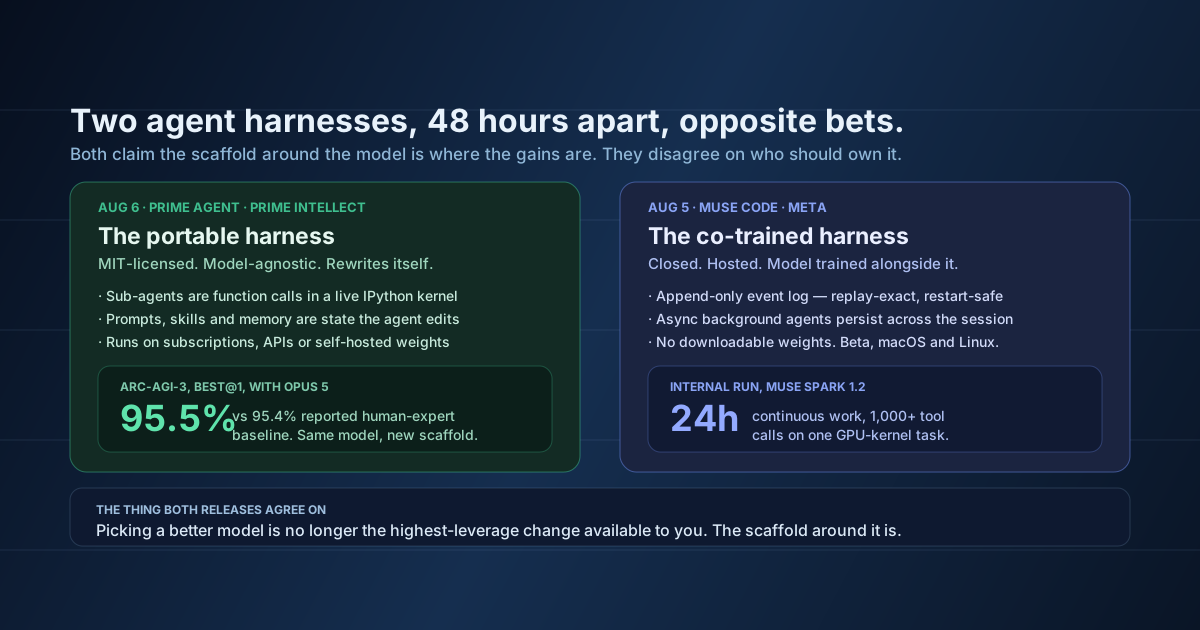
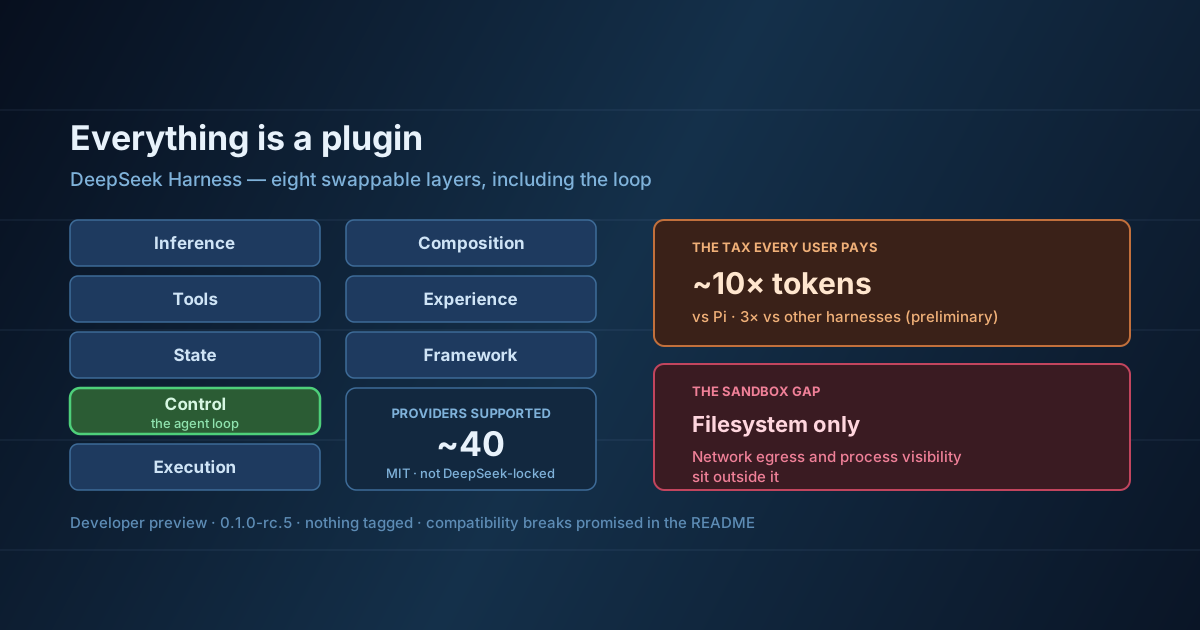
I have written about the harness twice this summer, both times as a thing you choose between. Prime Agent and Muse Code made opposite bets on open versus hosted, and DeepSeek open-sourced one where even the loop is a plugin. The shared premise of that whole argument was that the harness is a real piece of engineering with real design choices, and that picking one is a strategic act.
That premise just weakened considerably — at least for the parts everybody was building identically.
Nobody was differentiating on their retry logic. They were just all writing it.
Go through the list of what the managed harness now does and ask, honestly, which of them your team was doing better than a competent default. Context compaction when the window fills. Parallel tool calls. A subagent that gets its own context and returns a result. Resuming after a crash without replaying from turn one. Loading tool schemas lazily so a hundred tools do not cost a hundred schemas per turn.
Those are the exact items on every agent team's internal infrastructure backlog, and they are not where anyone's product wins. If a competitor ships them for free and they work, keeping your own version is a decision you now have to justify rather than one that justifies itself.
The genuine efficiency argument
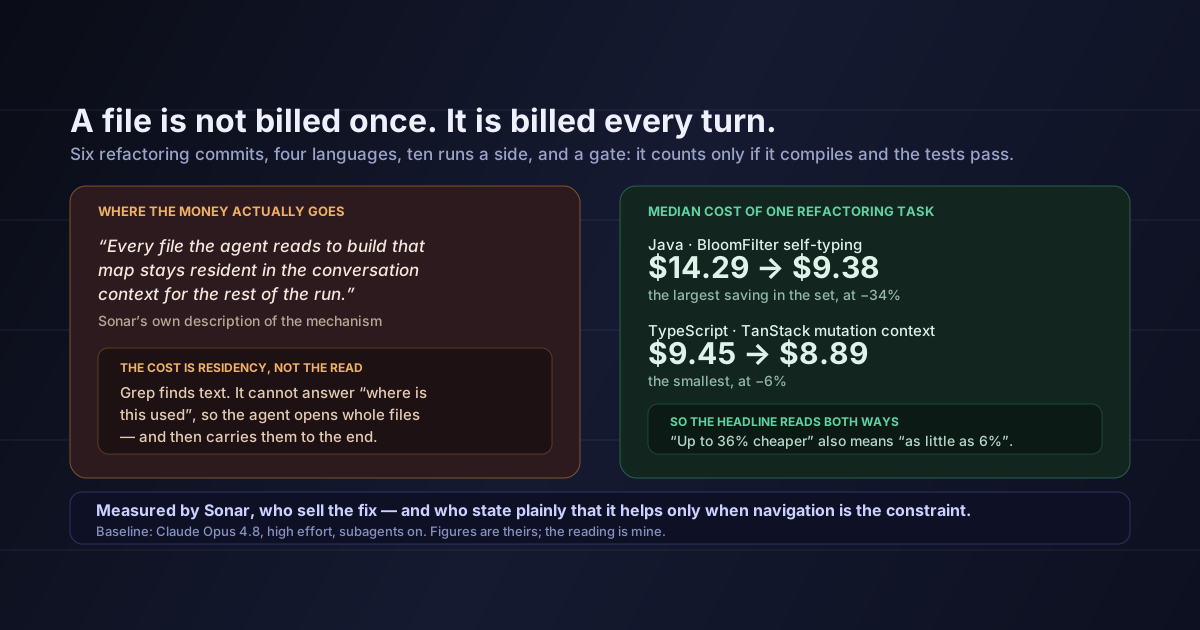
Lazy tool definitions and automatic compaction attack the residency problem directly — every file an agent reads stays resident and is re-billed every turn, and a managed compactor that runs correctly will beat a hand-rolled one that runs when someone remembers. This is a real saving, not a marketing one.
Here is the line, from OpenAI's own Agents API documentation:
From the Agents API limitations
The Agents API currently supports data residency only in the United States and does not support Zero Data Retention. Choosing a self-hosted sandbox does not make the Agents API ZDR-eligible.
Read that last sentence twice, because it closes the escape hatch a founder would reach for first.
The intuition goes: fine, our code is sensitive, so we will run the sandbox in our own VPC. You can. The compute moves. The files stay on your infrastructure. And you are still not ZDR-eligible, because the sandbox was never the thing being retained.
This is the part I would want a founder to actually internalise, because it is not a policy gap that a later release fixes.
What makes a durable session valuable is that it remembers. You can hand a task back to it tomorrow and it knows what it read, what it tried, what failed and what it concluded, without you rebuilding any of it. OpenAI's docs put it plainly: the API "retains session state so you can continue work across turns without rebuilding the conversation context."
Now describe the same mechanism to a security reviewer. A third party holds a persistent, replayable record of everything your agent touched — file contents, tool outputs, intermediate reasoning, customer data that passed through — on infrastructure you do not control, in a jurisdiction you did not choose.
Durability is retention with the marketing on. They are one property, described by engineering and by legal.
There is no version of this where the session survives a restart and nothing is kept. Zero Data Retention and a durable session are mutually exclusive by construction, and the honest reading of that limitations page is not "not yet" but "not while the feature works this way."
That reframes the decision. This is not a checkbox that unblocks in Q1. It is a structural trade: you are exchanging the ability to promise a buyer that nothing is retained for the ability to stop maintaining an agent loop. For plenty of products that trade is obviously correct. For some it is disqualifying on day one, and the useful thing is knowing which you are before you build eight months on top of it.
The open-source framing has confused people, so it is worth separating cleanly.
codex exec-server means the execution environment is a real choice, with real CPU, GPU, memory and VPC options. If your concern is where code executes and where files live, that concern is addressable today.gpt-6-astra. A harness that manages context, chooses when to compact and coordinates subagents is co-designed with the model it was tuned against. Even with open harness code, "swap in another provider" is a rewrite of the tuning, not a config change.The switching cost moved. It used to be the orchestration code you wrote, which was annoying but yours. It is now the transcripts you did not write, which are not.
If you want the free loop — and most teams should at least price it — the architecture that keeps your options open is the same one that makes your agent debuggable, which is a pleasant coincidence.
Do these and the Agents API becomes an accelerator you can leave. Skip them and it becomes the place your product's memory lives.
The launch carried customer results, and they are worth stating accurately and discounting appropriately: one design partner reported an evaluation score moving from 0.71 to 0.85 with a roughly 4x latency reduction, another a 60% cost reduction per case, a third 86% fewer failed responses.
These are real teams reporting real deltas. They are also vendor-selected, self-reported, un-audited, and measured against whatever those teams had before — which, for a company that agreed to be a launch partner for managed orchestration, was plausibly a hand-rolled loop that needed replacing.
What the numbers do and do not establish
They establish that a competent managed harness beats a neglected in-house one, which was never in doubt. They do not establish that it beats a maintained in-house one, and no published comparison does. Treat them as evidence the thing works, not as your projected improvement.
A straight answer by situation
The retention line decides most of this before anything else does
Public beta is public beta. Residency, ZDR and model support can all change, and a limitation that is structural today for the durable-session design may be answered by a different session mode later. Build for what is documented, not for what is plausible.
"No fee" is not "no cost." Container time is billed, hosted tools are billed, and a harness that transparently compacts and spawns subagents makes token consumption harder to predict, not easier. Instrument spend per completed task from the first day, not per call.
Free orchestration is a strategy, not generosity. Giving away the layer above to sell the tokens below is the oldest move in infrastructure, and it works precisely because the free layer is genuinely good. That is an argument for using it clear-eyed, not for refusing it.
The agent harness stopped being a differentiator on 10 September 2026. Context compaction, subagent coordination, lazy tool loading and crash recovery are now a managed service at no markup, and the case for maintaining your own version of those has to be made rather than assumed.
What replaced it as the strategic question is the session. A durable agent session is the most useful primitive in the release and the one you cannot self-host, cannot get retention guarantees on, and cannot take with you. Durability and retention are the same property, which means this is a trade rather than a temporary gap.
Rent the loop. Own the state. The teams that get this wrong will not notice for a year, and will notice all at once.
Sources: OpenAI, "Introducing the Agents API" · OpenAI API documentation, Agents API overview · OpenAI API changelog, 10 September 2026 · MarkTechPost, "OpenAI Launches the Agents API in Public Beta, Putting the Codex Harness Behind One API Call" · Primitives, the limitations text and all pricing components are quoted from OpenAI's documentation; the design-partner figures are vendor-reported. The reading of durability and retention as one property, and every architectural recommendation, is mine. For how the harness debate looked when it was still a choice between vendors, see the two harnesses that shipped in 48 hours making opposite bets.
IdeaToMVP Academy
4-week live cohort for founders. Learn to ship AI agents, scope MVPs, and automate your business — taught by the same team that writes these guides.