DeepSeek Open-Sourced a Harness Where Even the Loop Is a Plugin (2026)

By Surya Pratap
August 18, 2026
12 min read
AI & Technology

August 18, 2026
12 min read
 Eight replaceable layersHover to explore
On August 13, DeepSeek put its agent harness into developer preview under MIT, alongside moving V4-Pro to general availability. Twenty-eight hours later the repository had 92,700 stars. Two days later it had more than 8,400 forks.
Star counts measure attention, not fitness, and you should discount them accordingly. But the design underneath is worth your time even if you never run it, because it takes a position that the other harness releases this month did not — and because its two biggest problems are ones you would inherit on day one.
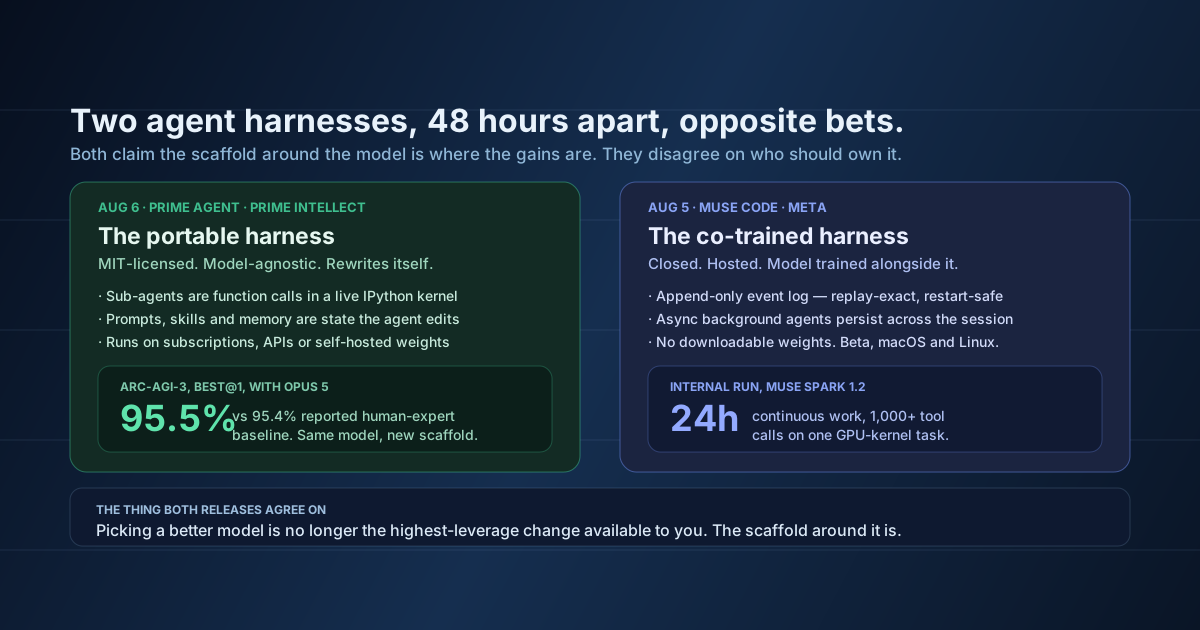
Earlier this month two harnesses shipped 48 hours apart and made opposite bets. Prime Agent said the harness is portable and should be owned by you: MIT, run any model. Muse Code said the harness only works when the model was trained inside it, so it belongs to the lab. We wrote about that split in Two Agent Harnesses Shipped in 48 Hours, and the conclusion was that you would have to pick a side.
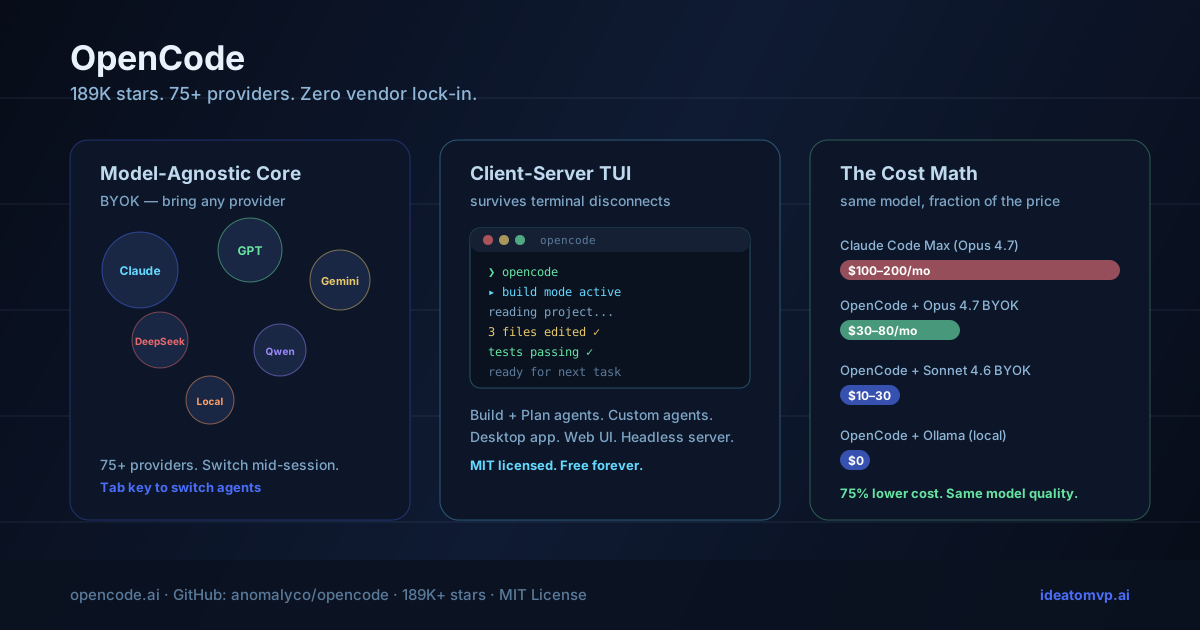
DeepSeek Harness declines to pick. It is MIT-licensed, explicitly not DeepSeek-locked, and ships a plugin adapter layer covering roughly 40 providers — DeepSeek, Anthropic, OpenAI, Google, Kimi, Bedrock, Vertex, Azure, and any OpenAI-compatible endpoint. That is the Prime Agent position.
It is also co-designed with V4. DeepSeek's own framing is Model + Harness = Agent, and V4's dual-tier split was built with harness workflows in mind: V4-Pro handles orchestration and complex decisions, V4-Flash serves parallel sub-agent calls. The harness exploits V4-specific behaviour — prefix caching, KV-cache management, long-context handling. That is the Muse Code position.
Why claiming both is interesting rather than incoherent
Portability and co-design are not actually contradictory — they are a trade you can price. A portable harness must express every provider through a common abstraction, and abstractions cost tokens and latency. A co-designed harness can skip the abstraction because it knows what is underneath. DeepSeek is betting it can pay the portability tax and still win on co-design for its own models. Section 3 is where that bet shows up on your invoice.
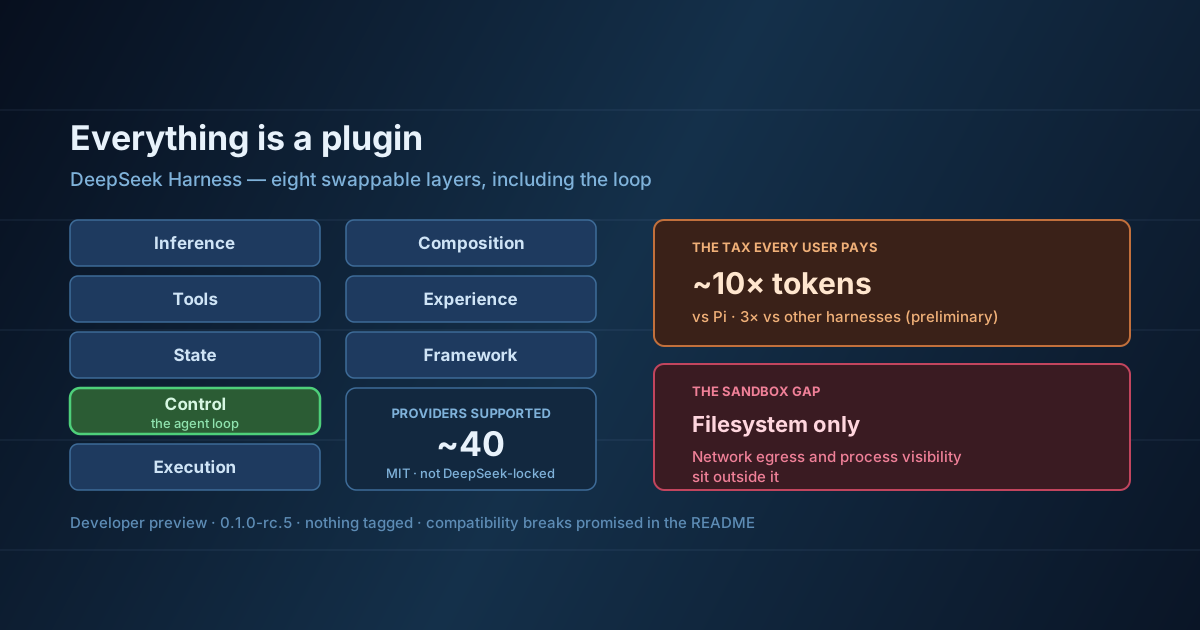
Eight layers are independently swappable: Inference, Tools, State, Control, Execution, Composition, Experience, and Framework — the last built on a dependency-injection system called Cordis.
Seven of those are unsurprising. Most serious harnesses let you swap tools and inference. The one that is not standard is Control, which is the agent loop itself. Not the prompt that drives the loop, not the policy inside it — the loop. You replace it by configuration, at runtime.
If you have written a supervisor node in LangGraph, you have hand-built one specific loop and hard-wired it. DeepSeek Harness treats that loop as a slot. Whether that is liberating or alarming depends entirely on whether anyone on your team will ever need a different one.
There is a second design decision worth more than the plugin system: model-visible means logged. Anything the model can see is recorded, and that is enforced by the architecture rather than left to a logging convention someone can forget. For anyone who has tried to reconstruct why an agent did something three days ago, that is a genuinely valuable property, and it is the part of this release I would steal outright.
The engineering discipline on display is unusual too — 1,386 recorded decision notes, and documentation that is drift-checked against the code rather than rotting beside it.
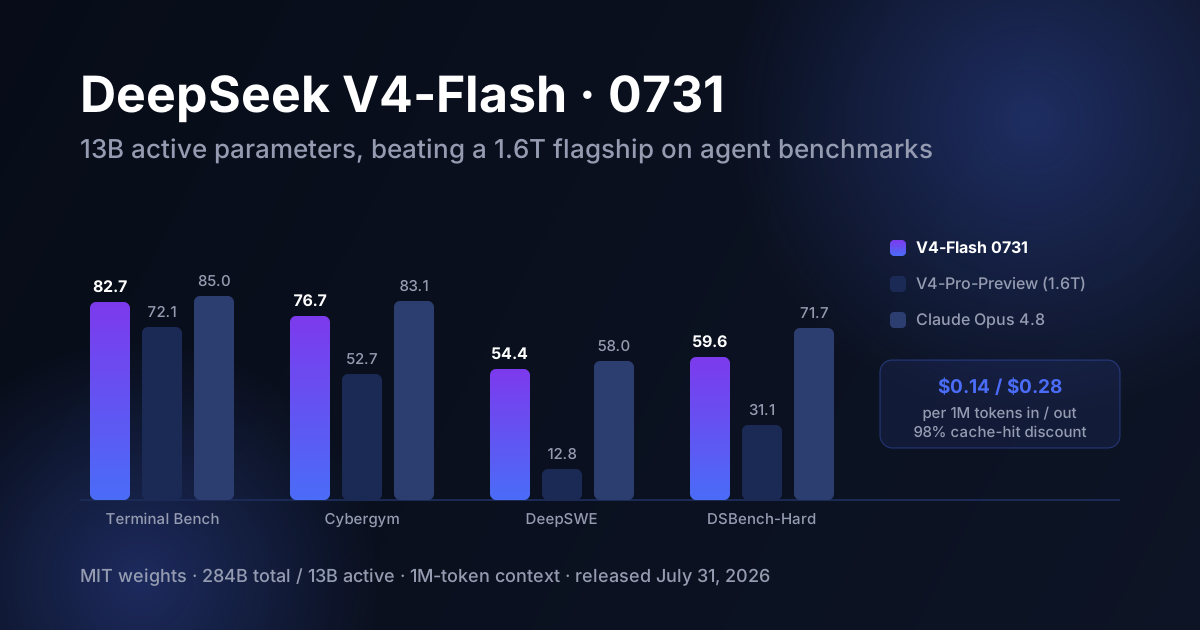
DeepSeek's reputation is cheapness. That reputation is now partly out of date.
V4-Pro's general-availability pricing introduced surge windows: $3.96 per million output tokens at peak, with off-peak set at 50% of the peak price. Against prior rates that is an output increase of roughly 2.28x to 4.55x.
Now put that next to the harness's routing design. V4-Pro orchestrates. V4-Flash fans out to sub-agents. Orchestration is the long-running, context-heavy, high-output part of an agent run — which means the harness concentrates your expensive tokens on precisely the model whose output price just rose the most.
That is not a criticism of the architecture. Routing reasoning to the strong model and parallel work to the cheap one is correct. It is a warning that the old mental arithmetic — "DeepSeek, so it is basically free" — no longer survives contact with an agent workload, and that a peak-hours batch job now costs double an off-peak one.
Then multiply
Preliminary community testing puts dsh at roughly 10x the token consumption of Pi and 3x other harnesses. One confirmed contributor: it reads both CLAUDE.md and AGENTS.md, so teams whose tooling keeps both files in sync get their system prompt duplicated outright. That is a bug and it will be fixed. The abstraction overhead behind the rest of the multiple is structural, and it lands on top of the surge pricing above.
This is the finding that should govern where you are willing to run it.
DeepSeek Harness defines a filesystem sandbox. The sandbox governs filesystem effects. Network access and process visibility sit outside that vocabulary — and enforcement is reported as only partial on older Landlock environments and on current Windows ACL boundaries.
Read that plainly: an agent can be confined to a directory and still open a socket. Filesystem confinement does not constrain outbound traffic, so it does not stop exfiltration. Sandboxing is also optional rather than on by default.
If you are running a harness against a repository that contains credentials, customer data, or anything under a contractual confidentiality obligation, a filesystem-only sandbox is not the control you need. You need egress rules at the network layer, and you need them from the environment, not from the harness.
What that means in practice
If you have read our agent security guide, none of this is new. What is new is that a harness this composable widens the surface: every replaceable layer is a place where behaviour can be substituted.
The sharpest criticism in circulation is not that the design is wrong but that its costs are distributed badly: the complexity and token overhead are paid by every user, while the benefit of hot-swapping the loop at runtime accrues to a small slice of them.
The supporting detail is concrete. Codex's declarative, folder-based plugins reload in two or three seconds. Runtime-swappable plugins have to handle dangling references, terminate in-flight tasks and coordinate dependencies — the lifecycle-management module alone runs to 750 lines. That is real complexity in exchange for a capability most teams will configure once and never touch.
My read: the critique is right about who pays and wrong to treat that as disqualifying. Infrastructure that is too flexible for today's use case is how you find out what next year's use case is. But you should not pay that bill on a product deadline, and "we might need it later" is not a reason to run it against production code this quarter.
The benchmarks are also company-reported. V4-Pro's Terminal Bench 2.1 of 87.9 and DeepSWE of 62.7 have not been independently reproduced, and DeepSeek has previously drawn criticism for vendor-reported, unreproducible scores.
The version is 0.1.0-rc.5. Nothing is tagged. The README warns about compatibility-breaking changes in capital letters.
That is the project telling you, in the clearest language available to it, not to build anything load-bearing on it yet. A repository can hold 92,700 stars and still be pre-1.0 infrastructure — those facts are unrelated, and conflating them is how teams end up pinned to a release candidate that no longer exists.
DeepSeek Harness is the most architecturally ambitious of this month's three harness releases and the least ready of them. It refuses the portable-versus-co-designed choice the other two forced, which is genuinely interesting, and it makes traceability a structural guarantee rather than a habit, which is genuinely useful.
It also costs roughly ten times the tokens of the leanest alternative, routes your spend onto a model that just got two to four times more expensive on output, and ships a sandbox that will not stop an agent from talking to the internet.
Pilot it in a box with the network locked down. Steal the logging idea immediately. Revisit the rest when there is something tagged to revisit.
Sources: DeepSeek Harness developer preview · DeepSeek V4-Pro GA, harness and surge pricing · The New Stack, on the plugin architecture · TechNode, on the Claude Cowork positioning · MarkTechPost release write-up · Justin3go, the over-engineering critique and token measurements · Wavect, production-readiness and sandbox scope · AIToolsReview, licence, layers and pricing analysis
IdeaToMVP Academy
4-week live cohort for founders. Learn to ship AI agents, scope MVPs, and automate your business — taught by the same team that writes these guides.