OpenCode: The Open-Source AI Coding Agent That Crossed 189K GitHub Stars (2026 Guide)

By Surya Pratap
July 28, 2026
AI & Technology

July 28, 2026
There is a class of developer tools that crosses 100K GitHub stars because they solve a problem the commercial market refuses to address. OpenCode crossed 189K stars in under a year because it solves vendor lock-in in AI coding agents — the problem where your entire workflow is hostage to one model provider, one pricing page, one set of rate limits.
This article pulls from the official OpenCode documentation, the GitHub repository, and real developer discussions on Reddit and X to give you an honest picture of what OpenCode is, where it excels, where it falls short, and whether it belongs in your stack.
OpenCode is an open-source AI coding agent built by the team at SST (Anomaly Innovations), the same people behind the SST serverless framework. It runs as a terminal user interface (TUI), a desktop app, a web interface, or a headless server — and underneath all of those surfaces is the same engine. It reads your codebase, edits files, runs shell commands, searches across your project, and iterates until the task is done.
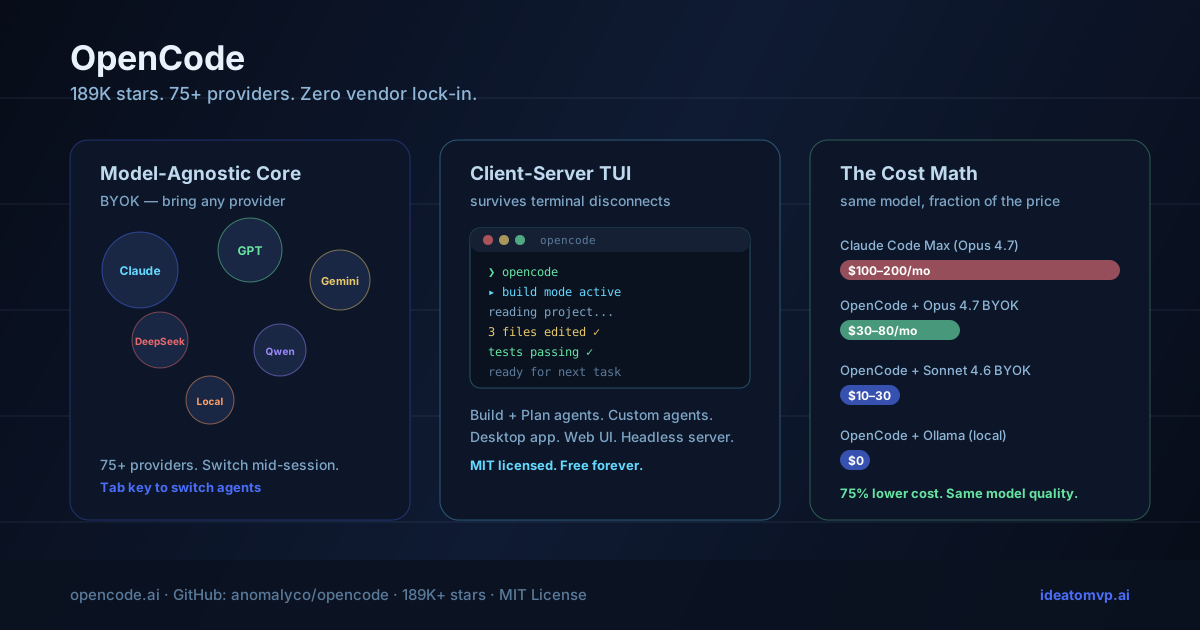
The critical difference from Claude Code or Codex: OpenCode is model-agnostic. You can point it at Claude, GPT, Gemini, DeepSeek, Qwen, Mistral, local Ollama instances, or any of 75+ other providers. One command, different provider, same workflow. The app is MIT-licensed and free forever. You pay your model provider directly.
OpenCode uses a client-server architecture. The TUI connects to a local server process that keeps running even if your terminal disconnects. SSH drops, terminal crashes, accidental closures — the agent process survives and you reconnect where you left off. This is architecturally different from Claude Code, which exits when your terminal closes (though it has session resumption via claude --resume).
The codebase is a Bun/TypeScript monorepo containing the core CLI, a server package, web app, desktop app, JavaScript SDK, plugin system, and the LLM/provider integration layer. It is not a thin wrapper — it is a full agent runtime with its own context management, tool orchestration, and session persistence.
OpenCode ships with two primary agents you switch between with the Tab key:
There is also a general subagent for complex searches and multi-step tasks, invoked internally or via @general in messages. Custom agents can be created with opencode agent create, specifying permissions, model, and system prompt.
The r/opencodeCLI subreddit (separate from the newly launched r/opencode) is the most active community hub. Here is the pattern across dozens of threads:
The cost conversation dominates. A thread titled "Best bang for your bucks plan?" ranked OpenCode's BYOK approach as the top value option. The math is simple: run Claude Opus 4.7 through OpenCode and you get $30–80/month in API costs versus $100–200/month on Claude Code Max. Same model, similar quality, lower cost. One user noted: "OpenCode Black/Zen is best value; multi-model; cheap entry."
The comparison conversations are nuanced. A developer who tested OpenCode + GPT-5.2 alongside Codex CLI reported: "I entered the exact same command — the answers are essentially the same, but OpenCode explains it much more clearly." Another thread compared OpenCode to Gemini CLI, with developers noting OpenCode's 75+ provider support as the decisive advantage over Google's single-ecosystem approach.
The ecosystem is building fast. Community members have built VS Code companions (Sidekick Agent Hub), native macOS clients (TrixCode wrapping OpenCode's local server), and cloud sandbox integrations (E2B for running OpenCode in disposable environments). One developer built an OpenClaw-like agent using OpenCode + Composio integrations + cron, shipping it as an open-source MIT project.
The honest critiques land hard. Developers consistently flag that OpenCode lacks the polish of Claude Code — no equivalent of Claude's Skills marketplace, no 29-hook governance system, no Agent Teams for coordinating parallel sub-agents. The desktop app is still in beta. Documentation lags the feature set. One DEV Community review captured it precisely: "OpenCode gives you the loop, but you assemble the rest. No equivalent of Claude skills, no hook system as mature, no desktop app supervising a fleet. If you want 'it just works,' this isn't it."
X discourse skews more promotional but reveals the same patterns. OpenCode's official account positions it as "the open source AI coding agent" with desktop app betas now available on macOS, Windows, and Linux. The developer community highlights the provider-agnostic angle harder on X — the ability to run Claude Sonnet for deep refactors, switch to GPT-5.5 for terminal tasks, and drop to a local Ollama model for quick questions, all without leaving the interface. The provider switching is not just a feature; it is the core differentiator that no closed-source competitor can match.
Multiple independent benchmarks and comparison articles converge on the same framework. Here is the distilled version:
| Dimension | OpenCode | Claude Code | Codex CLI |
|---|---|---|---|
| Model flexibility | 75+ providers, local models, switch mid-session | Claude only | GPT only |
| Pricing | Free app + API costs ($10–80/mo typical) | $20/mo Pro, $100–200/mo Max | Included in ChatGPT Plus/Pro |
| Session resilience | Server survives disconnects, reconnect seamlessly | Exits on terminal close, resume via flag | Cloud sandbox persists, local exits |
| Governance / hooks | Custom agent permissions, basic | 29-hook system, Skills marketplace, Agent Teams | Kernel sandbox, 3 safety modes |
| Privacy | No code storage, self-hostable, local models | Anthropic data policies | OpenAI data policies |
| Polish | Functional TUI, desktop app in beta | Refined, mature ecosystem | CLI + cloud, improving fast |
The benchmark angle is worth understanding: OpenCode is infrastructure, not a model. Its performance is entirely determined by whichever model you plug in. Run Opus 4.7 through OpenCode and you get Claude Code-tier scores. Run GPT-5.5 and you get Codex-tier scores. The Developers Digest comparison put it clearly: "If you hate lock-in, want to run local models, or just want to see how the sausage is made, OpenCode."
The comparison that matters: Claude Code Max (Opus 4.7) at $100–200/month versus OpenCode BYOK with Opus 4.7 at $30–80 per month. Same model. Similar quality. Lower cost. What you pay for with Claude Code is the Skills marketplace, 29-hook governance, Agent Teams coordination, and first-class Anthropic integration — not the model itself. For Claude Sonnet 4.6, regular professional coding runs $10–30/month through OpenCode. For heavy Opus 4.7 usage, $30–80/month. For local models via Ollama: $0.
If you already pay for ChatGPT Plus or GitHub Copilot, OpenCode can use those as providers at no additional cost. The BYOK model means you are never paying a middleman premium.
The honest version: OpenCode involves more setup steps. Provider configuration, API key management, model selection — overhead that Claude Code and Codex eliminate by design. The TUI is functional but not polished. The desktop app is in beta. Documentation consistently lags the feature set. There is no equivalent of Claude Code's CLAUDE.md project memory hierarchy, no Agent Teams for parallel coordination, no mature hook system for governance.
As one developer on DEV Community wrote: "After using it alongside Claude Code for a while, I notice OpenCode doesn't feel like it's building a working relationship with your project. There's no CLAUDE.md equivalent that persists project context. The autonomous behavior is functional but less mature." This is the trade-off: you gain flexibility and cost control, you lose the curated, opinionated experience.
OpenCode is the right tool for specific situations:
The developers getting the most value are not picking one tool. They are running two or three:
These agents do not conflict — they are separate processes with separate context windows. The cost adds up, but the productivity gain often justifies running multiple subscriptions. OpenCode serves as the flexible backbone: the tool that works with whatever model is performing best this week, at whatever price point makes sense for the task.
Install:
# Option 1: Install script
curl -fsSL https://opencode.ai/install | bash

# Option 2: Package managers
npm i -g opencode-ai@latest
brew install anomalyco/tap/opencode
Connect a provider:
# Run opencode in your project directory
opencode

# Inside the TUI, run:
/connect
Initialize project context with /init— OpenCode scans your project, reads file structure and dependencies, and generates an AGENTS.md file that gives the agent a shared understanding of your codebase. Then start prompting.
OpenCode is not trying to be Claude Code with a different logo. It is a different philosophy: give developers the agent runtime and let them choose the model. That philosophy produces a tool that is more flexible, cheaper, more private, and less polished. For founders building AI products, the practical takeaway is this: OpenCode eliminates the argument that you need a $200/month per-developer subscription to get production-quality AI coding assistance. You can run the best models available through an open-source interface at a fraction of the cost. The trade-off is assembly time. If your team can absorb that, OpenCode belongs in your toolkit.
IdeaToMVP Academy
4-week live cohort for founders. Learn to ship AI agents, scope MVPs, and automate your business — taught by the same team that writes these guides.