NVIDIA's New Rubin Chips Aren't Just Faster GPUs: What AI Founders Need to Know

By Surya Pratap
July 21, 2026
8 min read
AI & Technology

July 21, 2026
8 min read
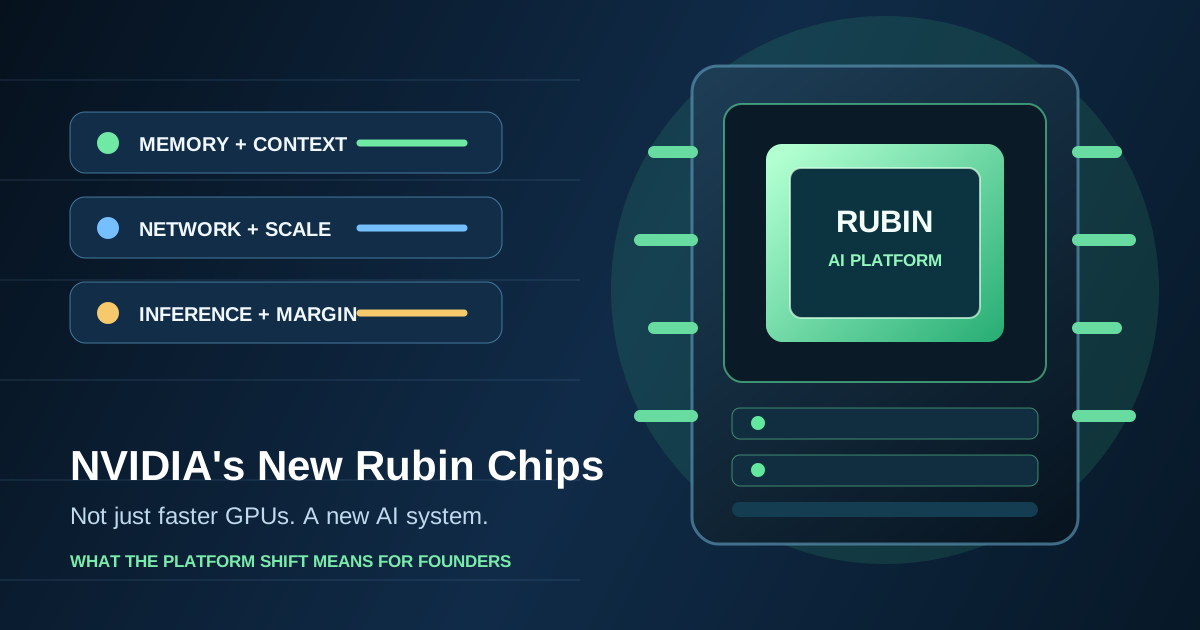
The discussion around NVIDIA's upcoming Rubin platform often gets reduced to a single question: how much faster is the new GPU? That is the least useful way for most founders to interpret a new AI chip generation. The meaningful shift is at the system level: compute, high-bandwidth memory, networking, and software are increasingly designed as one machine for training and serving AI.
That distinction changes how a product team should plan. Your customers do not buy floating-point performance. They experience a response that is either useful or not, a waiting time that is either acceptable or not, and a price that either supports the product margin or does not. The new platform matters when it improves one of those outcomes for your specific workload.
Modern AI systems bottleneck in different places. A model may be limited by memory capacity because its weights cannot fit comfortably on one accelerator. It may be limited by memory bandwidth because every generated token requires moving large amounts of model state. Or it may be limited by communication between accelerators when one request is spread across a cluster.
This is why NVIDIA's platform announcements include networking, CPUs, rack designs, and software alongside GPUs. For frontier labs, these pieces determine whether a giant training run finishes in a practical time. For application founders, they influence the services and prices that clouds and inference providers can eventually offer.
Founder translation
A faster accelerator does not automatically make your app faster. The valuable question is whether a provider can serve your chosen model, context length, and concurrency target at a better quality–latency–cost trade-off.
The more useful an AI product becomes, the more context it tends to carry: customer documents, conversation history, retrieved records, tool results, and policy instructions. That context consumes memory. During generation, systems also maintain a key-value cache so the model can refer back to previous tokens. At scale, this cache can become a larger operational concern than the prompt itself.
New AI platforms improve the ceiling, but product design remains the first lever. Retrieve only the evidence needed for the task. Summarize durable history. Set sensible context budgets. Route simple extraction and classification work to smaller models. These choices lower cost on today's infrastructure and make your architecture more resilient when capacity is tight.
Training attracts headlines; inference pays the recurring bill. A new NVIDIA generation can eventually improve inference economics through more efficient serving, better batching, and larger memory pools. But an average cost-per-token number can conceal the thing that breaks your user experience: a burst of concurrent requests, a long document, or an agent workflow that makes many sequential calls.
Measure end-to-end cost per completed user task. Include embeddings, reranking, failed retries, tool calls, and the model output that the user never sees because they abandoned the page. This gives you a real baseline for judging any new hardware-backed provider offering.
The best preparation for Rubin is not an early hardware commitment. It is a portable serving boundary. Keep your application's model calls behind a provider-neutral interface. Store prompts and evaluation cases outside deployment code. Record latency, quality, and cost by task. Then when new capacity reaches the market, you can run an evidence-based comparison instead of following the announcement cycle.
NVIDIA's new chips will help push the industry's capability and capacity forward. Founders win by converting that macro trend into a smaller, disciplined decision: does this change make one important customer job faster, more reliable, or more profitable? If the answer is yes, adopt it. If the answer is unclear, keep learning from customers on the infrastructure you have.
IdeaToMVP Academy
4-week live cohort for founders. Learn to ship AI agents, scope MVPs, and automate your business — taught by the same team that writes these guides.