NVIDIA's Next AI Chips: What Founders Should Watch Before They Buy GPUs

By Surya Pratap
July 20, 2026
8 min read
AI & Technology

July 20, 2026
8 min read
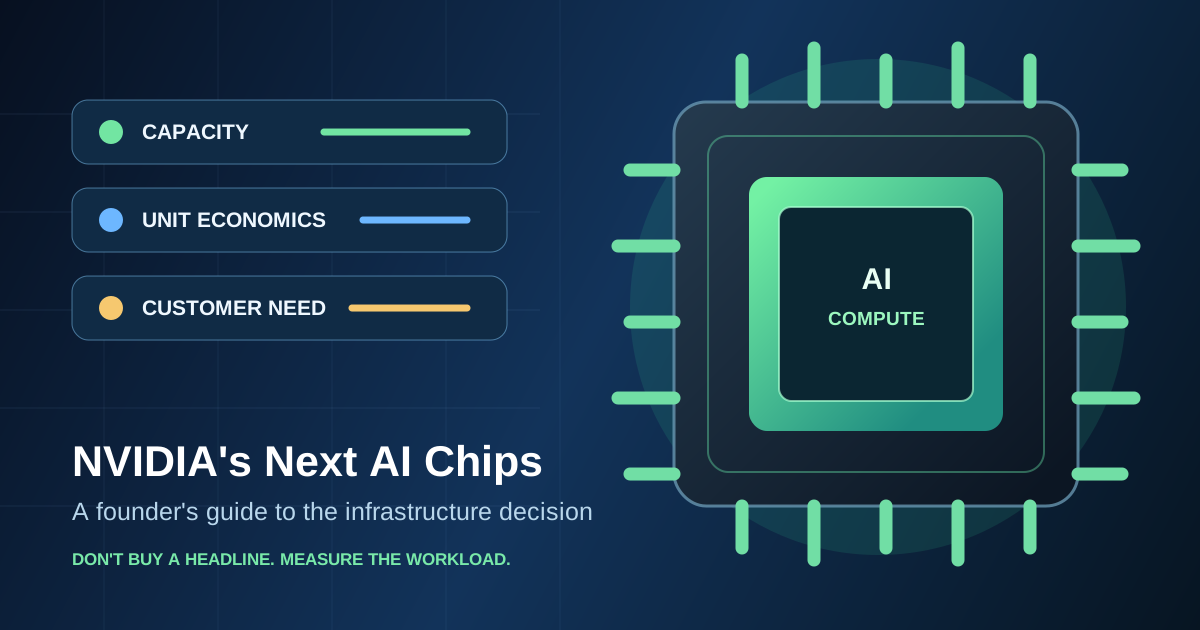
NVIDIA's roadmap now moves quickly enough to create a familiar founder anxiety: should we wait for the next chip, reserve a cluster now, or keep using an API? Blackwell systems are still being brought online at scale while NVIDIA has already made the next-generation Rubin platform the conversation. On X, the loud debate is usually peak performance. In Reddit threads, it is more often availability, cloud markups, power limits, and whether a smaller open model can do the job instead.
Both conversations miss the question that matters for an AI MVP: what workload are you trying to make economically reliable? Hardware announcements are useful signals about future capacity. They are not, by themselves, a procurement strategy. The right choice is determined by your model, request shape, latency target, data constraints, and the rate at which customer usage is growing.
NVIDIA's accelerated-computing generations combine faster GPUs, more high-bandwidth memory, networking, and systems engineering. That matters most for teams training frontier models or serving very large models at sustained volume. A new generation can improve tokens per dollar and unlock model sizes that were previously impractical—but those gains arrive through real systems, not a single chip you casually add to a cart.
For a startup, the transition from one generation to the next also affects the market around it. Cloud providers add capacity in waves. Prior-generation instances become easier to obtain. Inference providers compete more aggressively. Model teams tune kernels and quantization paths for the hardware customers can actually rent. The indirect effect may be more valuable to you than owning the newest silicon.
A useful rule of thumb
Do not delay validation to wait for a hardware generation. Use the cheapest reliable capacity that lets you learn from customers, then revisit the stack when usage—not announcement-day excitement— makes infrastructure a material line item.
X is optimized for striking charts: benchmark deltas, rack-scale performance figures, and claims that a generation changes everything. Reddit is better at surfacing operational friction: unavailable instances, unexpected egress charges, driver problems, and the difference between advertised and usable throughput. Read both as input, not evidence. A post about a massive training cluster does not map cleanly to a product handling a few thousand daily requests.
Before accepting a claim, ask four questions: which model, what batch size, what context length, and what service-level target? Without those details, a tokens-per-second number is marketing—or at best, an interesting engineering anecdote. Your product has its own traffic pattern and its own tolerance for queueing and quality trade-offs.
For most teams, an API is the fastest path to product truth. It avoids capacity commitments, exposes strong models immediately, and makes it easy to change providers while your product is still fluid. The downside is less control over unit cost, model availability, and data boundaries. That is acceptable while you are proving that users return and pay.
When an open-weight model fits the task, an inference provider can offer lower cost, predictable latency, and a clearer route to model control. This is often the middle ground for products with stable, high-volume workloads. Benchmark it with real requests, including long contexts and concurrent users—not a single clean prompt.
Reserved capacity becomes rational when inference demand is steady, the workload is well understood, and utilization can stay high. It can also be necessary for data residency, fine-tuning, or custom serving requirements. It is not merely a cost decision: your team takes on deployment, observability, failure handling, scheduling, and model-serving expertise.
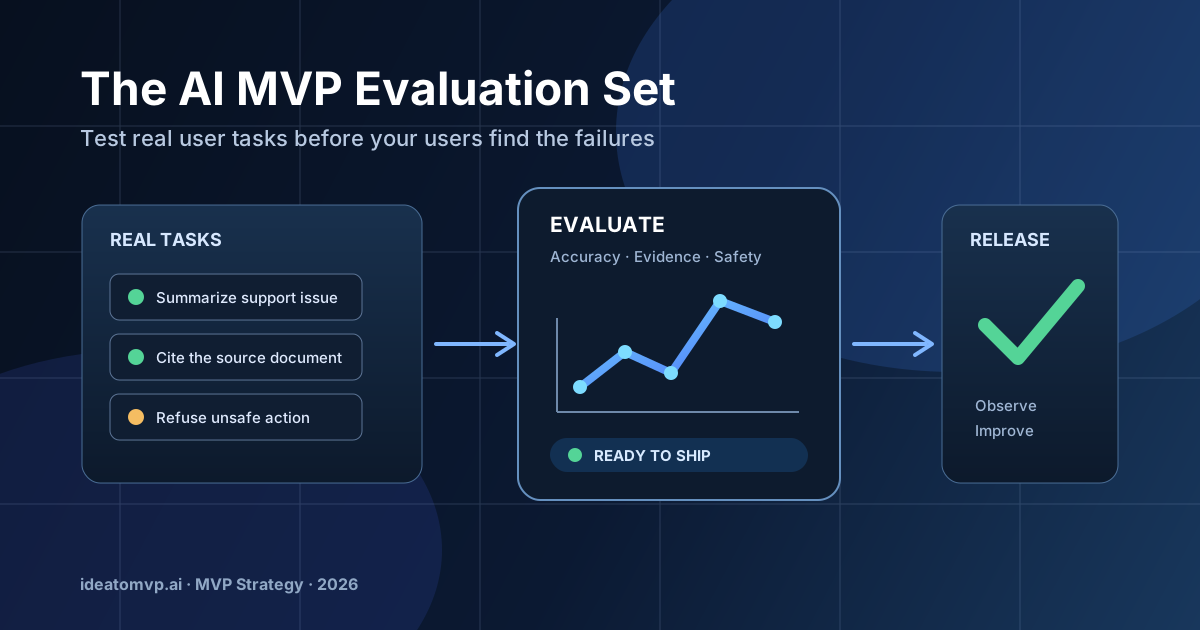
Create an infrastructure scorecard using production-like traces. Record prompt and completion tokens, context length, requests per minute, concurrency, time-to-first-token, total response latency, failures, and cost per successful user task. Then group requests by job: retrieval answer, extraction, code generation, classification, or agent action. One product can have workloads that deserve different models and different hardware paths.
NVIDIA's ecosystem is valuable because its software, tooling, and broad cloud availability reduce execution risk. That does not mean your application should become inseparable from one deployment assumption. Separate model selection from product logic. Version prompts and evaluation data. Treat embeddings, retrieval, reranking, generation, and tool execution as independently measurable layers.
This is not an argument to optimize for hypothetical alternatives. It is an argument to preserve a credible choice. If a better NVIDIA-backed endpoint, a lower-cost open model, or a different accelerator changes the economics, you should be able to run your evaluation set and decide in days—not rebuild your product in a quarter.
The winning move is not predicting NVIDIA's next launch perfectly. It is building a product and measurement loop that can take advantage of new capacity when it genuinely changes your unit economics. Let the chip cycle expand your options; do not let it postpone customer learning.
IdeaToMVP Academy
4-week live cohort for founders. Learn to ship AI agents, scope MVPs, and automate your business — taught by the same team that writes these guides.