Etched Doubled to $21B in a Month — and Shipped No Benchmark (2026)

By Surya Pratap
August 19, 2026
11 min read
AI & Technology

August 19, 2026
11 min read
 Two kinds of evidenceHover to explore
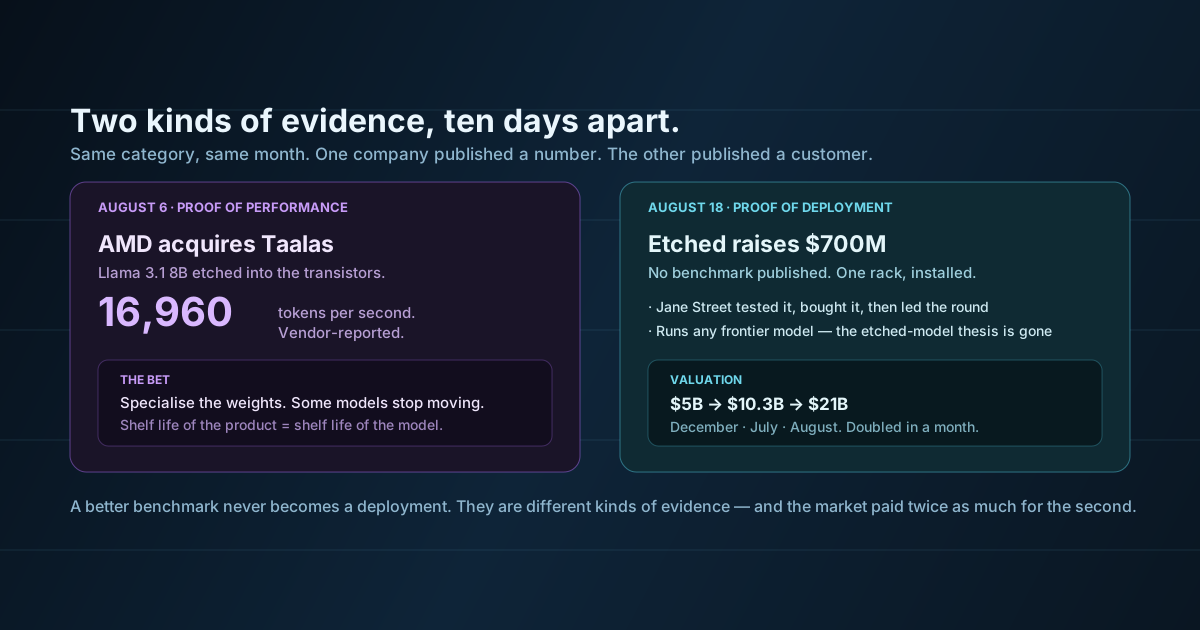
On August 18, Etched announced $700 million at a $21 billion valuation. Five weeks earlier it had raised $300 million at $10.3 billion. Eight months before that it was worth $5 billion. The valuation roughly doubled in a month.
The announcement contained no benchmark. No tokens per second, no comparison against an H100 or a B200, no efficiency multiple. What it contained instead was a sentence about where the hardware currently sits: Jane Street installed Etched's first shipped cluster in its own data center, tested it, and then led the round.
That inversion — a customer deployment where the performance table normally goes — is the interesting part, and it is worth more to most founders than the chip is.
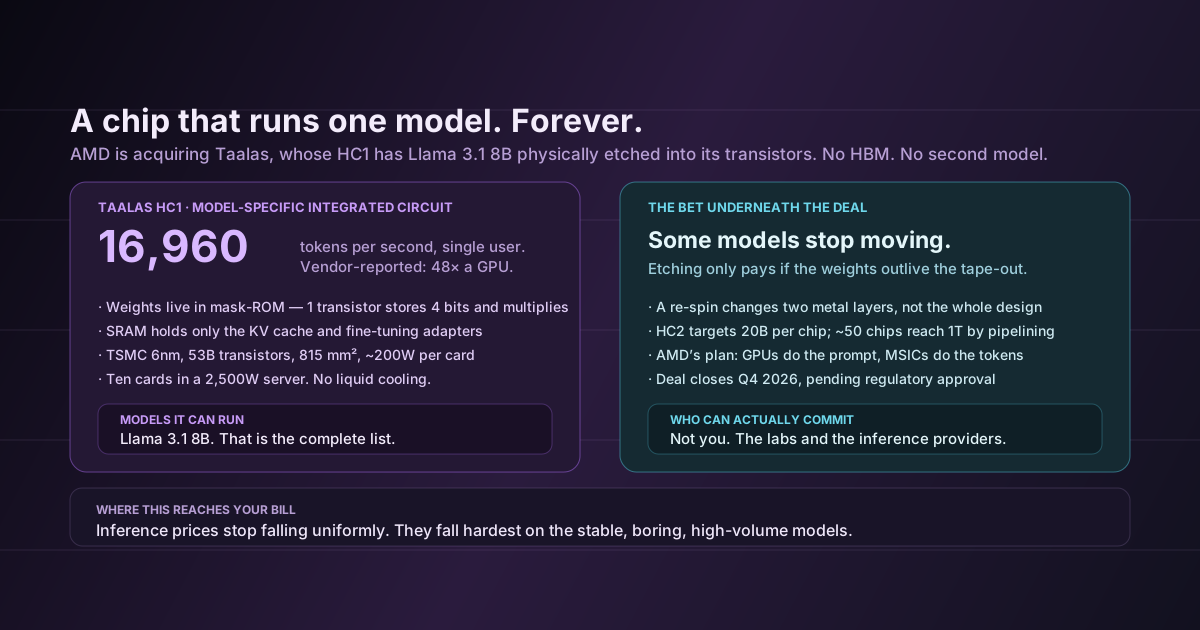
On August 6, AMD agreed to acquire Taalas, whose HC1 has Llama 3.1 8B physically etched into its transistors. We wrote about it in AMD Just Bought a Chip That Runs One Model and Nothing Else. The bet underneath that deal was that some models stop moving — that a set of weights can be worth freezing into silicon because it will outlive the tape-out.
Etched was the company that invented that thesis. Founded in 2022 by three Harvard dropouts — Gavin Uberti, Chris Zhu and Robert Wachen — its original product was Sohu, a transformer ASIC, and its original pitch was the model in the hardware. It raised $120 million in June 2024 to fabricate at TSMC on exactly that story.
It no longer tells that story. Reporting on this round is explicit that Etched is still fighting the perception that it etches a particular model into its chips, and that the perception is out of date: that was the original intention and is not the current design. Etched's systems run any frontier model.
So within ten days, the category's largest independent company confirmed it had walked away from the thesis a chipmaker had just paid to acquire — and the market responded by doubling its valuation.
This is not a contradiction, and reading it as one gets it backwards
Both moves are bets on specialisation. They disagree about what layer to specialise. Taalas specialises the weights: maximum efficiency, zero optionality, and a product whose shelf life is the model's shelf life. Etched now specialises the workload shape — prefill versus decode — which is a property of transformer inference generally, not of any one checkpoint. The second bet survives a model release. The first one has to be re-fabbed.
Two custom pieces, and they map onto the two halves of an inference request.
A prefill chip that runs at low voltage. Prefill is the compute-bound half: chewing through the prompt before the first token comes out. Running the silicon at lower voltage lets Etched pack transistors more densely without the thermal ceiling that density normally imposes. More arithmetic per unit of heat, aimed at the phase that is arithmetic-bound.
A decode-side memory system Etched calls cluster-scale memory. Decode is the memory-bound half: one token at a time, dragging the KV cache around. The design lets many chips connect and draw on a shared pool at very low latency, so the working set is not trapped behind any single chip's memory ceiling.
This is the same prefill/decode split AMD wanted Taalas for, solved without giving up the ability to run a model that did not exist when the mask was cut. If you have been treating "inference chip" as one category, stop. The workload has two halves with opposite bottlenecks, and 2026's hardware is being designed against that seam rather than against the model.
Nothing in this announcement is independently benchmarked. Etched published no throughput figure, and Jane Street's public assessment is that it tested the chip and is pleased with the early results. That is a customer's impression, not a measurement. Treat it as such.
Jane Street tested the hardware, bought it, installed it, and then led a $700 million round into the company that makes it.
That is a genuinely strong signal and a genuinely compromised one, and both halves need saying. Strong, because a quantitative trading firm putting a novel accelerator into its own production data center is about as unsentimental a purchase decision as exists — latency is revenue there, and nobody buys a rack for the narrative. Compromised, because the lead investor now holds a position in the thing it is validating, and its assessment of the product is no longer independent of its assessment of the equity.
The other names in the round — Kleiner Perkins, Sequoia, Andreessen Horowitz, Peter Thiel, Tiger Global, Bain Capital Ventures, Blackstone — are the reason the number is $21 billion. The Jane Street rack is the reason they were willing.
Etched spent roughly two years in a state most founders would recognise: a compelling thesis, real engineering, and no way to prove the thing worked outside its own lab. It published a benchmark. The benchmark did not settle the argument, because vendor-published benchmarks never do — everyone in the market knows they are chosen by the vendor.
What settled it was a customer taking delivery.
The gap between those two is where most technical startups stall, and the mistake is almost always the same: treating the benchmark as a smaller version of the deployment, and trying to make it more convincing. A better benchmark does not become a deployment. They are different kinds of evidence, and the second one is what reprices you.
For an MVP this translates directly. One customer using the product on their real data, whose name you are allowed to say, outperforms any demo you can build — including a demo that is objectively more impressive. If you are choosing this quarter between making the product better and getting one real installation, take the installation. That is what a month of Etched's history is worth as advice.
Being clear about the weak parts, because the number is large enough to switch people's judgement off:
If you are building on inference rather than selling it, here is the honest scope of the news.
Nothing changes this quarter. You cannot buy this. There is one publicly known customer and no general availability. Any plan that depends on it is a plan built on a press release.
Something changes over 12 to 24 months, if this works. Specialised inference silicon aimed at the prefill/decode seam is a real cost-structure argument, and it is being funded seriously by more than one company. The plausible outcome is not uniformly cheaper inference. It is inference whose price depends much more sharply on the shape of your workload — prompt-heavy versus generation-heavy, batch versus interactive — because the hardware underneath has stopped being one undifferentiated thing.
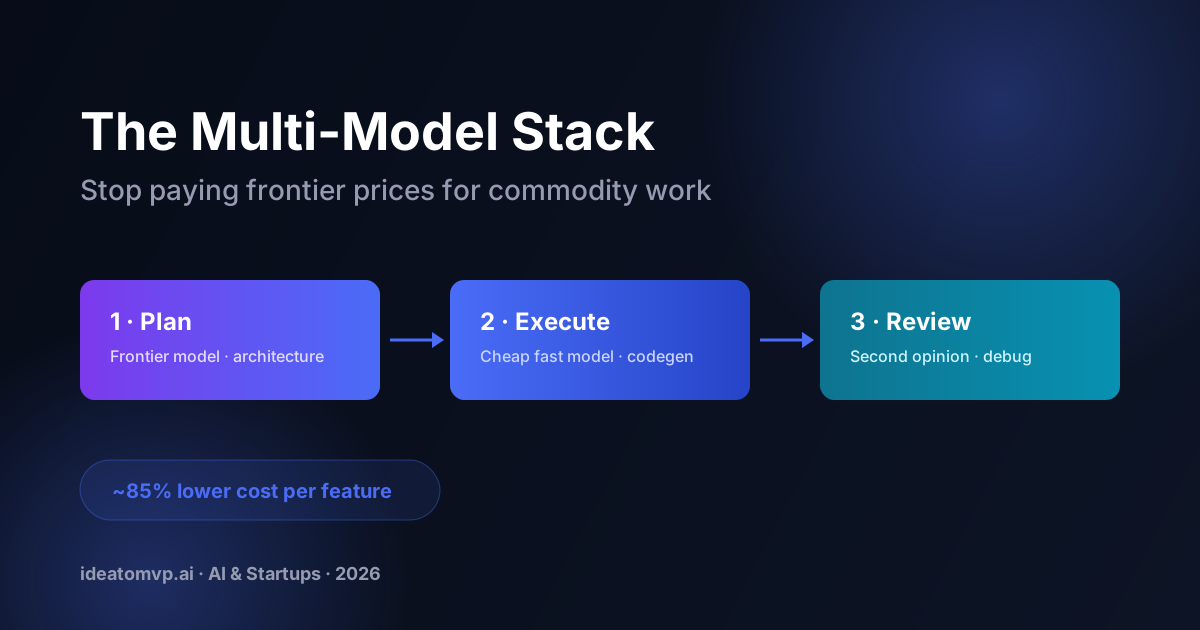
The architectural response is the same as it was two weeks ago, which is a good sign. Keep the model boundary swappable. Know your own prefill-to-decode ratio, because it is about to become a pricing input rather than an implementation detail. Do not couple your product to one provider's inference economics at a moment when those economics are visibly in motion. We went through this in more depth in the multi-model stack cost breakdown, and nothing here invalidates it.
If you cannot currently state what fraction of your token spend is prefill versus decode, that is the one piece of work this news should actually prompt. It is a day of instrumentation, it is useful regardless of what any chip company does next, and every hardware pricing story from here will be quoted in those terms.
Etched is worth $21 billion because a serious customer installed its hardware and then wrote a cheque, not because it published a compelling number. It quietly abandoned the hardwired-model thesis that made its name — the same thesis AMD bought ten days earlier — and moved its specialisation to the prefill/decode seam, where a model release does not obsolete the silicon.
For founders the transferable part has nothing to do with semiconductors. The company spent two years being judged on evidence it produced itself, and got repriced within a month of producing evidence someone else produced about it. Go and get that second kind.
Sources: Etched, $700M at a $21B valuation and first customer delivery to Jane Street · TechCrunch, on the valuation history and the move away from single-model silicon · Crypto Briefing, on the round, the investor list and the prefill/decode architecture · TNW, on the Series D · CNBC, on the 2024 Series A and the original Sohu positioning
IdeaToMVP Academy
4-week live cohort for founders. Learn to ship AI agents, scope MVPs, and automate your business — taught by the same team that writes these guides.