AMD Just Bought a Chip That Runs One Model and Nothing Else (2026)

By Surya Pratap
August 8, 2026
11 min read
AI & Technology

August 8, 2026
11 min read
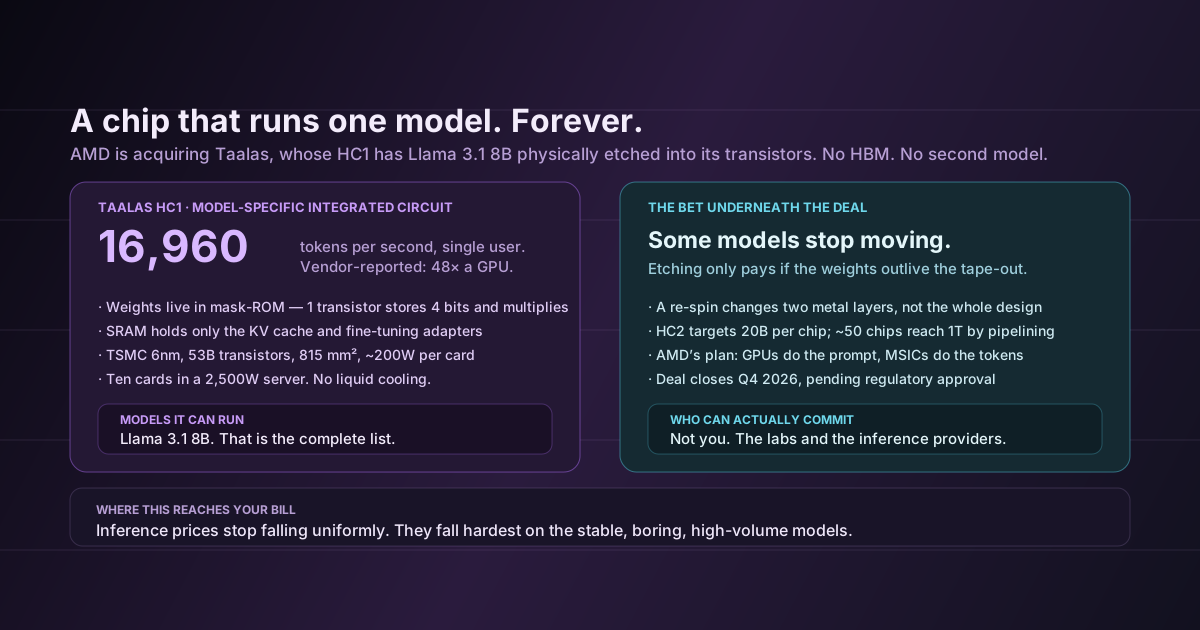
On August 6, AMD agreed to acquire Taalas, a three-year-old Toronto startup that has raised $219 million to build chips with the model baked in. Not optimised for. Baked in. Taalas' first product, the HC1, runs Meta's Llama 3.1 8B, and the reason it cannot run anything else is that the weights are physically etched into the transistors.
It reports 16,960 tokens per second for a single user. Vendor-published, so treat it as directional — but the claimed multiple against contemporary GPUs is roughly 48×, which is a large enough number that even heavy discounting leaves something interesting.
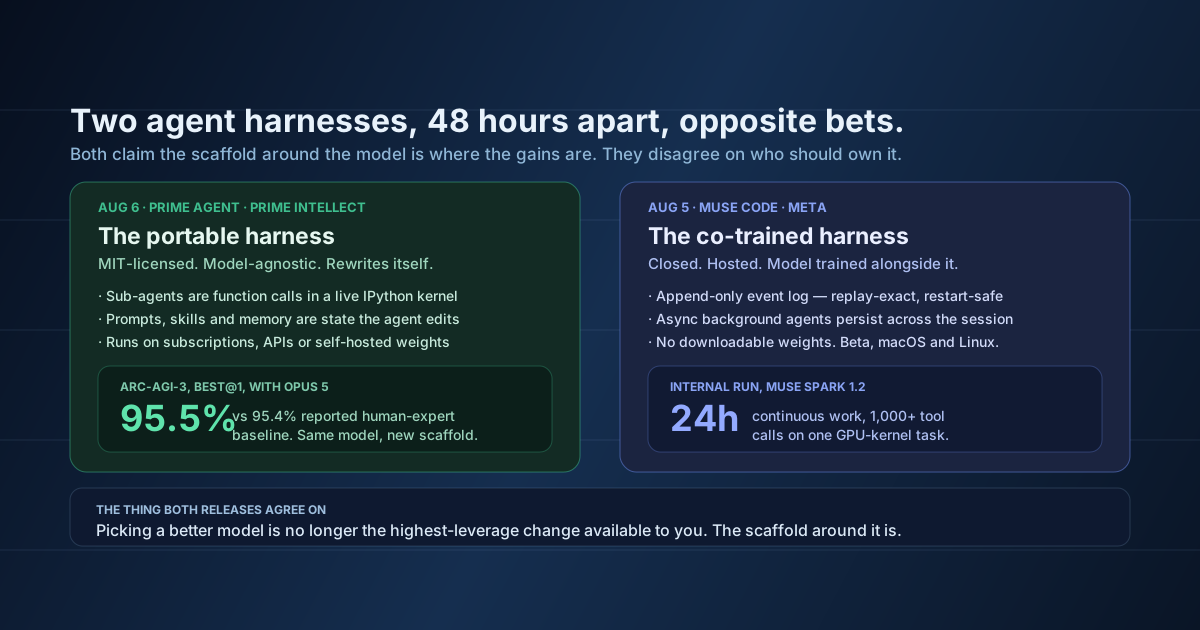
Yesterday I wrote about two coding agents that shipped a day apart making opposite bets on whether the harness should be portable. This is the same argument at a much lower layer of the stack, and at a far more extreme setting. Everything in AI tooling for two years has been optimising for optionality — gateways, routers, abstraction layers, swap the model in a config change. AMD just spent real money on the opposite bet. That is worth understanding, because it tells you something about where the cost curve is going next.
The category name is model-specific integrated circuit — an MSIC, by analogy to the ASIC. The design flow takes a trained model's math, routing and parameters and lays them out as fixed logic.
The chip has two regions. Weights live in a mask-ROM recall fabric, where — in founder Ljubisa Bajic's description — a single transistor stores four bits and performs the multiply associated with them. SRAM handles the parts that genuinely have to change at runtime: the KV cache and fine-tuning adapters. There is no HBM anywhere, which is the whole point. On a GPU, most of the energy and most of the waiting goes into moving weights from high-bandwidth memory to the compute units, over and over, for every token. If the weights are already inside the logic, that traffic does not exist.
The physical numbers: TSMC 6nm, 53 billion transistors on an 815 mm² die, roughly 200 watts per card. Ten cards fit in a dual-socket x86 server inside a standard 2,500-watt envelope with no liquid cooling. That last detail is easy to skim past and is arguably the most consequential one in the whole announcement — it means this deploys into ordinary racks in ordinary buildings, not into the specialised, power-constrained, eighteen-month-waiting-list facilities that frontier GPU clusters need.
The second-generation HC2, targeted for this summer, aims at 20 billion parameters per chip, with pipeline parallelism across accelerators to go bigger — roughly 50 chips to reach a trillion parameters. Taalas claims etching a model into silicon costs about 100× less than training a frontier model, which is a comparison to a very large number and should be read as “affordable relative to a training run,” not “cheap.”
AMD's stated plan is not to replace its GPUs. It is to disaggregate the two halves of inference, which have never really wanted the same hardware.
Processing your prompt — prefill — is compute-bound and highly parallel. Every input token can be worked on at once, which is exactly what a GPU is good at. Generating the response — decode — is memory-bandwidth-bound and stubbornly sequential: one token at a time, each requiring the full weight set to be read again. GPUs are wasteful at this and always have been. Under AMD's plan, Instinct GPUs handle the prompt, Taalas accelerators generate the tokens, and the whole thing sits inside its Helios rack-scale platform alongside EPYC and ROCm. The alternative it floats is a tick-tock cycle: customers validate a model on Instinct GPUs, then move the settled workload onto an MSIC.
There is also a straightforwardly competitive reading. NVIDIA's moat is substantially a memory and interconnect moat. A design that routes around HBM entirely is one of the few attacks available that does not involve out-executing NVIDIA at its own game. The deal closes in Q4 2026 subject to regulatory approval, so none of this is imminent.
Here is the part worth sitting with. Etching a model into silicon only makes economic sense if the weights outlive the tape-out. AMD is paying for the proposition that some models will stop changing.
That runs directly against the prevailing story, including the one I have been telling on this blog — that models ship monthly, that any routing decision is wrong within a quarter, that you should build so responding to a new release is cheap. All of that remains true at the frontier. But the frontier is not where the token volume is.
Think about where inference actually gets spent in a mature product: classification, extraction, reranking, embedding pipelines, routing decisions, guardrail checks, the intermediate steps of an agent loop that no human ever reads. That work does not need this quarter's frontier model. It needs a competent 8B that behaves the same way tomorrow as it did today. Teams pin those models deliberately, because changing them means re-validating everything downstream. Llama 3.1 8B being the HC1's first target is not an accident — it is a workhorse that has been stable long enough to have accumulated an enormous, boring, high-volume install base.
Two things that look contradictory and are not
Model churn is accelerating and a large share of production tokens is consolidating onto a small number of frozen workhorses. Both are true because they describe different layers. The frontier moves fast because that is where the competition is; the substrate settles because re-validating a pinned model across a production system is expensive and nobody does it for fun.
A chip locked to one model in a market shipping new models monthly sounds like an expensive way to be obsolete. Three things soften it, and one does not.
You are never going to buy one of these. You will rent the consequences, and the consequences are more specific than “inference gets cheaper.”
Every number in this piece is vendor-published, from a company that has not yet shipped its second product, inside a deal that has not yet closed. Silicon roadmaps slip, benchmark claims compress under independent testing, and acquisitions get absorbed into product lines and quietly disappear. Hold the specifics loosely.
Hold the direction more firmly. For three years the entire AI stack has been soft — everything a config change, everything swappable, optionality preserved at every layer because nobody knew what would matter. Hardening starts when the answers stop changing. A company etching weights into ROM is making a claim that parts of this are now known well enough to commit to physically, and a company the size of AMD agreeing with them is the actual news here, more than any throughput number.
For founders, the useful move is not picking a side. It is knowing which parts of your own system are which. The things you will still be running in two years — your evaluation set, your retrieval logic, the workhorse model doing the unglamorous 90% of your tokens — deserve to be treated as infrastructure and optimised hard. The frontier call you make this week deserves to stay behind a gateway where changing it costs an afternoon. Most teams have that exactly backwards: they obsess over the model choice that will be obsolete in a quarter and improvise the parts that will outlive it.
IdeaToMVP Academy
4-week live cohort for founders. Learn to ship AI agents, scope MVPs, and automate your business — taught by the same team that writes these guides.