The Month-Two Wall: Why Your AI Agent Forgets — and the Memory Architecture That Fixes It (2026)

By Surya Pratap
July 27, 2026
10 min read
AI & Technology

July 27, 2026
10 min read
There is a very specific complaint circulating in the agent-builder corners of Reddit right now—r/AI_Agents, r/Automation, r/n8n—and it always arrives on the same schedule. The demo worked. The pilot worked. Then somewhere around week six or eight, with real usage and real session lengths, the agent started getting things subtly wrong. It re-asked a question it had already answered. It acted on a customer detail that had changed two weeks ago. It lost the thread of a long task and confidently finished the wrong one. Builders have started calling it the month-two wall, and the frustrating part is that nothing broke. No error, no exception, no failed deploy. The agent just quietly got worse.
The instinct is to blame the model and upgrade. That almost never fixes it, because this is not a model failure—it is a memory architecture failure. Most agent failures in production are context failures, and the shape of the problem has become clear enough in 2026 that it has a name, a body of measurement behind it, and a set of fixes that are boring in the best possible way. This is a founder's guide to what actually goes wrong, why bigger context windows did not save anyone, and what the memory layer should look like before your agent meets its second month.
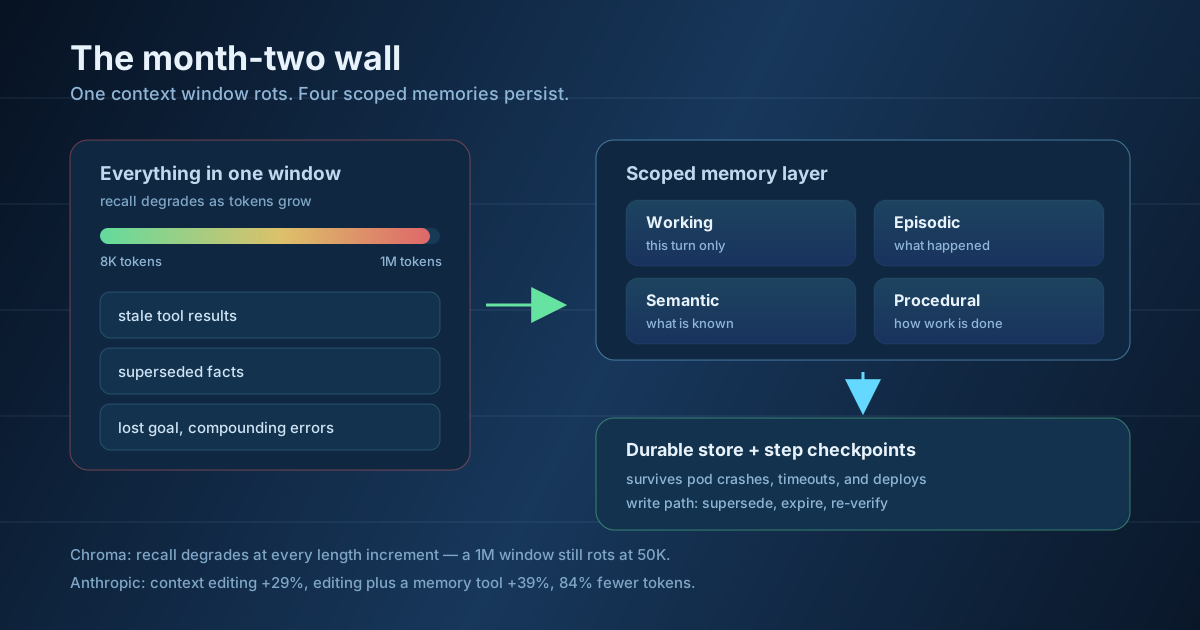
The clearest evidence comes from Chroma's Context Rot research, which evaluated 18 frontier models—GPT-4.1, Claude 4, Gemini 2.5, Qwen3 among them—across eight input lengths on deliberately simple tasks like retrieval and text replication. The result is uncomfortable: models do not process context uniformly. Recall degrades at every length increment, not just near the limit. A model with a one-million-token context window already shows measurable degradation at fifty thousand tokens.
Two details matter more than the headline. First, degradation accelerates as the semantic similarity between the buried fact and the question drops—so the harder the retrieval, the faster the rot. Second, distractors and haystack structure change the curve independently of raw length. Together they point at the same conclusion: signal-to-noise ratio matters more than capacity. Stuffing a bigger window is not a strategy; it is the thing that causes the problem.
Why the wall shows up in month two specifically
Demos are short. Pilots are short. Real usage is where sessions get long, histories accumulate, and facts learned in week one go stale. The context that was clean at launch is, by month two, a large pile of half-relevant tool results and superseded truths—and that is precisely the regime where recall falls apart.
The single most useful reframe is that “memory” is not one thing. Production agent systems separate at least four kinds, and most early MVPs collapse all four into a single growing conversation transcript. Working memory is what the agent needs for the current step and should be aggressively disposable. Episodic memory is what happened—the record of past sessions and outcomes. Semantic memory is what is known—durable facts about a user, an account, a domain. Procedural memory is how work gets done—the learned workflows and patterns that should survive every session.
They have completely different lifetimes, and that is the whole point. Working memory should be cleared constantly; semantic memory should persist for months but be correctable; procedural memory should be versioned like code. When all four live in one context window, you get the worst policy for each: nothing is ever cleared, nothing is ever properly updated, and every fact competes for attention with every stale tool result. Context rot, memory drift, lost goals, and compounding errors are what that single-window design produces under load.
Alongside the types, scope matters. Mature memory systems key retrieval on identity: user, agent, session or run, and organization. A fact learned about one user should not leak into another's session; a workflow learned org-wide should be available everywhere. If your agent has no scoping model, it either forgets too much or remembers things it has no business remembering—and the second failure is a privacy incident waiting to happen.
The encouraging part of 2026 is that the fixes are measurable, and they are architectural rather than model-dependent. Anthropic's published results on its own agentic-search evaluations are the cleanest example: context editing—automatically stripping outdated tool calls and results out of the window—delivered a 29% improvement on complex multi-step tasks. Adding a memory tool, where the model reads and writes files in a memory directory that lives outside the context window, took the combined lift to 39%. In a hundred-turn web search evaluation, context editing let agents finish workflows that previously died from context exhaustion, while cutting token consumption by 84%.
Read that pairing carefully, because it is the design lesson. Editing alone helps because it raises signal-to-noise. Editing plus an external memory helps more because the agent stops having to choose between forgetting something and drowning in it. The 84% token reduction is the part founders should notice twice: this is one of the rare cases where the reliability fix and the cost fix are the same change.
Dedicated memory layers report similar gains on the standard benchmarks—scores in the low-to-mid nineties on LoCoMo and LongMemEval at roughly seven thousand tokens per query, with double-digit jumps in temporal and multi-hop reasoning over previous approaches. But the honest number is the one from large-scale evaluation: on BEAM, performance drops from around 64 at one million tokens of history to around 49 at ten million. Even good memory systems degrade as history grows. Retrieval quality is a real constraint, not a solved problem, and any roadmap that assumes “we'll just add memory” is skipping the hard half.
The cheapest first move
Before you evaluate a single memory vendor, add context editing: expire tool results once they have been acted on, and drop reasoning traces that no longer inform the next step. It is a few days of work, it needs no new infrastructure, and it is the change with the best measured return per hour spent.
Almost every memory conversation focuses on retrieval—embeddings, rerankers, hybrid search. But the failures builders describe on Reddit are overwhelmingly write-path failures. The agent remembered something correctly and then the world changed. The customer moved to a different plan. The policy was updated. The contact who approved things left. The memory is not wrong about the past; it is wrong about now, and the system has no mechanism for noticing.
One commenter in those threads put it better than most vendor documentation does: long-horizon reliability needs a way to forget, supersede, and re-verify facts. Those are three distinct operations. Forgetting is a time-to-live on memories that were only ever situational. Superseding is writing a new fact that explicitly retires an old one rather than sitting beside it—because two contradictory memories in a retrieval index is a coin flip, not a knowledge base. Re-verifying is re-checking high-stakes facts against the source system before acting on them, rather than trusting a six-week-old note.
Memory staleness is openly acknowledged as an unsolved problem even by the teams building memory infrastructure, alongside temporal abstraction and identity resolution. So do not wait for a library to handle it. Decide, per category of fact, how long it stays true and what happens when it does not—and write that policy into the system rather than into a design doc.
The other half of the month-two wall is not cognitive at all—it is infrastructural. Agents that run for hours or days will hit provider timeouts, pod crashes, scheduled deployments, and network interruptions. These are not edge cases; over a long enough horizon they are guaranteed. If session state lives in process memory or on a pod's ephemeral disk, every one of those events silently destroys everything the agent knew, and the agent restarts the workflow from the top, burning tokens and sometimes repeating side effects it should never repeat.
The pattern that works is dull and well understood: state in durable storage, checkpoints written before each step executes, and resumption at the exact point of failure rather than the beginning. The observation from those same builder communities is blunt—the agents making money have durable recovery paths, and the ones failing in production do not. This is also why the recurring critique in this summer's graphs-versus-loops orchestration debate on X landed so hard: as the creator of XState pointed out, the industry keeps rediscovering decades-old software engineering patterns under new names. Durable state machines are one of them. Your agent needs the same recovery guarantees any long-running job has needed for thirty years.
If you are shipping an AI MVP in the next quarter, you do not need a research-grade memory system. You need to not hit the wall. That is a much smaller job, and it is mostly about making four decisions explicitly instead of by accident.
That last item is the one most teams skip. The whole reason the month-two wall is a surprise is that nobody tested for month two—the evaluation set was built from clean, short, first-session tasks, so it kept passing while real reliability slid. If you take one thing from all of this, make it that: put a deliberately long, deliberately stale session in your test suite, with a fact that changed halfway through, and see whether your agent notices.
The broader shift here is worth naming. Buyers in 2026 have stopped being impressed by agent demos, because everyone has one. What they are actually buying is task completion that holds up on the hundredth run, and that is decided almost entirely by architecture the demo never exercises. Memory is where that gets won—not by the model you pick, but by what you choose to keep, what you choose to throw away, and what you make sure survives a deploy.
IdeaToMVP Academy
4-week live cohort for founders. Learn to ship AI agents, scope MVPs, and automate your business — taught by the same team that writes these guides.