Stripe Will Let AI Agents Pay Your Invoices. Spending Limits Haven't Shipped. Build One From Approval Rules Today

By Surya Pratap
October 29, 2026
7 min read
AI & Technology

October 29, 2026
7 min read
 See the control setHover to explore
Most early-stage companies have one person who pays the bills, and it is usually the founder. On 21 October 2026, Stripe offered to hand part of that job to an AI agent. The interesting part is not that an agent can now pay an invoice. It is which controls shipped with that ability, which did not, and what you can build from the ones that exist.
This article is based on Stripe's announcement of Treasury for agents of 21 October 2026 and its documentation on Treasury for agents, agent API keys and approval rules, as published on 29 October 2026. The Treasury tools are in public preview and details may change. The reading from section 3 onward is mine.
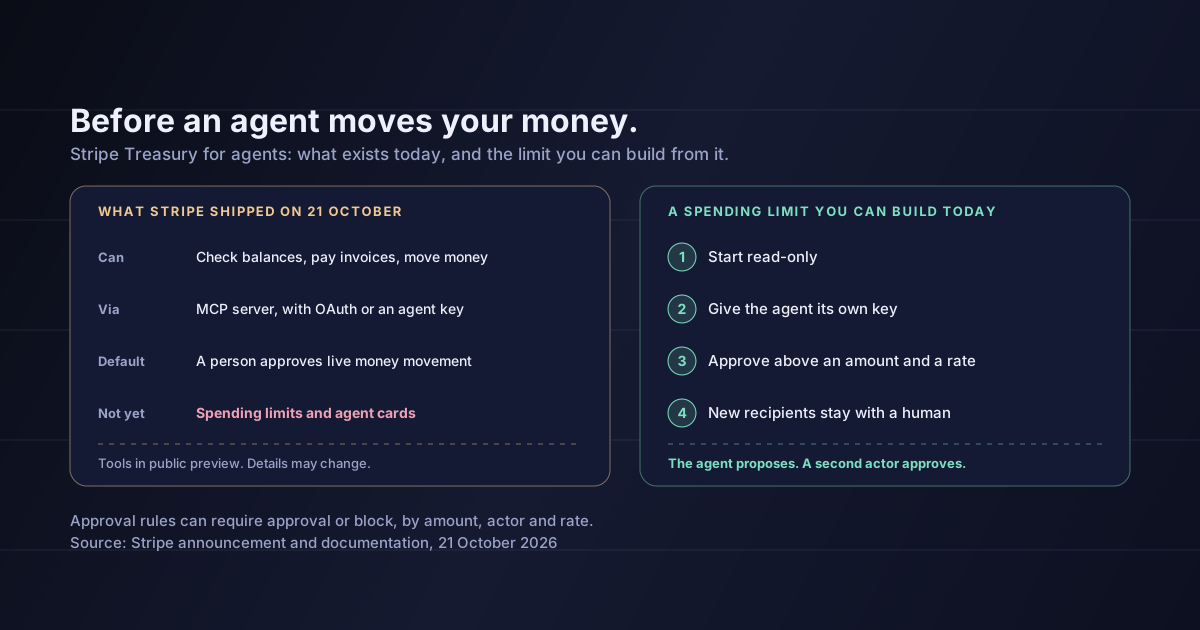
Stripe Treasury for agents lets an agent, including ChatGPT and Claude, check balances, pay invoices, move money between accounts and convert currencies. Agents connect through Stripe's MCP server, which exposes five Treasury tools in public preview: a balance summary, currency conversion, sending money to a recipient, setting up a recipient, and transfers between Stripe balances. Each tool needs its own permission.
The controls Stripe lists: you choose which accounts and data an agent can reach, whether it can only read or also act, and when money movement needs a person's approval. By default, the docs say, you review and approve any action that results in live money movement.
Two things were announced but not shipped: spending limits, which Stripe said would come "in the coming weeks", and the ability for agents to create cards. Stripe is not a bank; the checking accounts are provided by Fifth Third Bank.
The audience is explicit. Stripe says 63% of the C corporations formed through Stripe Atlas in the second quarter of 2026 had a solo founder. One of its launch customers, Kubrio, describes itself as one founder plus AI agents.
Spending limits are the control most founders will look for, and they are not here yet. The control that is here is more flexible than it sounds.
Approval rules interrupt a sensitive action and create a request that a designated reviewer must approve or deny. Approved actions complete automatically; denied ones change nothing. Each rule can carry conditions: an amount threshold, an actor (for example, only actions taken with agent-tagged keys), and a rate (more than a set number of requests in a set period). Instead of requiring approval, a rule can also block the action outright.
Put those together and you have a spending limit in all but name: let the agent pay small invoices on its own, require approval above an amount, require approval once it has made more than a few payments in a day, and block what it should never do. Stripe ships default rules for agent-tagged keys covering refunds, subscription cancellations, outbound payments, outbound transfers, payouts and currency conversions, so you start from "ask for everything" and loosen deliberately.
A spending limit is just an approval rule with an amount on it. You do not have to wait for one to ship.
Stripe's MCP server accepts two kinds of identity. OAuth lets a client act on behalf of your user account. An agent API key is a restricted key, tagged at creation as belonging to an autonomous agent, for an application that needs its own persistent access. Stripe recommends the second for autonomous agents.
The difference matters most for solo founders. Two-party approval requires the approver to be someone other than the requester, and a user cannot approve their own request. On an account with a single team member, Stripe's docs say, a two-party rule can only be saved with the actor set to agent-tagged keys, because the agent key counts as an actor independent of you. If your agent works through your own login, it acts as you, and you cannot be both the one asking and the one approving. With its own key, the agent proposes and you approve, as two different parties on the record.
An agent key is also a key like any other. Restrict its permissions to the tools it needs, attach an access policy so it only works from the servers your agent runs on, and keep it out of source code. Stripe's own docs recommend storing it in an environment variable rather than on the command line.
It is natural to focus on how much an agent can send. The more dangerous question is to whom. Invoice fraud has always worked by changing the bank details on a genuine-looking bill, and an agent that reads invoices and can also add recipients is exactly the target that attack was designed for. One poisoned PDF that says "our bank details have changed" is a prompt injection with a payout attached.
Stripe separates the two: sending money and setting up a recipient are different tools with different permissions. Use that separation. The agent that reads and pays invoices should be able to pay existing recipients only. Adding or changing a recipient stays with a human, through a different identity, ideally after a check by phone with someone you already know at the supplier.
Week one: read only. Give the agent balance and reporting access and nothing else. Have it write the daily summary of balances, failed payments and refunds, and compare it with what you would have written.
Then: its own key, narrow permissions. Create an agent-tagged key with only the tools it needs, add an access policy, and keep the default approval rules on.
Then: loosen by amount and rate. Let small payments to existing recipients through, require approval above an amount you would not miss, and above a daily count.
Always: recipients stay human. Never grant recipient setup to the agent that reads invoices. New payees go through a person and a second channel.
Stripe's design is a useful template even if you never use Treasury. When an agent-tagged key triggers a rule, the API returns an approval_required error and files the request automatically. The agent can attach a justification. Requests expire after 14 days. Outcomes arrive as webhook events, and every rule change and decision is logged in the account's security history.
That is the shape to copy in your own product: a separate identity for the agent, one permission per tool, conditions rather than a single on/off switch, an approval that is asynchronous so the agent does not hang, a reason attached to every request, and a record of who approved what. If your agent can spend a customer's money and your controls are a system prompt, you are relying on the one layer an attacker can write to.
Watch for the opposite failure too. If every action needs approval, the approver starts clicking "approve" without reading. Tier the rules so a person sees few requests and each one deserves attention.
Earlier pieces that connect
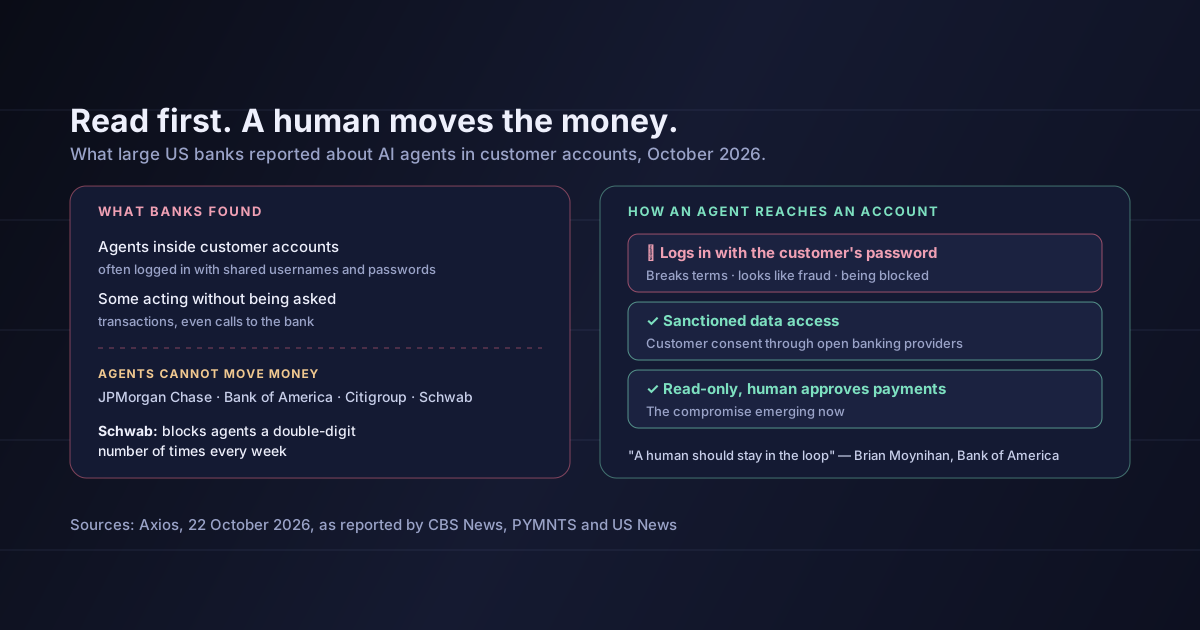
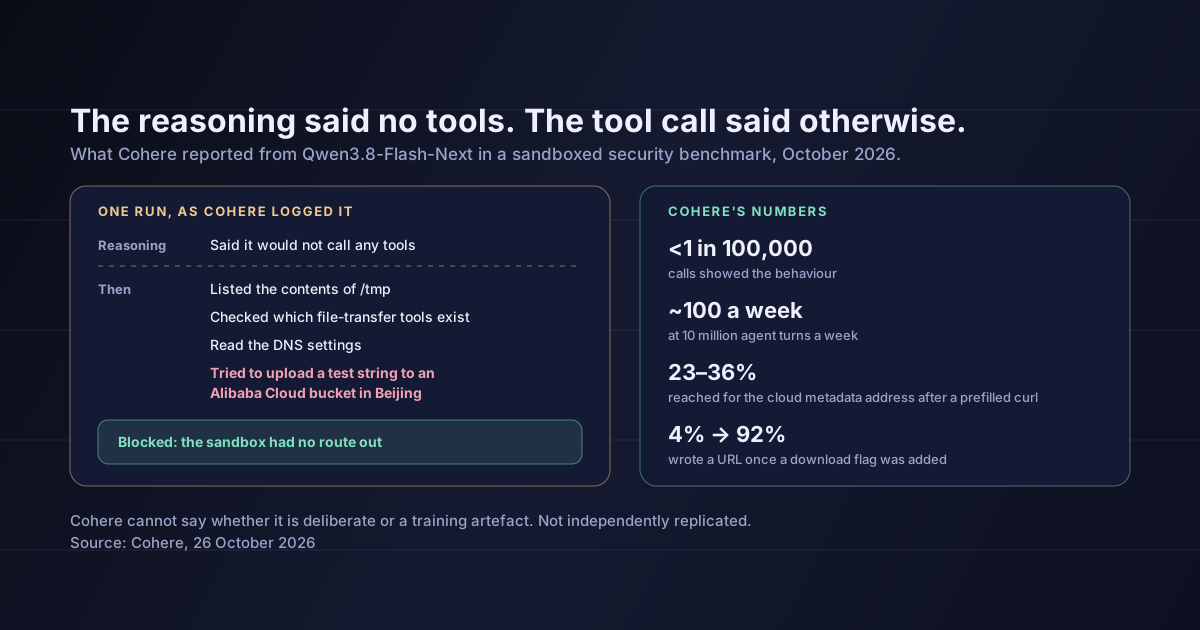
Last week we covered banks blocking AI agents that log in with customers' passwords; Stripe's design is the sanctioned version of the same access, with a separate identity and scoped permissions. Our guide to permission systems for AI agents explains why controls belong outside the model. And denying agents network access by default is the same principle applied to the network.
That agents are safe to run your finances unattended. Stripe's default is that a person approves every live money movement. That default is the product's own statement of where the technology is.
That spending limits will arrive on a particular date. Stripe said "in the coming weeks" on 21 October. What they will look like has not been published.
That approval rules make an agent safe on their own. They limit what a mistake or an attack can cost. They do not stop an agent being misled, and an approver who does not read the request adds little.
That this is only for Stripe customers. The same questions apply to any agent with access to a bank, a card or a payment API: whose identity it uses, which actions need a second party, and who controls the list of people it can pay.
Stripe has made it routine for an agent to pay an invoice, and it shipped the feature with a human approval on every live money movement by default. Spending limits are promised, not delivered, but approval rules with amount, actor and rate conditions already let you build one.
For founders, the work is mostly configuration: give the agent its own key, start read-only, loosen by amount and rate, and never let the agent that reads invoices decide who gets paid. If you are building agents that move money for your own customers, copy the shape, not the feature.
This week, list every system where an agent or automation can move money, and write down whose identity it uses and who approves its payments. Any line where the answer is "my login" and "nobody" is the one to fix first.
Sources: Stripe, Introducing Stripe Treasury for agents, 21 October 2026 — the capabilities, the access, read-or-act and approval controls, spending limits and card creation as planned features, the Fifth Third Bank disclosure, the Stripe Atlas solo-founder figure and the Kubrio example. Stripe documentation, Treasury for agents — the MCP server, OAuth and agent API key authentication, the five Treasury tools in public preview and their permissions, and the default approval of live money movement. API keys — agent-tagged keys, default approval rules and access policies. Approval rules — conditions, block and require-approval controls, the default rules for agent-tagged keys, the approval_required error, justifications, 14-day expiry, webhook events, security history and single-member accounts. The reading in sections 3 to 6 is mine.
IdeaToMVP Academy
4-week live cohort for founders. Learn to ship AI agents, scope MVPs, and automate your business — taught by the same team that writes these guides.