Stripe Bought the Layer That Picks Your Model. Know What Leaving Would Cost (2026)

By Surya Pratap
August 21, 2026
11 min read
AI & Technology

August 21, 2026
11 min read
 The dependency, and the doorHover to explore
Stripe has agreed to acquire OpenRouter, the gateway that routes token traffic across more than 400 models from over 80 providers. Reported figures put the deal above $8 billion in cash and stock — against a $1.3 billion valuation in a round that closed in May. Roughly five times, in about three months.
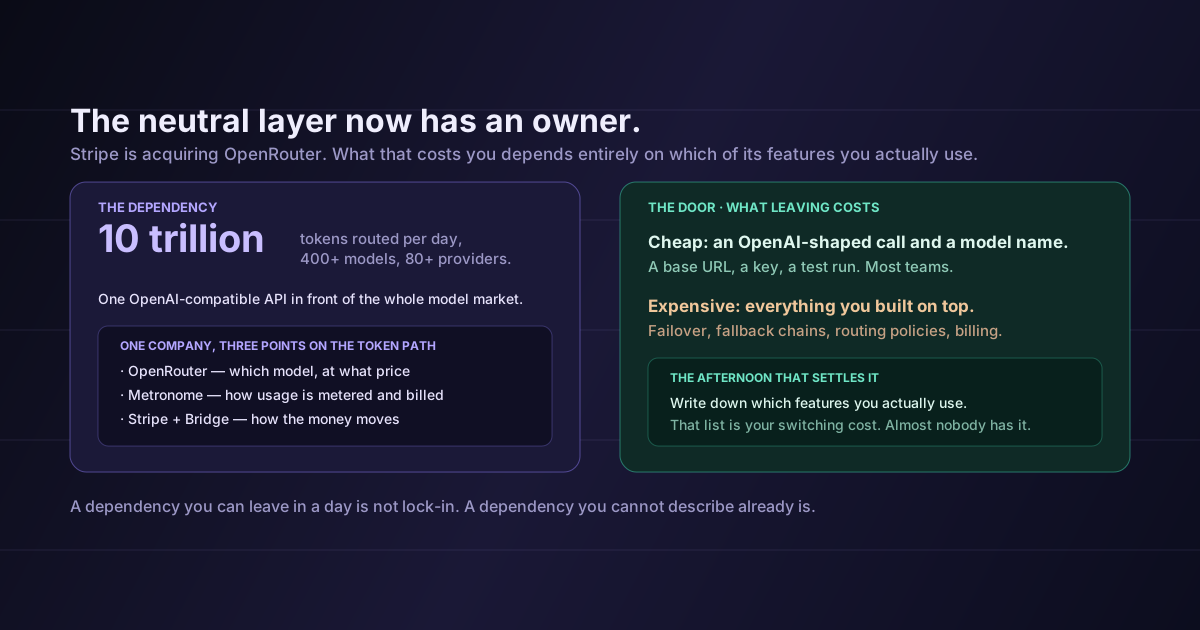
OpenRouter moves more than 10 trillion tokens a day. If you are building on AI and you are not calling model APIs directly, there is a reasonable chance some of your traffic is in that number.
The reflex reaction is lock-in panic. I think that is the wrong read, and the right question is more specific and more useful.
One OpenAI-compatible API in front of the entire model market. You write against a single interface, name a model, and OpenRouter handles the provider contract, the failover when a provider degrades, and the per-token billing across all of them. No separate agreement with OpenAI, Google, Anthropic, Meta and eighty others.
That is a genuinely useful piece of infrastructure, and its value was always partly that it had no horse in the race. It did not care which model you picked. Stripe's announcement names NVIDIA, Zoom and Lovable as users.
Worth saying plainly before the caveats, because the counterfactuals were worse.
If OpenAI had bought the layer that chooses between OpenAI and its competitors, that would be a straightforward conflict. Same for Google, same for Anthropic, same for any provider with a model to favour in the routing table. Stripe does not have a model. There is no house model for the router to quietly prefer, and no margin to protect by nudging traffic one way.
Patrick Collison's framing is that "tokens are the central currency for companies building with AI," and that Stripe is "building the economic infrastructure for AI." That is coherent. Metering, routing and payment are the same problem viewed from three angles, and Stripe has been assembling exactly that: Bridge for stablecoin payment rails, Metronome for billing and metering, now OpenRouter for routing. It is a strategy, not an impulse buy.
Neutrality by incentive versus neutrality by policy
Until this week, OpenRouter was neutral because it had no reason not to be — its entire business was being the layer that did not care. That is neutrality held in place by incentive, and it is the strongest kind, because you do not have to trust anyone for it to hold. Inside a platform, neutrality becomes a policy: something the owner chooses, states, and can revise. Stripe's incentives here still point the right way. But the mechanism holding the property changed, and that is worth noticing even when you like the owner.
Both quotes in the announcement reach for it. Collison's does not, but OpenRouter CEO Alex Atallah says Stripe "has spent over a decade building trusted, neutral infrastructure," and the release describes OpenRouter's philosophy as remaining "a neutral layer to orchestrate and manage" multi-model systems.
What the announcement does not contain is a commitment. No stated independence period, no governance arrangement, no undertaking that routing decisions stay independent of Stripe's commercial relationships, no pricing guarantee. That is entirely normal for an acquisition announcement — companies do not typically bind their own hands in a press release — and I want to be careful not to present a normal absence as evidence of intent.
But it does mean the honest status is: stated philosophy, no mechanism. If you are making a two-year architectural bet on this dependency, that is the fact to plan against, not the adjective.
Take the three acquisitions together and follow a token through them.
One company, three points on the same path
None of those is objectionable on its own, and Stripe's record on infrastructure is genuinely good. But the aggregate is that one company now sits on the selection, the measurement and the settlement of AI spend. That is a lot of the money path for a market this young, and it is the sort of position that gets scrutinised later rather than at announcement.
I am not predicting abuse. I am pointing out that "we use OpenRouter" was a commodity decision last week and is a platform decision this week, and those get reviewed differently.
Here is the part that is actually actionable, and it is better news than the framing above suggests.
OpenRouter's interface is OpenAI-compatible. That compatibility was a convenience feature; it is now your escape hatch. If your code calls a model through an OpenAI-shaped client and names a model string, you can point that client somewhere else — a provider directly, a different gateway, a self-hosted proxy — and most of your application does not notice.
Which means switching cost is not one number. It is a function of how much router-specific behaviour you adopted.
The useful exercise is not a migration. It is an afternoon spent answering: if this dependency changed its terms in six months, what would we have to write? Teams that can answer that in a sentence are fine. Teams that discover the answer is "we don't know what our fallback logic even does" have learned something worth more than the acquisition news.
A dependency you can leave in a day is not lock-in, whoever owns it. A dependency you cannot describe is lock-in already, no matter how neutral the owner is. The acquisition did not change which of those you have — it just gave you a reason to find out.
Nothing this quarter. The deal terms were not disclosed in the announcement, the transaction has to close, and nothing about your integration changes on the day. Any plan built on predicted post-acquisition behaviour is a plan built on a guess.
Something changes over 12 to 24 months, in a predictable direction. Acquired infrastructure gets integrated. Expect routing to become more tightly coupled to Stripe's billing and metering — that is the entire rationale of the purchase, stated openly. For teams already on Stripe for payments, that integration is a genuine convenience. For teams that are not, it is a reason the product roadmap may stop being aimed at them.
The thing to actually watch is pricing and terms, not favouritism. Model favouritism is the fear, and it is the least likely outcome given Stripe has no model. The realistic risk is ordinary platform economics: bundling, tier restructuring, and features that assume you are on the rest of the stack.
If you are on OpenRouter today, the single most useful thing this week is to write down which of its features you actually use — plain routing, or failover, fallback chains, provider preferences, and unified billing. That list is your switching cost, and almost nobody has it written down before they need it.
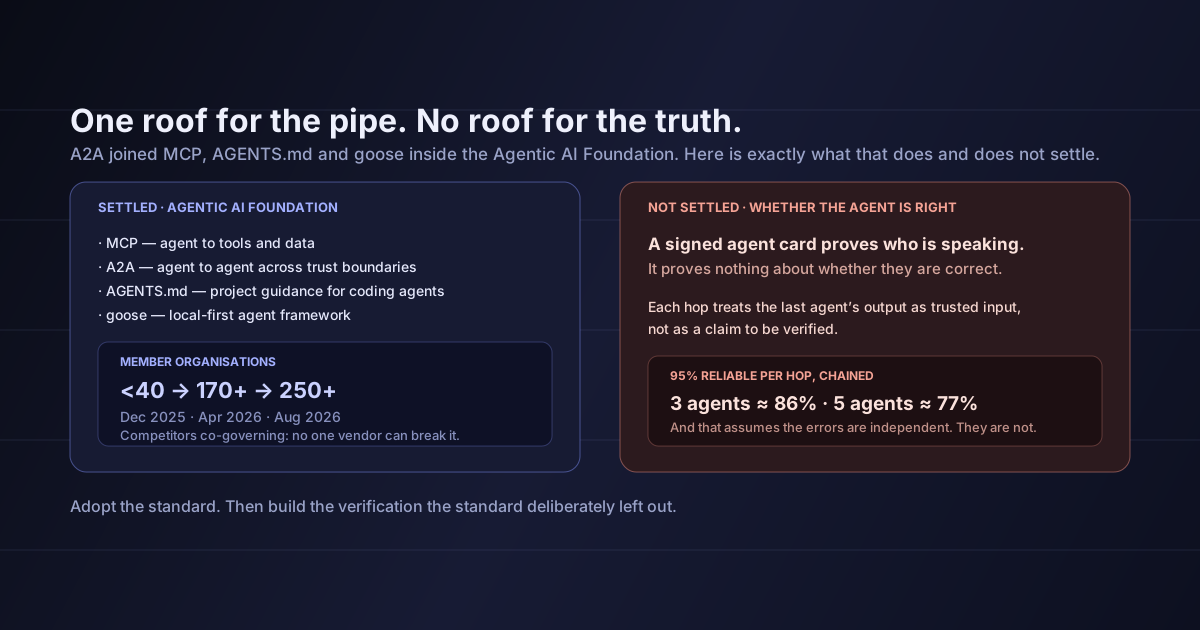
Yesterday the agent protocols moved in the opposite direction — Google handed Agent2Agent to a neutral foundation where MCP and AGENTS.md already sit, putting a shared dependency further out of any one company's hands. We wrote about that in Every Agent Protocol Now Lives Under One Roof.
This week's move goes the other way: a neutral layer moving into a company. Both are rational. Protocols benefit from neutral governance because their value is universal adoption; routing benefits from an owner because someone has to run it, negotiate the contracts and eat the failover engineering.
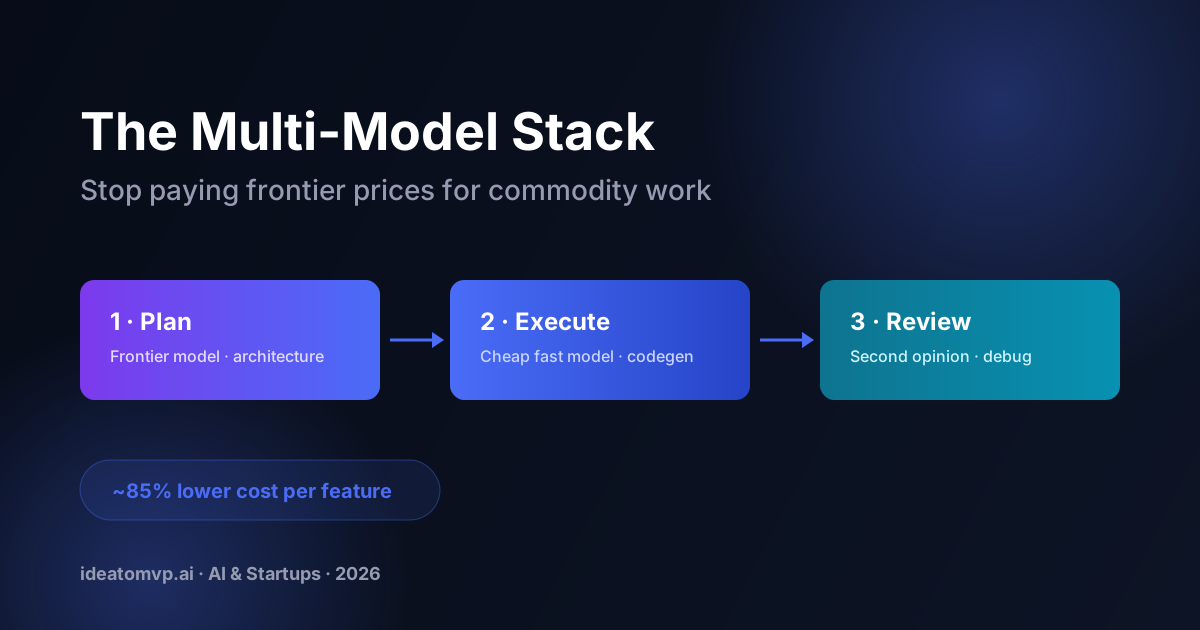
The founder lesson is not "foundations good, acquisitions bad." It is that the ownership structure of each dependency is a property worth knowing, because it tells you what kind of change to expect and how much warning you will get. We made the adjacent argument about not coupling to one provider's economics in the multi-model stack cost breakdown, and this is the same discipline applied one layer up — to the thing that chooses the provider.
Stripe bought the most-used neutral layer in the model market, and it is the best available owner for it: no model to favour, a coherent strategy, and a decade of not abusing infrastructure positions. The reflexive panic is not warranted.
What did change is the mechanism. Neutrality that was guaranteed by having no other business is now neutrality that depends on a stated philosophy with no commitment behind it, inside a company that now touches the selection, metering and settlement of AI spend.
That is a reason to know your switching cost, not a reason to switch. Spend the afternoon. Write down which features you use. Then get back to building, on a dependency you now understand instead of one you assumed.
Sources: Stripe, on agreeing to acquire OpenRouter · Forbes, on the reported deal size and OpenRouter's traffic · Bloomberg, on the deal terms · The New Stack, on OpenRouter as the "Stripe for LLMs" · TNW, on the confirmed acquisition
IdeaToMVP Academy
4-week live cohort for founders. Learn to ship AI agents, scope MVPs, and automate your business — taught by the same team that writes these guides.