How Much Does a Startup MVP Cost in 2026? A Non-Technical Founder’s Guide

By Surya Pratap
April 6, 2026
12 min read
MVP Strategy

April 6, 2026
12 min read
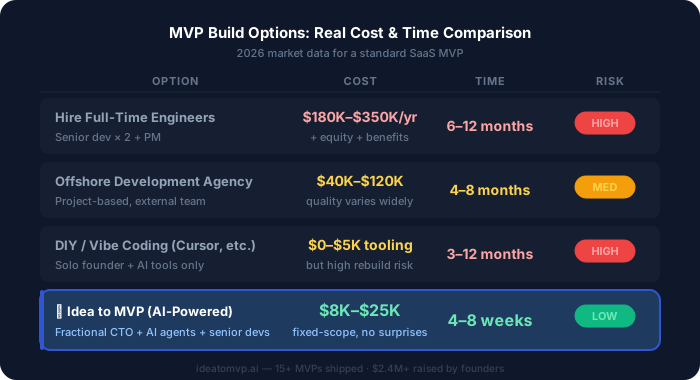
If you are a non-technical founder, the first practical question after “Is this idea viable?” is what it will cost to get a real MVP live. Not a slide deck. Not a prototype that falls over when ten people sign up. A deployable product you can charge for or put in front of design partners.
In 2026, AI-assisted development has compressed timelines — but it has not removed economics. Someone still has to own scope, security, integrations, and the fact that users do unexpected things. Below is how we think about honest cost bands at Idea to MVP, and what typically moves you from the low end of a range to the high end.
Use this as a budgeting lens before you sign anything. If a quote is far below these bands for a comparable scope, ask what is missing. If it is far above, ask what assumption is driving it — there may be a simpler MVP that proves the same point.
These are order-of-magnitude ranges for a professionally built MVP from an experienced team — not offshore body shops, not solo freelancers learning on your dime, and not enterprise vendor rates by default.
Marketing site, email capture, simple CMS or spreadsheet handoff. Fast path to test demand — not a product loop yet.
Auth, one core user journey, billing or usage metering, production deploy, basic observability. Most B2B SaaS MVPs land here.
Retrieval pipelines, evaluation, guardrails, provider failover, and cost controls. The “AI line item” is rarely the model — it is reliability and ops.
Every extra user role, integration, and “nice to have” screen multiplies review, testing, and edge cases. The cheapest MVP is one persona, one job-to-be-done, one happy path.
HIPAA, SOC 2 readiness, on-prem options, and complex permissions are not “later” problems if you promise them in v1. They change architecture on day one.
A fixed price only works when scope is frozen. If priorities shift weekly, you will pay for either change orders or velocity loss — often both.
Whether you work with Idea to MVP or anyone else, clarity beats optimism. A serious proposal should list: in-scope user stories (or equivalent), explicit out-of-scope items, infrastructure and third-party fees (who pays Stripe, OpenAI, hosting), ownership of code and accounts, warranty or fix period after launch, and how change requests work.
The goal of an MVP budget is not to spend as little as possible — it is to buy the maximum learning per dollar without paying for the same work twice. If these ranges feel high, narrow the scope. If they feel low for what you are describing, you are probably underestimating surface area.
IdeaToMVP Academy
4-week live cohort for founders. Learn to ship AI agents, scope MVPs, and automate your business — taught by the same team that writes these guides.