How to Set Up a Discovery Call: The Founder's Guide to Getting It Right (2026)

By Surya Pratap
March 26, 2026
11 min read
Startup Strategy

March 26, 2026
11 min read
Most founders waste their first $20,000 on development because they skipped one conversation. Not a pitch deck. Not a financial model. A technical discovery call.
A discovery call is a structured 30-minute conversation between you (the founder) and a technical partner — before a single line of code is written. It's where your idea gets stress-tested, scoped, and priced honestly. Done right, it saves you months of wasted time and tens of thousands of dollars.
Done wrong — or skipped entirely — it's how you end up six months in with a product nobody wants, an architecture that can't scale, and a vendor who says “that's out of scope” every time you ask for something basic.
A lot of founders expect a discovery call to feel like a sales meeting. It's the opposite. Think of it as a diagnostic session — like going to a doctor before they write a prescription. The technical partner is trying to understand the problem, not sell you a solution.
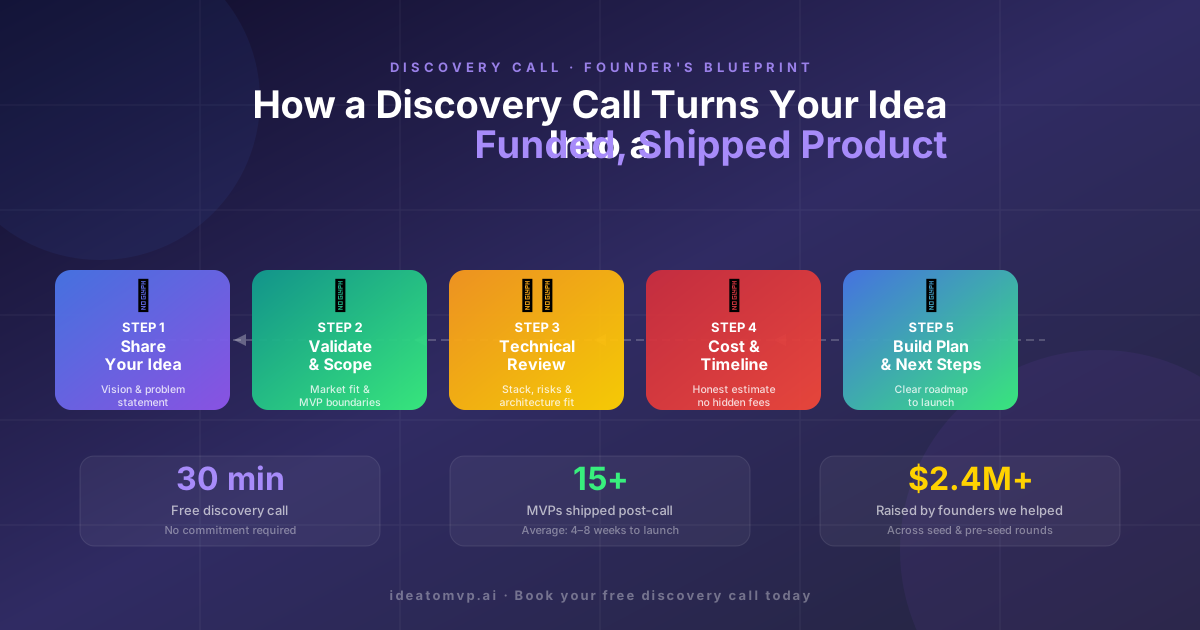
Every great discovery call moves through five stages:
💡
Step 01
You describe what you want to build, the problem it solves, and who it's for. The goal is to understand the vision, not pitch — a good technical partner asks clarifying questions, not whether it sounds cool.
🔍
Step 02
Together you pressure-test the core assumptions: Is the problem real? Who is the first target user? What is the absolute minimum the product needs to do to be useful on day one?
⚙️
Step 03
The technical partner maps out the right architecture, identifies risky integrations, and flags anything that could blow up your timeline — before you've spent a dollar.
📊
Step 04
You get a real, honest estimate: what the MVP will cost, how long it will take, and what the tradeoffs are. No vague ranges, no bait-and-switch. Numbers you can actually plan around.
🚀
Step 05
You leave with a clear action plan: what to build first, what to defer, and exactly what happens next if you decide to move forward. No cliffhangers.
You don't need a 40-slide deck. You don't need mockups. You don't need a spec document. You need clear, honest answers to five questions — and the more specific your answers, the more value you'll extract from the call.
Tip: Be specific. “People struggle to find X” is far more powerful than “I want to build a platform.”
Tip: Not your target market — your first 10 users. Name the type of person, their job, their pain.
Tip: Give a number: 50 paying users, 3 enterprise pilots, $5K MRR. Concrete goals shape better MVPs.
Tip: Mockups, landing pages, spreadsheets, customer interviews — bring everything. Context saves time.
Tip: Budget ceiling, launch date, technical must-haves. Knowing constraints upfront prevents painful surprises.
Write your answers down before the call. Even rough notes are better than trying to recall on the fly. The founders who come prepared with concrete answers leave with concrete plans. The ones who come vague leave with vague next steps.
You don't need much — but what you do bring should be substantive, not polished. Technical partners prefer raw truth over a polished presentation. Here's the short list:
Not all discovery calls are equal. The quality of the conversation tells you almost everything you need to know about whether you should work with this person or team. Here's what to watch for:
A discovery call is a two-way evaluation. You're assessing whether this technical partner is the right one. Here are the 10 questions every founder should ask before the call ends:
“What would you cut from my MVP scope to hit a 4-week timeline?”
Why this matters: Forces them to think critically about what's truly necessary vs. nice-to-have.
“What's the highest-risk part of what I'm trying to build?”
Why this matters: A good technical partner surfaces risk proactively. A bad one minimizes it to close the deal.
“Have you built something similar before? What happened?”
Why this matters: Pattern recognition beats everything. Find out what war stories they carry.
“What does your typical build process look like week-by-week?”
Why this matters: Vague answers here = vague delivery later. You want a clear phase-by-phase picture.
“Who specifically will be working on my project?”
Why this matters: Don't get bait-and-switched — the senior person on the call shouldn't disappear after signing.
“What will I own at the end — code, hosting, accounts?”
Why this matters: You should own everything. Any hesitation here is a serious warning sign.
“What's included in the price, and what costs extra?”
Why this matters: Get the scope boundary in writing. Vague scopes create expensive change orders.
“How do you handle changes in requirements mid-build?”
Why this matters: Requirements always change. A mature team has a clear process. A bad team has excuses.
“Can I speak to a founder you've worked with before?”
Why this matters: References should be offered proactively. If they aren't, ask — and evaluate the hesitation.
“What does success look like from your side?”
Why this matters: Aligns your definition of done. A partner who cares about your outcome, not just the invoice.
By the time you hang up, you should have three things:
🗺️
What the MVP includes, what it excludes, and exactly what you'll have at the end of week four or eight.
💰
Not a vague “starting from $X” — a range with the variables explained. You should be able to plan your budget.
📅
A short doc or email arriving within 24 hours that summarizes the call, proposes a path forward, and outlines what happens if you say yes.
If you leave the call more confused than when you started, or you still don't have a rough number and timeline 24 hours later — that is the answer. Move on.
There are three reasons founders skip the discovery call:
The founders who skip this call are the ones who show up six months later with a product that works perfectly — for a customer that doesn't exist at a price point that doesn't work in a market that's already been taken.
✅ You're a great fit if you…
✕ This probably isn't right if you…
IdeaToMVP Academy
4-week live cohort for founders. Learn to ship AI agents, scope MVPs, and automate your business — taught by the same team that writes these guides.