
March 21, 2026
You have a startup idea. You're not technical. You need someone who can tell you whether it's buildable, what it will cost, how long it will take, and then actually make it happen — without burning six months and $150K finding out none of those things. That's the exact gap a fractional CTO or AI technical consultant fills. In 2026, with AI dramatically accelerating development timelines, this model has become the default path for smart founders who want to get to market fast without overhiring.
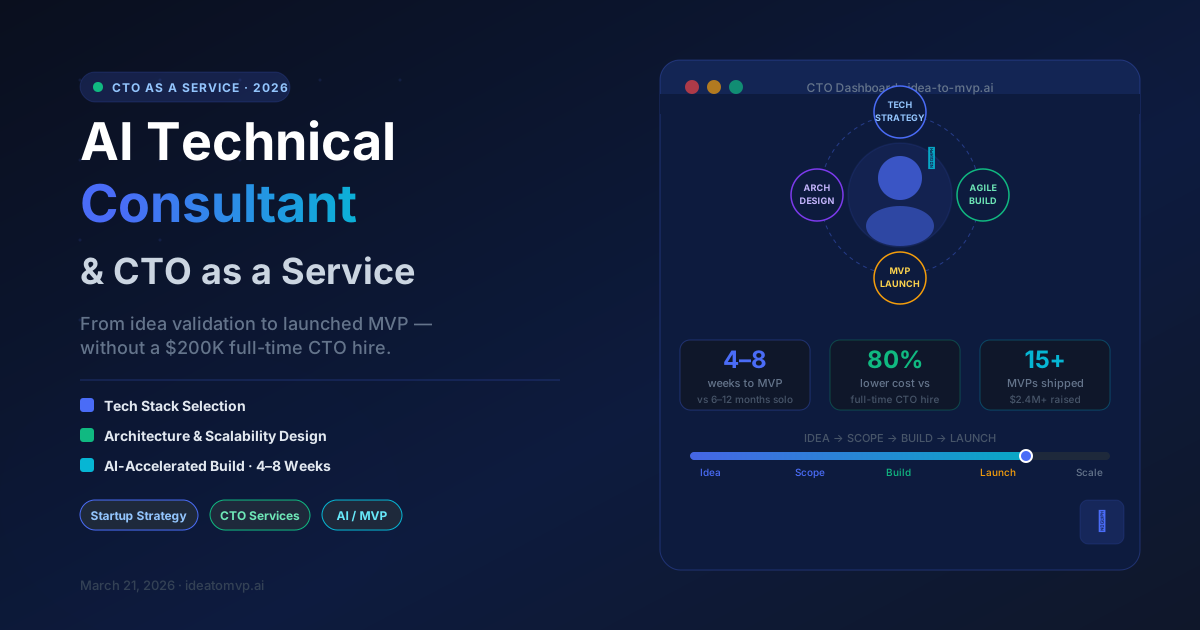
80%
lower cost vs. a full-time CTO at $180–220K/year
4–8
weeks from kick-off to launched MVP with AI-assisted build
73%
of startups that fail cite wrong tech decisions as a primary cause (CB Insights)
Free · 30 Minutes · No Pitch
Book a free discovery call. We'll scope your idea, flag technical risks, and give you an honest cost estimate — before you commit to anything.
You post in r/startups or r/entrepreneur looking for a technical co-founder. Crickets, or a dozen conversations that go nowhere. You get quotes from dev agencies — $80K to $200K for something that may or may not resemble what you envisioned. You consider hiring a full-time CTO, then realise the salary plus equity plus benefits puts you $200K+ in the hole before a single user signs up.
Meanwhile, you have an idea that might be genuinely valuable — and every month you spend searching for technical leadership is a month a competitor could be shipping. This is the founder's technical trap. And it's been the single most common reason promising startup ideas die before they're ever tested.
“The most dangerous belief a non-technical founder can hold is that they need to find a technical co-founder before they can start. You need to validate the idea first. The technical architecture should follow the market insight — not the other way around.”
A fractional CTO or AI technical consultant is not a glorified developer. The role is strategic and architectural: it's the person who sits between your business vision and the engineering execution, making sure the two are aligned at every stage. In the pre-AI era, this was expensive because it required years of accumulated technical judgement. In 2026, AI tools have compressed many of the repeatable parts of that work — making fractional arrangements dramatically more effective per dollar spent.
What you actually get:
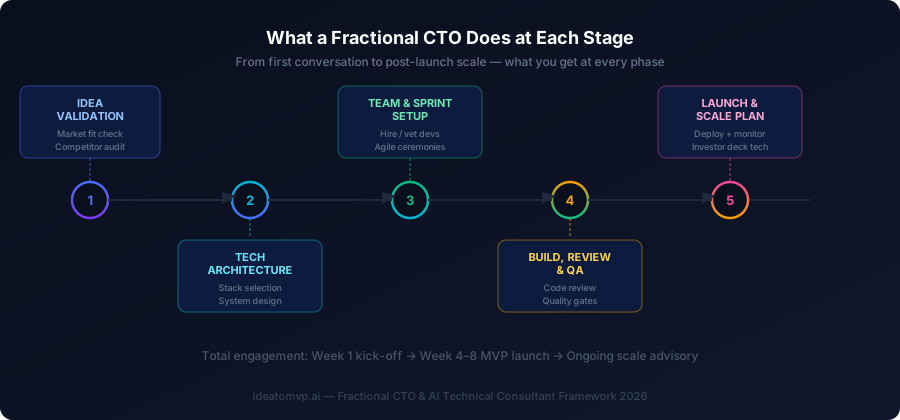
Before any technical decisions are made, the engagement starts with a structured discovery: What problem does this solve? Who has it most acutely? What do existing alternatives do wrong? What is the simplest version of this product that would be genuinely useful? A fractional CTO brings a technical lens to these questions — evaluating competitor architectures, API availability, data licensing constraints, and build-vs-buy decisions that a business-only analysis misses entirely.
This is the highest-leverage stage. The stack decision made here will live with your startup for years. A CTO evaluates the right framework (Next.js vs. Django vs. Rails), database (Postgres vs. MongoDB vs. Supabase), hosting (Vercel vs. AWS vs. Fly.io), AI layer (OpenAI API vs. Anthropic vs. local models), and data architecture based on your specific throughput, security, and cost requirements — not generic best practices. In 2026, this increasingly includes decisions about where and how to integrate AI agents and RAG pipelines into the product core.
A fractional CTO either works with your existing developers or helps you hire the right ones. They write the job specs, run technical screens, and assess code samples. Once the team is in place, they set up the development environment, CI/CD pipeline, and sprint cadence. The first sprint goal is always the same: get something working that can be put in front of a real user as fast as possible.
During the build phase, a fractional CTO reviews pull requests, enforces quality standards, unblocks architectural decisions, and manages scope creep — one of the most destructive forces in early-stage product development. With AI-assisted development tools (GitHub Copilot, Cursor, Claude), a well-structured team can now ship in 4–8 weeks what previously took 4–8 months. The CTO's job is to maintain the architectural integrity of the build while the AI tools accelerate the output.
“AI tools have changed what's possible in four weeks. But they haven't changed the need for architectural judgement. Someone still needs to make the decisions that AI can't make — about trade-offs, scalability, and what to cut.”
Post-launch, a fractional CTO's role shifts to monitoring, incident response, and planning the next phase. They set up observability (logging, error tracking, uptime alerts), review the first real-user feedback for technical signals, and prepare the technical narrative for investor conversations — including architecture diagrams, scalability roadmap, and a plain-English explanation of how the product works for due diligence.
| Fractional CTO | Full-Time CTO | Dev Agency | |
|---|---|---|---|
| Cost | $5–20K / project | $180–220K / year | $50–200K / project |
| Time to start | Days | 3–6 months | 2–4 weeks |
| Strategic ownership | High | High | Low |
| Equity required | None / minimal | 1–5% | None |
| Code quality accountability | High | High | Variable |
| Best for | Pre-seed / seed | Series A+ | Defined-scope builds |
Three years ago, a fractional CTO could realistically oversee one or two early-stage builds at a time because the cognitive and coordination overhead of managing a development team was high. In 2026, AI has changed this calculus in specific ways:
15+ MVPs Shipped · $2.4M+ Raised by Our Founders
We act as your fractional CTO from Day 1 — scoping, architecting, building, and launching your MVP in 4–8 weeks at 80% lower cost than a full-time hire.
Whether you're evaluating a fractional CTO, a technical co-founder, or an agency, these five questions will reveal the quality of their thinking within the first conversation:
Kick-off call, market and competitor research, feasibility analysis, first architecture draft, tech stack recommendation with trade-off rationale. Deliverable: a Technical Scope Document you can share with developers, investors, or advisors.
Environment setup, repository scaffolding, CI/CD pipeline, developer onboarding, first sprint planning. First working demo typically appears by end of Week 3 — something real you can show to users for feedback.
Weekly sprint reviews, pull request reviews, architectural decisions, scope management, and user feedback loops. The goal is a product that core users find genuinely useful — not a polished demo, but a working tool that solves the primary problem.
Production deployment, monitoring setup, documentation handoff, investor-ready technical narrative. Optional ongoing advisory retainer for post-launch scale questions, fundraising technical due diligence, and future sprint planning.
A fractional CTO or AI technical consultant is the right choice if:
No pitch deck required · Honest scoping · Fixed-price quotes
We work with non-technical founders as fractional CTO and AI technical consultant — from idea validation to launched MVP in 4–8 weeks.
15+
MVPs shipped
$2.4M+
raised by our founders
4–8 wks
avg. delivery
Or email directly: [email protected]