
March 20, 2026
Most SaaS companies collect feedback. Almost none systematically convert it into revenue. That gap — between listening and earning — is one of the largest untapped growth levers available to founders today. According to Forrester, 85% of companies that actively prioritize customer feedback see a measurable revenue increase — yet only 7% truly seek it out. The fastest-growing SaaS companies of the last five years (Figma, Linear, Notion, Intercom, Superhuman) didn't just happen to build great products. They built systems that turned user voices into a compounding revenue engine.

85%
of companies prioritizing feedback see revenue increase
2.5x
faster revenue growth with mature VoC programs (Forrester)
25%
reduction in churn when companies act on feedback systematically
The typical SaaS feedback workflow looks like this: a user submits a support ticket or fills in an NPS survey, a CS rep logs it somewhere, a PM skims it during quarterly planning, and 80% of it disappears forever. The problem isn't data volume — companies are drowning in feedback. The problem is the missing chain between a user's voice and a revenue-impacting decision.
Patrick Campbell — who bootstrapped ProfitWell to a $200M+ exit — studied over 3,000 SaaS companies and arrived at a single overriding insight: “Talk to your customers.” The companies that built sustainable retention and expansion revenue weren't the ones with the cleverest ad budgets — they were the ones who listened most systematically and acted most decisively on what they heard.
“Figma's magic isn't in the code — it's in how we listen. Every pixel we ship starts with a user's voice.”
— Dylan Field, Co-Founder & CEO, Figma
Not all feedback programs are equal. The following five levels describe where companies sit on the spectrum from passive data collection to predictive revenue intelligence. Each level unlocks meaningfully more revenue than the one below it.
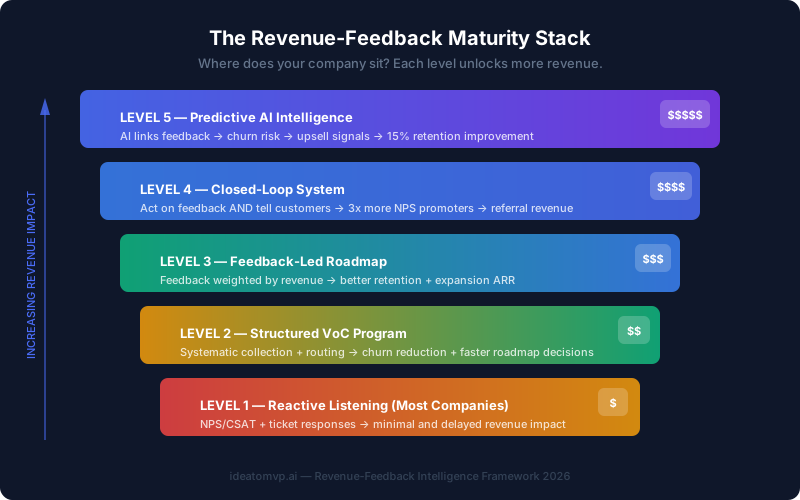
NPS surveys sent quarterly. Support tickets triaged by CS. Feature requests filed in a Notion doc. Revenue impact is minimal and delayed — because the feedback never reaches a decision-maker in time to change anything important. The signal gets lost. The customer churns. The company wonders why.
Feedback is systematically collected, categorized, and routed to product, CS, and leadership. A shared taxonomy exists. There is a tool in place — even if it's just a tagged spreadsheet. Companies at this level begin to see measurable churn reduction and faster roadmap decisions. The investment is small; the return is immediate.
Feedback directly shapes the product roadmap — but not all feedback equally. At Level 3, companies weight requests by customer segment, contract value, and churn risk. A mid-market customer with $30K ARR asking for a specific integration gets a different priority than an individual user asking for a dark mode toggle. The result: better retention, expansion revenue, and accelerated PMF.
The moment most companies break the revenue chain: they collect feedback, act on it, and never tell the customer they did. Closing the loop means completing the cycle — you collected feedback, you acted on it, and you told the customer exactly what you shipped because of them. The customer intelligence firm CustomerGauge found that companies that systematically closed their feedback loops had 3x more NPS promoters at their next survey cycle. Promoters drive referrals, reviews, and upsell conversations. That's directly measurable revenue.
The frontier in 2026. AI tools link feedback themes directly to CRM data — surfacing which feature complaints correlate with churn risk, which requests signal expansion readiness, and which sentiment patterns precede a contract cancellation. Gartner found that AI-powered feedback analysis reduces triage time by 40% and produces a 15% improvement in customer retention. For a $10M ARR company, that retention improvement alone represents $1.5M in saved revenue annually.
Rahul Vohra, co-founder of Superhuman, built perhaps the most cited feedback-to-revenue framework in SaaS history. Starting in 2017 with a PMF score of just 22%, the team ran a deceptively simple survey: “How would you feel if you could no longer use this product?” — with answer options ranging from “not disappointed” to “very disappointed.” The benchmark: if 40%+ answer “very disappointed,” you have product-market fit.
The counterintuitive insight: Vohra deliberately ignored most of the feedback — specifically from users who would never become true advocates. Instead, he built a High-Expectation Customer (HXC) persona — “Nicole,” a busy executive handling 100–200 emails/day — and allocated 50% of the roadmap to doubling what Nicole loved and 50% to removing what blocked her. Three quarters later, the PMF score had jumped from 22% to 58%. Narrowing focus on the right feedback actually accelerated growth.
“We focused only on users who would be very disappointed without the product. Ignoring most feedback was the most important product decision we made.”
— Rahul Vohra, Co-Founder & CEO, Superhuman
Figma — which reached $400M+ ARR before its Adobe acquisition attempt — built one of the most sophisticated Voice of Customer programs in SaaS. Half of Figma's company-wide objectives directly reference VoC insights as their motivation. New PM onboarding includes mandatory VoC program exposure. They partnered with Enterpret to auto-aggregate and label feedback as a single source of truth across support tickets, interviews, reviews, and community posts. The result: a three-pillar system of Alignment, Awareness, and Analysis that unlocked use cases from beta customer identification to revenue-informed pricing decisions to integration request standardization.
Des Traynor, co-founder of Intercom, conducted in-depth interviews with 40 different customers early on — not to count feature requests, but to identify Jobs-to-Be-Done: the actual outcomes customers were trying to achieve. The discovery: five distinct jobs, each representing a different market segment. Intercom transitioned from a single product with four use cases to four distinct, deeply integrated products — each priced and marketed to a separate job. This feedback-led restructuring correlated with their acceleration to $100M ARR, one of the fastest in SaaS at the time.
Co-founder Ciaran Lee described the moment that seeded the entire company: when they added a messaging feature to their error-tracking app, he noticed “there was more interest from some people in that than the actual product that we were paying to use.” That signal — a single piece of unexpected feedback — became the foundation of Intercom.
Linear spent an entire year in closed beta before launch — obsessing over speed and elegance in direct response to early user sessions. They shipped a “Customer Requests” feature and “Linear Asks” that made feedback a first-class object inside the product itself. Early users from Cohere, Runway, and Ramp organically recruited their entire companies. The company reached a $400M valuation having spent just $35,000 on marketing. The feedback loop was the growth channel.
The single biggest shift in the feedback-to-revenue space right now is AI-assisted analysis. The old constraint was bandwidth: someone had to read thousands of survey responses and interview transcripts, manually tag themes, and build a mental model of what users actually needed. This was expensive, slow, and biased toward whoever shouted loudest.
AI changes the economics of feedback entirely:
The competitive implication is stark. Companies that build AI-assisted feedback loops in 2026 will surface product insights, churn signals, and upsell opportunities months faster than competitors still using manual analysis. In a market where iteration speed is a primary moat, this becomes a structural revenue advantage — not a nice-to-have.
Across r/SaaS and r/entrepreneur — communities of 100K+ founders sharing real metrics — the consistent thread among founders who hit $10K MRR milestones is the same story told in different words: they found their first customers through direct conversations, acted on feedback within days (not quarters), and resisted scaling until users could clearly articulate why they'd be devastated to lose the product.
ChartMogul's 2025 SaaS Growth Report — widely discussed in these communities — found that only 3.3% of startups reach $1M ARR in under a year. The common thread among those that do: a tight feedback loop with early users from day one, rapid acting on signals, and resistance to premature scaling. The “build in public” movement on X (Twitter) amplifies this — founders like Arvid Kahl built FeedbackPanda to $55K MRR with zero ad spend, entirely by sharing metrics and product decisions publicly, turning their audience into an active feedback and customer acquisition channel simultaneously.
Before collecting a single piece of feedback, define who you are collecting it from. Not all users are equal. Superhuman built “Nicole.” Intercom built five JTBD personas. Your HXC is the user who would be devastated to lose your product. Their feedback is the signal. Everyone else's is noise — at least until you've satisfied the HXC.
Send the Superhuman PMF survey (“How disappointed would you be if you could no longer use this product?”) to users who have engaged with the product at least twice in the past 14 days. Track the “very disappointed” cohort over time. If it's below 40%, stop spending on acquisition and start spending on understanding why. If it's above 40%, your growth spend will compound.
When you receive feedback, ask: does this help us retain customers at risk? acquire new ones or close open deals? expand revenue per user? Or is it a nice-to-have that touches none of those? Tagging to a revenue bucket immediately transforms your feedback from a feature wishlist into a revenue roadmap.
Group your users by the job they are hiring your product to do — not by company size or industry. Feedback from the same job will cluster around the same friction points. Solving those friction points doesn't just satisfy one user — it compounds across every user with that job. This is how Intercom turned 40 interviews into a $100M ARR business architecture.
When you ship something a user asked for, tell them. A personal email. A changelog post. A tweet crediting the request. This is the highest-ROI touchpoint in your entire customer success motion — it converts a passive user into an active promoter at near-zero cost. The 3x NPS promoter effect is real. Promoters generate referrals. Referrals are your cheapest CAC.
At scale, manually reviewing feedback stops being feasible. Tools like Enterpret, Dovetail, and Sprig use AI to auto-cluster feedback, detect sentiment shifts, and crucially — link customer segments to revenue data so you know which feedback themes represent churn risk vs. expansion opportunity. In 2026, this step has moved from enterprise luxury to early-stage necessity. The companies that move first will build a structural moat in iteration speed.
“With Voice of Customer powered by AI, we're democratizing feedback and making it accessible for everyone across product, customer success, marketing, and leadership.”
— Figma VoC Team, on using Enterpret at scale
Run this audit quickly:
If you answered “no” to most of these, you are operating at Level 1 or 2 — and every month you stay there is a month you are leaving churn reduction, NPS promoters, and expansion revenue on the table. The gap between where you are and where Figma, Linear, and Superhuman operate is not primarily a budget gap. It is a systems gap. The tools exist. The frameworks exist. The only missing ingredient is the decision to build the loop.
We help founders go from idea to launched MVP in 4–8 weeks — with feedback loops and revenue systems built in from day one. 15+ MVPs shipped. $2.4M+ raised by our founders.
Book a Free Discovery Call