March 9, 2026
42% of startups fail because they build something nobody wants. Not because of bad code. Not because of funding. Because they skipped the one thing that would have told them they were wrong: building a Minimum Viable Product and putting it in front of real users.
In 2026, the barrier to building an MVP has never been lower. AI tools have compressed timelines from 6 months to 6 weeks. Costs have dropped from $100K+ to under $30K. But speed without direction is just velocity into a wall. This guide walks you through how to actually create an MVP that validates your idea — step by step, backed by data from Y Combinator, LinkedIn founders, and real-world case studies.

Photo by Unsplash
An MVP is not a half-built product. It's not a landing page. It's not a Figma prototype. An MVP is the smallest functional product that tests your riskiest assumption — the one thing that, if wrong, means your whole business doesn't work.
Y Combinator puts it simply: your MVP needs sufficient “quantum of utility” — enough value that users will tolerate its flaws because it genuinely solves their problem. A mediocre product launched today beats a perfect product launched in six months.
“Focus relentlessly on writing code and talking to users — these are the only tasks that matter for early-stage companies. Do unscalable things initially to deeply understand customer needs.”
— Y Combinator, Essential Startup Advice
68%
Of startups now use MVP methodology
60%
Lower failure rate for MVP-driven startups
30%
Faster fundraising with MVP traction
$15K-50K
Cost range for a simple MVP in 2026
2-6 Weeks
AI-assisted MVP build timeline
45%
Over budget for IT projects without MVPs
This framework is drawn from Y Combinator's methodology, the Lean Startup playbook, and our experience shipping 15+ MVPs for founders. Each step has a clear outcome that gates the next one.
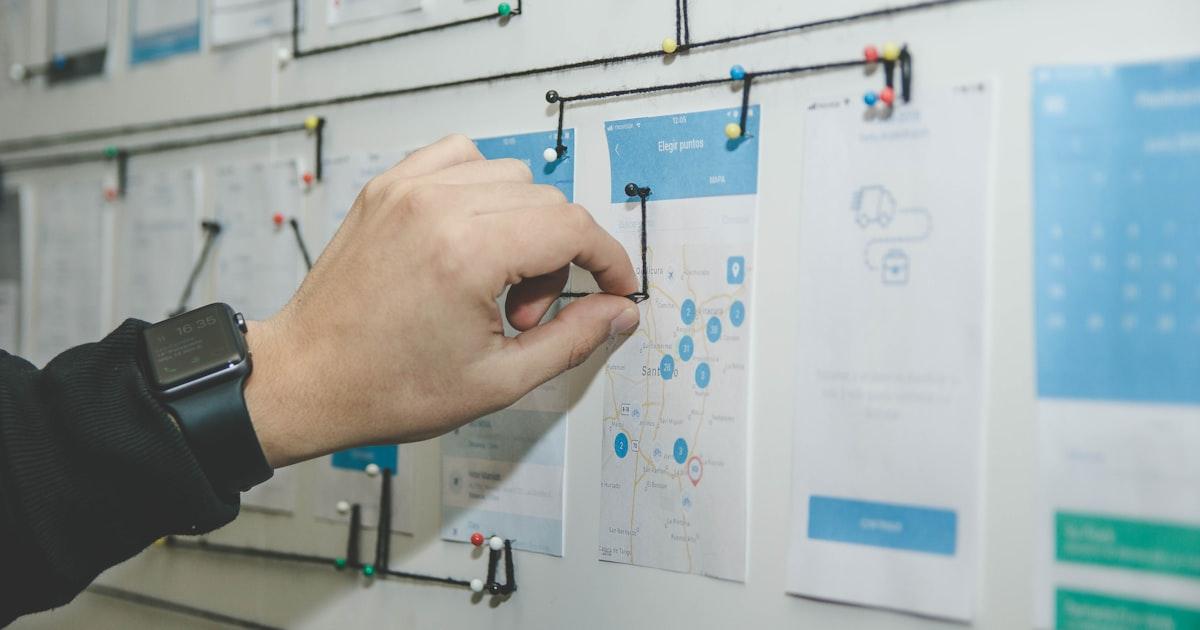
Photo by Unsplash
Paul Graham calls these “hair on fire” problems — issues so urgent that users will grab any solution, even an imperfect one. Document the specific pain point in one sentence: who has this problem, how often, and what it costs them (in time, money, or frustration).
Output: A one-sentence problem statement and a list of 10-15 people who have this problem.
Talk to those 10-15 people. Not a survey. Not a questionnaire. Real conversations. Ask about their current workflow, what they've tried, what they'd pay for a solution. Five early customers willing to pre-pay proves more than 500 survey responses. If people won't commit to value in a conversation, they won't pay for your product.
Output: Confirmation that 5+ people would pay for this solution, documented in their own words.
Your MVP solves one problem through one core workflow. Map that workflow step by step — from the moment the user arrives to the moment they get value. For Uber, this was: open app → see nearby cars → tap to request → car arrives. That's it. Every screen, button, and interaction in your MVP should serve this flow.
Output: A wireframe or flow diagram of 5-8 screens covering the core journey.
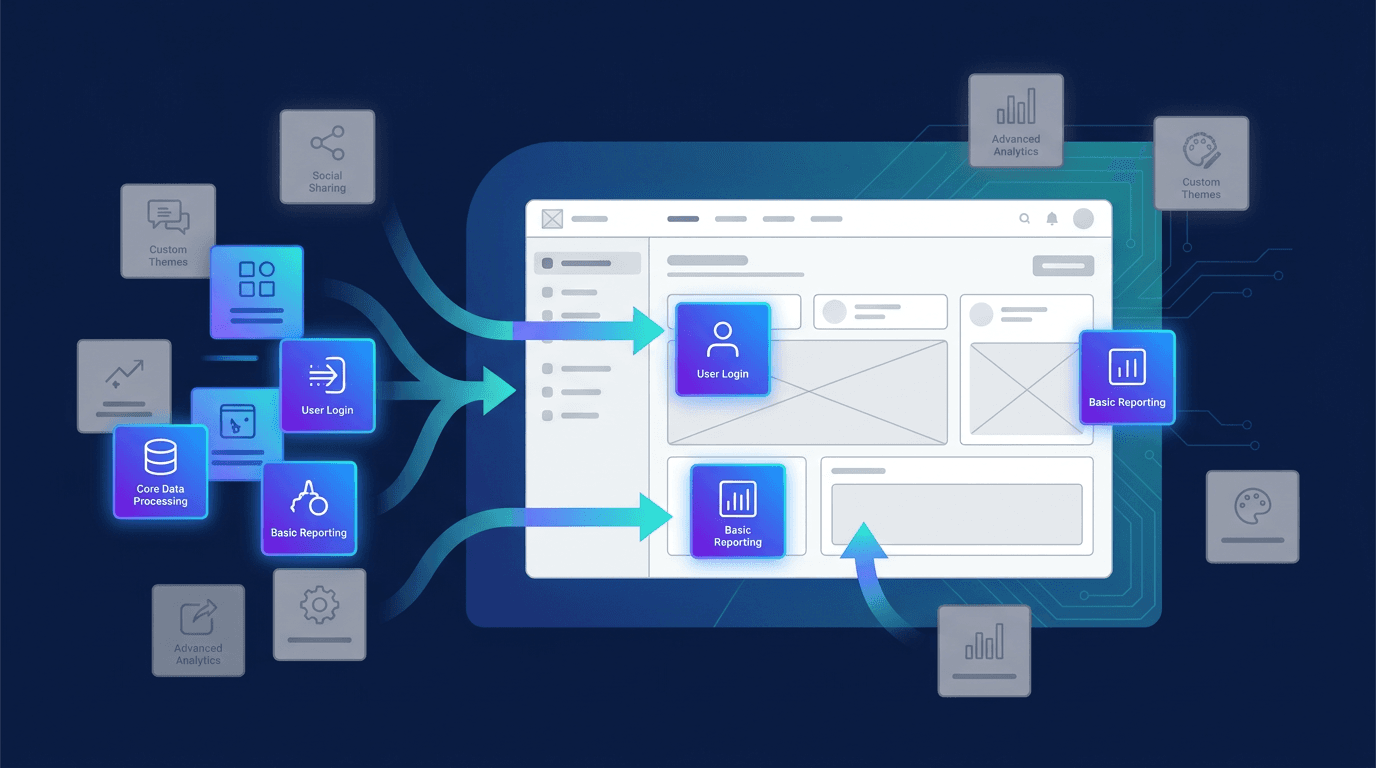
List every feature you can think of. Then categorize each one using MoSCoW: Must have, Should have, Could have, Won't have. Your MVP includes only the “Must have” features — the ones without which the core flow breaks. Everything else goes on the post-launch roadmap.
| Category | What It Means | Example |
|---|---|---|
| Must | Core flow breaks without it | User auth, core feature, payment |
| Should | Important, but workarounds exist | Email notifications, search |
| Could | Nice to have | Dark mode, advanced filters |
| Won't | Not for this version | Mobile app, integrations, i18n |
Your tech stack should optimize for speed of development and ease of iteration — not scalability to a million users. Choose proven, well-documented frameworks: Next.js or Rails for the app, PostgreSQL or Supabase for the database, Stripe for payments, Vercel or Railway for deployment. Save Kubernetes for when you actually need it.
Ship working features every 1-2 weeks. Each sprint should produce something a real user can interact with. Week 1-2: auth + core feature skeleton. Week 3-4: core flow complete. Week 5-6: polish, payments, analytics, launch. AI coding tools (Cursor, Copilot) can accelerate each sprint significantly — teams report shipping 2.1x more features per sprint with AI assistance.
Release to a small group of early users. Measure the metrics that matter: activation rate (do users complete onboarding?), retention (do they come back?), and the 40% test (would 40% be “very disappointed” without your product?). Use these signals — not opinions — to decide what to build next.

Photo by Unsplash
Every billion-dollar company started with something embarrassingly simple. These stories prove that the right MVP isn't about features — it's about testing the right assumption.
Drew Houston didn't build file-syncing infrastructure first. He recorded a 3-minute screencast showing files being dragged into a folder on one computer and appearing on another. That video generated 70,000 email signups overnight — validating massive demand before writing a single line of the actual sync engine.
Riskiest assumption tested: “People want seamless file sync across devices.”
The original “Airbed & Breakfast” was three air mattresses on the founders' living room floor, a basic website with photos, and email-based communication. No booking engine. No payment processing. No reviews. They solved trust by being the first hosts themselves.
Riskiest assumption tested: “Strangers will pay to stay in someone's home.”
Uber's 2010 beta was iPhone-only, San Francisco only, with one function: tap a button, get a black car, pay with credit card. No fare estimates, no driver ratings, no ride sharing, no multiple car types. Just the core transaction.
Riskiest assumption tested: “People will summon and pay for a car through their phone.”
“Usefulness trumps novelty. Solve boring problems that actually exist rather than chasing originality. Most successful startups end up doing something different than originally planned, so flexibility matters more than rigid adherence to initial ideas.”
— Paul Graham, Y Combinator Co-founder
Costs vary wildly depending on complexity, industry, and who builds it. Here's the real breakdown based on 2026 market data:
| MVP Type | Cost Range | Timeline |
|---|---|---|
| Simple (SaaS, tool) | $15K – $50K | 2 – 3 months |
| Medium (marketplace, AI) | $50K – $150K | 3 – 6 months |
| Complex (FinTech, HealthTech) | $150K – $300K | 6 – 9 months |
| AI-Supervised Build | $9K – $50K | 2 – 4 weeks |
The key insight: 72% of successful startups budget between $40K-$100K for their MVP. AI-supervised builds (where experienced engineers use AI tools to accelerate development) offer the best value — delivering traditional agency quality at a fraction of the cost and timeline.

Photo by Unsplash
LinkedIn has become the primary platform where founders share hard-won MVP lessons. With 930+ million users and growing organic reach for thought leadership content, it's where the real conversations about building startups happen in 2026. The recurring themes are clear:
“AI can build your MVP faster. But it can't build your business. Speed alone no longer differentiates — investors now expect fast-built MVPs as baseline and focus instead on durability, defensibility, and real user validation.”
— Amit Patriwala, via LinkedIn/Medium (2026)
Creating an MVP in 2026 has never been faster or cheaper. But the fundamentals haven't changed: define a real problem, validate it with real people, build the minimum needed to test your riskiest assumption, and let user feedback guide everything after that.
The tools are better. The advice is clearer. The cost is lower. The only thing that can stop you is building the wrong thing — and that's exactly what an MVP is designed to prevent.
As Reid Hoffman said: “If you're not embarrassed by the first version of your product, you've launched too late.”
We've helped 15+ founders go from idea to launched MVP in 4-8 weeks. AI-powered speed meets engineering rigor. $2.4M+ raised by our founders.
Book a Free Discovery Call